
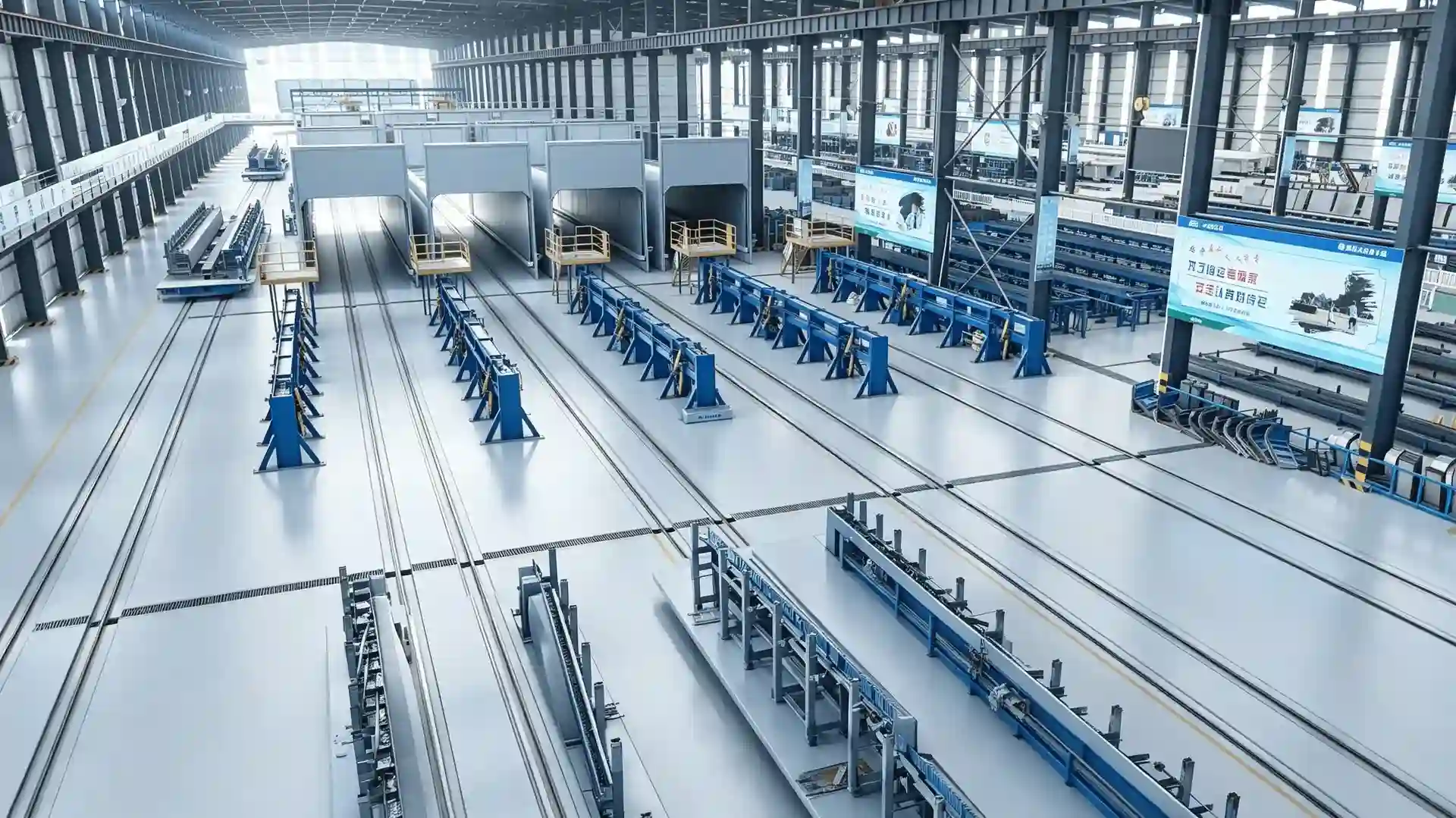
Why one price request produces very different quotations
Buyers often begin with a reasonable question: how much does a precast beam production line cost? The problem is that “one production line” can describe anything from a focused set of moulds and material-handling equipment to a highly integrated factory with automated transfer, curing, prestressing, production software and site services.
Two suppliers can therefore quote different totals without quoting the same solution. One may include moulds, cranes, utilities, installation and operator training. Another may show only the core equipment price. A lower number is not necessarily a lower project cost; it may simply have a narrower boundary.
The fastest way to obtain a useful budget is to define seven cost drivers before requesting a quotation. This gives suppliers a common basis and helps the buyer separate essential capacity from options that can be phased later.
Cost driver 1: beam type and mould strategy
The product is the starting point. A line for T-beams, I-girders, U-beams, small box girders or full-span box girders does not have the same moulds, handling loads, prestressing arrangement or factory footprint. Even within one beam family, length range, cross-section, weight, embedded items and surface requirements can change the equipment concept.
Send suppliers a product schedule rather than one representative drawing. At minimum, list:
- beam types and drawing references;
- minimum and maximum length, width, height and finished weight;
- expected quantity of each type;
- whether dimensions will remain stable or vary by project;
- prestressing method and design responsibility; and
- which mould surfaces, inserts or accessories change between products.
Then decide the mould strategy. Dedicated moulds usually simplify changeover but require more capital and space. Adjustable or reconfigurable moulds may cover more variants, but buyers should ask how long a change takes, which parts must be replaced and how many operators are needed. A quotation cannot be compared until every supplier states the number of mould sets, their usable length and the product range each set covers.
Cost driver 2: required output and working calendar
Annual demand alone is not enough to size a line. Suppliers need the peak production requirement, working days per year, shifts per day, hours per shift, planned utilisation and product mix. The same annual volume can be produced with more parallel stations and fewer shifts, or with less equipment and a longer working calendar.
Ask each bidder to provide the production model behind the price. It should show the assumed cycle for mould preparation, reinforcement, concrete placing, curing, demoulding and transfer. It should also identify the bottleneck and the number of mould positions, curing positions and transfer resources used in the calculation.
Avoid asking for the highest theoretical output. A better purchasing question is: what equipment configuration meets the required output under the buyer's stated calendar and product mix, with an agreed allowance for changeovers and normal interruptions? This makes the priced capacity visible instead of hiding it inside a headline number.
Cost driver 3: material flow and handling boundary
The price changes materially depending on where the supplier's responsibility begins and ends. A line may need to receive reinforcement cages, fresh concrete, embedded items and consumables; move moulds or beams between stations; and deliver finished components to a storage or dispatch area.
Define which movements are included in the line and which will use buyer-provided cranes, forklifts, transporters or batching equipment. Provide maximum loads, travel distances, building clearances and proposed storage locations. If a new factory is planned, include the preliminary building grid and site constraints. If the line will enter an existing workshop, provide an accurate survey rather than an old general-arrangement drawing.
Handling choices also affect labour and throughput. A low equipment price that relies on frequent crane lifts may require more crane availability and coordination. A higher level of mechanised transfer may reduce those dependencies but add rails, controls, foundations and safety interfaces. Ask bidders to mark every transfer step on a layout and identify the supplied equipment for it.
Cost driver 4: curing and prestressing scope
Curing and prestressing are often large scope differences hidden behind similar line descriptions. For curing, state the required process, available energy source, environmental conditions and whether the quotation should include chambers, covers, pipework, controls, sensors or only interfaces to a buyer-provided system.
For prestressed products, provide the engineering basis and clarify whether the requirement uses pre-tensioning, post-tensioning or another approved method. The quotation should identify which jacks, pumps, anchor interfaces, measuring devices, protection systems and controls are included. Do not assume that “prestressing equipment” has the same boundary in every proposal.
These choices should be resolved while buying, not after supplier selection. The related curing-system buying questions and prestressing equipment buying questions can be issued as technical attachments to the main enquiry.
Cost driver 5: automation level and data requirements
Automation is not one feature that can be priced as a percentage. It may cover recipe selection, mould movement, concrete distribution, vibration, curing control, identification, production scheduling, status displays, alarms and record export. Each function has different hardware, software and integration requirements.
Divide automation into three groups:
- functions required for safe and repeatable operation from day one;
- functions that reduce labour or improve consistency at the target output; and
- functions that may be added after volume, staffing and product stability are proven.
For every software or data item, state the required users, languages, reports, connections and ownership of interfaces. If the line must exchange data with batching, laboratory, ERP or project systems, identify the existing platforms and responsible parties. An undefined “smart factory” requirement encourages suppliers to price different interpretations.
A phased automation plan works only if the initial equipment supports the agreed expansion. Ask which provisions must be purchased now to avoid replacing core equipment later.
Cost driver 6: site, building and utility conditions
Equipment price is only one part of the installed budget. Factory dimensions, floor capacity, foundations, drainage, ventilation, ambient temperature, electrical supply, compressed air, water, steam or other curing energy can change both the line design and the work retained by the buyer.
Include a site data sheet with the enquiry. It should cover country and location, indoor or outdoor installation, available building dimensions, crane capacity, utility voltage and frequency, environmental range, access restrictions and the expected installation window. State whether civil works, utility distribution and permits are excluded, supplied by the buyer or requested as separately priced items.
Currency, freight destination, taxes, duties, insurance, local transport and lifting also need a common basis. Ask every bidder to use the same delivery term and to identify items that ship separately or require special transport. A machine price at the supplier's factory gate cannot be compared directly with a delivered and installed package.
Cost driver 7: delivery scope and project support
The final driver is the commercial boundary around the equipment. Engineering studies, detailed layout, manufacturing, packing, freight, site supervision, installation labour, training, trial materials, spare parts and warranty support may be included, optional or excluded.
Create a responsibility matrix and ask suppliers to complete it. For each activity, show who provides people, tools, lifting equipment, consumables, travel, accommodation and local coordination. Also request a schedule with payment milestones tied to defined deliverables. This reveals cash-flow and resource differences that the headline price does not show.
The precast concrete production line should be priced against an agreed project boundary. Realjet confirms engineering, equipment, software, installation and service responsibilities in the specific proposal and contract; buyers should not assume that every possible service is automatically included.
Compare the total budget, not only the equipment subtotal
The European Commission's guidance on life-cycle costing distinguishes purchase price from associated delivery and installation costs, operating inputs, spares, maintenance and end-of-life costs. The guidance is written for public procurement, but the comparison principle is useful for any industrial-equipment buyer: define the calculation method and request the same data from each bidder.
Use a four-part comparison sheet:
| Cost group | Include in comparison | Ask the supplier to state | Buyer input needed |
|---|---|---|---|
| Core production package | Moulds, process equipment, handling and controls | Quantity, model, function and exclusions | Product schedule and target output |
| Delivered project cost | Packing, freight, insurance, duties basis and local delivery | Delivery term, destination and validity | Site location and import assumptions |
| Installation and start-up | Civil interfaces, utilities, installation, supervision and training | Included days, staffing and buyer obligations | Building, utilities and local resources |
| Ownership cost | Energy demand, staffing basis, wear parts, routine spares and service | Assumptions, recommended stock and service boundary | Operating calendar and local cost rates |
Do not force every uncertain future cost into one unsupported total. Record the assumptions, use the same analysis period and separate supplier data from buyer estimates. The purpose is to expose differences, not create false precision.
Issue a quotation template that makes offers comparable
A useful enquiry asks for a base configuration and clearly priced options. Require bidders to return the same schedule:
- product and capacity assumptions;
- process description and layout;
- equipment list with quantities;
- mould scope and product coverage;
- automation and software functions;
- utility consumption or connection requirements;
- supplied, optional, buyer-supplied and excluded items;
- delivery term, schedule and payment milestones;
- installation, training, spare-parts and support scope; and
- price validity, currency and stated commercial assumptions.
Ask for option prices that connect to a decision: an extra mould set, an additional curing position, a transfer upgrade, a second-shift spare-parts package or a later automation stage. Avoid a list of technology options without their effect on capacity, staffing, floor area or project risk.
Shortlist suppliers using the same buying case
Before comparing totals, confirm that every proposal answers the same buying case. Clarify quotations that omit the production model, leave major transfers unassigned or use a different product mix.
Then evaluate three questions:
- Fit: Does the configuration produce the defined beam range at the required output and site conditions?
- Boundary: Are all equipment, services, utilities and buyer responsibilities visible?
- Value: Which configuration gives the best balance of initial budget, operating requirements, expansion path and commercial risk?
The lowest comparable price can only be identified after technical and commercial alignment. Until then, the lowest number is simply the smallest stated scope.
Prepare the information needed for a budget proposal
To request a project-specific budget, send the beam drawings and quantity schedule, target production calendar, site and building data, proposed process, desired automation level, utility conditions, delivery destination and responsibility expectations. Mark information that is preliminary so suppliers can state allowances and exclusions rather than treating assumptions as confirmed facts.
Realjet develops project-specific production-line proposals based on the product, capacity, site and delivery boundary. Share those inputs through the precast beam factory production-line page to receive a configuration and price basis that can be evaluated against your purchasing case.