
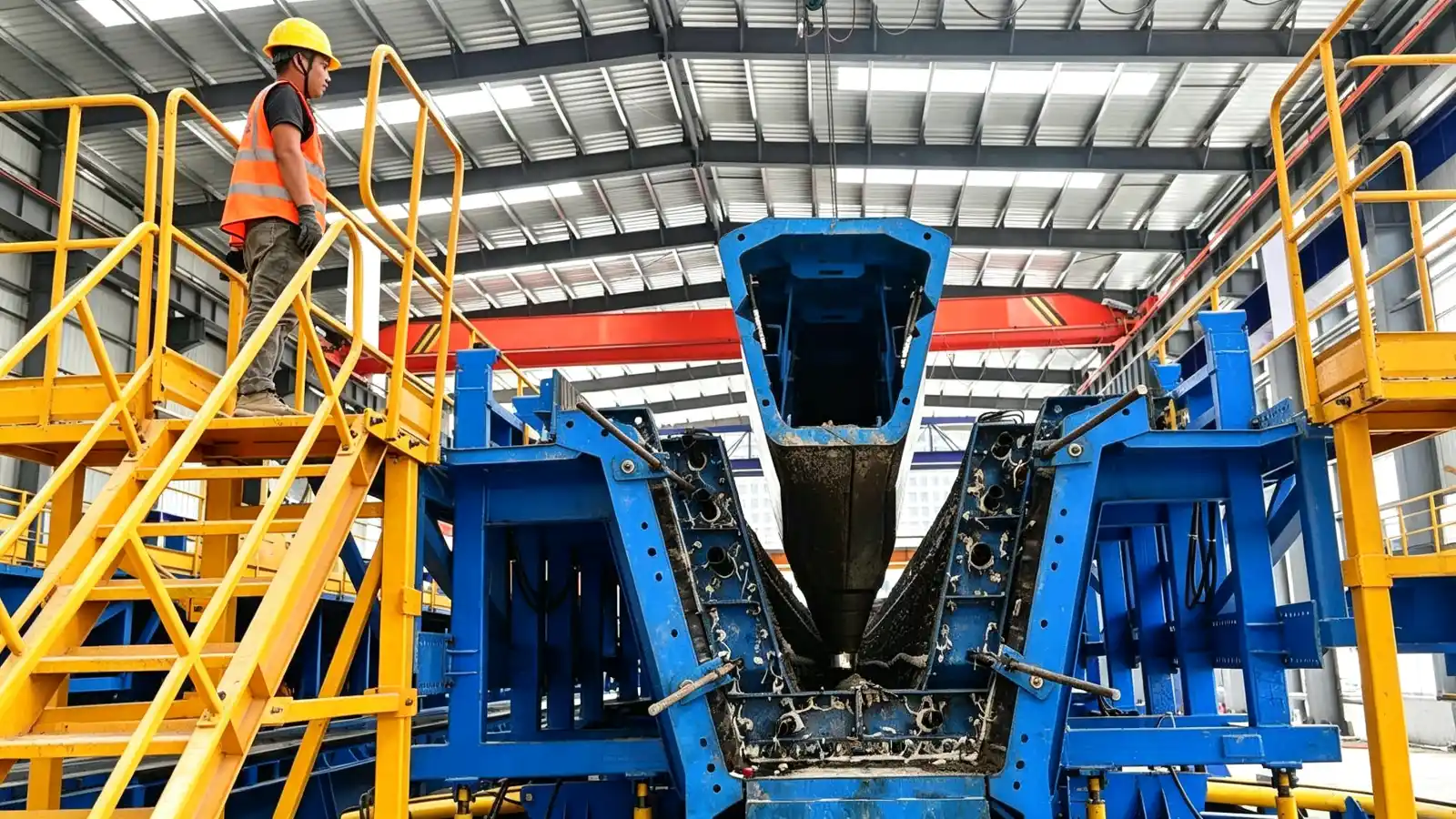
Why the internal form matters
A box girder has a hollow cross section, so the mould needs an internal form, often called the core or inner mould, that shapes the cavity and then has to come out. How that internal form is withdrawn sets part of the production cycle and the labour needed to run the mould. A design that withdraws cleanly keeps the box free of damage and lets the next cast start sooner.
The internal form is only one part of the mould. The outer side forms, the soffit and the end bulkheads define the outside; the internal form defines the inside. When you review a box girder mould, the withdrawal method deserves the same attention as the outer geometry, because it drives daily handling.
Hydraulic versus mechanical withdrawal
Internal forms are withdrawn by hydraulic or mechanical means. A hydraulic internal form uses jacks and a control system to fold or retract the panels and pull the core clear of the concrete. The advantage is that the movement is controlled and often needs fewer people inside the restricted space. A mechanical form relies on screw jacks, turnbuckles or travelling frames to collapse and extract the core.
Neither is universally better. Hydraulic withdrawal suits high-output lines where cycle time and repeatability matter. Mechanical withdrawal can be simpler to maintain and cheaper to buy, which suits lower volumes or sites where the crew is already trained on manual systems. The right choice follows the daily output and the crew, not a general preference. The decision also touches the yard's power and service layout: a hydraulic core needs a pump and hoses per station, while a mechanical core needs less auxiliary equipment but more hands during collapse and extraction.
Integral, segmented and extraction direction
The internal form can be a single integral unit or a segmented set of panels. An integral core is withdrawn as one piece along the girder axis, which is fast but needs clear space at the casting end to receive it. A segmented core collapses panel by panel and can suit tighter yards. The extraction direction, usually along the beam length, must clear the ends and any fixed equipment, so it depends on the yard layout as much as on the mould itself.
Box girder cross sections vary by project: single cell or multiple cells, with or without cantilevers. The internal form has to match the exact cavity, and that geometry is set by the bridge design, not by the mould supplier. Suppliers engineer the core to the approved section, so the drawing comes first.
Buyer inputs for the internal form
When you request a box girder mould, specify the points that shape the internal form:
- The approved box cross section, including cell count and any haunches.
- Span and the number of identical girders, to set reuse and wear.
- Required demoulding envelope and the space at each end of the bed.
- Whether the line is hydraulic or mechanical overall, for consistency of operation.
- Surface finish on the inner faces and any recesses for vents or bearings.
- Prestressing duct or anchorage recesses that the core must clear.
These inputs let the supplier propose an internal form that fits both the girder and the yard. Vague geometry leads to a core that needs rework or a yard layout that cannot extract it.
Wear and handling also belong in the brief. A core that is extracted hundreds of times per year needs robust guiding and a withdrawal path that does not depend on manual shimming. State the expected number of casts per mould and whether the core will be moved between beds, because that affects both the structure and the handling gear. The transport envelope of the collapsed core, including its length when folded, should clear the aisle and any overhead equipment.
Responsibility boundaries
Keep the roles clear. The bridge designer or the client provides the girder section, the tolerances and the performance intent. The mould supplier designs and builds the steel system, including the internal form and its withdrawal, to that geometry. Realjet supplies precast concrete moulds, including the box girder family; the engineering of the demoulding method is part of that supply.
Finishing details such as the exact surface class or secondary fittings are confirmed against the project drawings. The buyer should not assume a standard core fits a non-standard section. The approved section drawing is the contract base, and the internal form is built around it. For background on producer quality controls, PCI's plant certification program describes the audit framework many precast plants follow, which is separate from the mould supply but relevant when you later choose who runs the line.
Where to look next
Start from the precast concrete moulds overview to see the full range. The bridge and transportation moulds category groups the related bridge mould families, which helps compare a box girder with adjacent beam and girder types. For the product itself, the Box Girder Moulds page carries the cross section, the operation notes and the enquiry route. Bring the section drawing and the yard layout to that conversation so the internal form proposal matches both the girder and the site.