
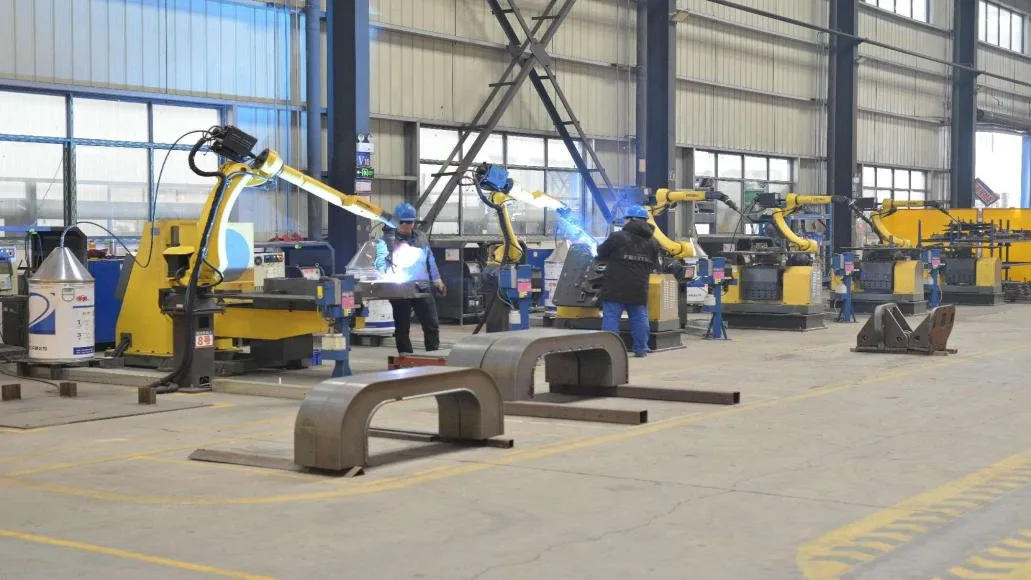
A machinery frame is drawn, welded and delivered, and somewhere in the paperwork is a line that says which execution class the fabrication is built to. That line decides how many welds are tested, what acceptance level they are judged against and how much material traceability the shop has to keep. When the line is missing, the shop falls back on a default and the buyer inherits whatever that default happens to be.
For a welded steel frame bought from a contract manufacturer, execution class is one of the few specification decisions that changes cost before any steel is cut. It is worth half an hour of the buyer's time.
What the class changes on the shop floor
EN 1090-2 sets four execution classes, EXC1 to EXC4, and each one carries a package of requirements that move together: welding procedure qualification, welder and operator qualification, the extent of non-destructive testing, the acceptance level for weld imperfections, dimensional tolerances, and the depth of documentation. Choosing a class is choosing a level of proof rather than a single test.
The published guidance from the British Constructional Steelwork Association describes the practical effect: a fabricator whose factory production control system is certified for EXC2 may only supply EXC1 and EXC2 work. The class is written on the certificate rather than negotiated per order.
Two of the differences matter most to a machinery buyer.
| Requirement | EXC2 | EXC3 |
|---|---|---|
| Routine supplementary NDT on transverse butt welds | 10 percent | 20 percent |
| Routine supplementary NDT on butt welds in T joints | 5 percent | 10 percent |
| Weld acceptance to ISO 5817 | level C | level B |
| Welding procedure qualification | prequalified procedures are often accepted for S235 to S355 | qualified procedures to ISO 15614-1 |
| Welding coordination to ISO 14731 | required | required, at a higher knowledge level |
Those percentages come from Table 24 of EN 1090-2, reproduced in a Swedish Institute of Steel Construction presentation on weld inspection. Every weld is visually inspected at 100 percent; the table governs the additional testing. A frame with 40 metres of transverse butt weld moves from 4 metres of routine testing to 8 metres, and the acceptance level tightens at the same time, so the same weld that passed at EXC2 may need repair at EXC3.
The designer picks the class, the shop executes it
Execution class is a design output. EN 1090-2 Annex B derives it from three inputs: the consequence class of the structure (CC1 to CC3), the service category (SC1 for quasi-static actions, SC2 where fatigue or significant seismic action applies), and the production category (PC1 or PC2). The BCSA guidance and the Ancon summary of the Annex B matrix both reproduce it, and both make the same point about defaults: where the specification says nothing, EXC2 is the class everyone assumes.
That default is reasonable for a building frame. It is a weak assumption for a machine support, because the two inputs a machinery buyer can actually influence, service category and production category, are frequently the ones that push a frame out of EXC2.
Why a welded machinery frame is usually PC2
Production category is about fabrication risk, not about how important the part is. PC1 covers non-welded components and welded components made from steel grades below S355. PC2 covers welded components from S355 and above, together with site-welded components, hot formed parts and parts that receive heat treatment during manufacture.
S355 is the default structural grade for welded machine frames and base frames, so most welded frames sit in PC2 without anyone deciding it. That single fact already puts a CC2 structure at EXC2 minimum, and removes the option of arguing the frame down to EXC1.
If a frame is genuinely built from S275, saying so on the drawing is worth more than it looks. It is one of the few levers that changes the production category.
Where machinery differs from buildings
The service category is where machinery separates from building work. SC1 covers structures designed for quasi-static actions. SC2 covers structures designed for fatigue actions to EN 1993-1-9, structures in regions of medium or high seismicity, and structures subject to vibration from wind, crowd or rotating machinery. Crane classification is explicit: EN 1991-3 and EN 13001-1 define crane classes S0 to S9, and classes S1 and above fall in SC2.
A frame carrying a vibrating screen, a crusher, a hydraulic power unit on resilient mounts, or a crane runway is not a quasi-static structure. Neither is a frame that supports a drive whose torque reversals reach the welded detail. Once SC2 applies, the matrix moves a CC2 frame with PC2 fabrication to EXC3.
The buyer does not have to perform this analysis. The buyer does have to make sure somebody did, and that the answer reached the enquiry. A one-line note in the RFQ asking which execution class applies, and on what basis, closes the gap.
Consequence class is the third input and the one a machinery buyer controls least. A frame inside a plant usually sits at CC2: failure stops production and may injure someone, but it does not threaten a grandstand. On its own that is not an argument for EXC3. Combined with SC2 and PC2, which is exactly the combination a vibrating machine creates, it is.
What EXC3 adds in the workshop
The visible change is testing volume. The invisible change is preparation. A shop working at EXC3 needs welding procedures qualified by test to ISO 15614-1 rather than procedures taken from the prequalified range, welders qualified for the process, position and material group they actually use, a welding coordinator at the knowledge level the class demands, and records that survive an audit. The procedure side of that work is set out in welding procedure and NDT for fabricated frames.
Acceptance moves from ISO 5817 level C to level B. ISO 5817 defines the quality levels for imperfections in fusion welded joints, and the step from C to B tightens limits on undercut, excess weld metal, misalignment and porosity. A shop that has been producing acceptable EXC2 work for years will still find welds that need attention when the same work is judged at level B, particularly at the toes of fillet welds and at restart points.
None of this is exotic. It is the difference between a fabrication inspected by eye and one inspected by eye plus a defined sample of volumetric or surface testing.
The certificate names a class
Buyers often check the welding system and stop there. Under EN 1090-1, a fabricator placing structural steel components on the European market works under factory production control assessed by a notified body, and the certificate states the execution class covered. A certificate for EXC2 does not authorise EXC3 supply.
A welding quality system is not the same document. Realjet works to ISO 3834-2 for welding quality management, the comprehensive level of the series, and holds EN 15085-2 CL1 for railway work. ISO 3834-2 describes how the welding activity is controlled; it does not by itself establish which execution class an EN 1090-1 certificate covers. Where a project needs CE marking, ask for the factory production control certificate and read the class printed on it, then confirm it covers the steel grades and thicknesses in the frame.
The same logic applies outside Europe. A project that specifies EN 1090-2 as the fabrication standard, common on exported plant and on equipment built for European owners, brings the class requirement with it even when CE marking itself is not being claimed.
Where the money goes
Buyers often assume EXC3 means a more expensive frame. It usually means a more expensive inspection and preparation package on the same frame. The steel, the cutting and the welding hours barely move; the additions are procedure qualification, welder qualification records, the NDT sample, the welding coordinator's time and the documentation set.
That has a practical consequence for enquiry timing. Procedure qualification and welder records are not things a shop can produce in a week for a new material group or a new joint detail. If the class is settled after the order, either the schedule moves or the class quietly drops. Both outcomes are worse than deciding early.
There is also a middle route that buyers underuse. Adding specific requirements to an EXC2 specification, such as full volumetric testing on nominated butt welds or level B acceptance on fatigue-critical details, is often cheaper than moving the whole frame to EXC3 and gives the same assurance where the load path actually needs it.
What to put in the enquiry
| Item | What to state |
|---|---|
| Execution class and basis | The class, and whether it comes from Annex B or from the project specification |
| Steel grades | Nominal grade and quality for each member, since grade drives the production category |
| Service category | Whether fatigue loading applies, and the source (crane class, machine excitation, design report) |
| Weld acceptance level | The ISO 5817 level per joint group, not one level for the whole frame |
| NDT scope | Percentage and method by weld type, plus any nominated joints tested at 100 percent |
| Evidence at dispatch | Procedure qualification records, welder certificates, NDT reports, dimensional record |
| Certificate scope | The factory production control certificate and the class it covers, where CE marking applies |
A frame is a purchased item with a quality argument attached. Writing the argument into the enquiry is cheaper than discovering it at the inspection.
Where the frame is one part of a larger equipment package, the same discipline applies to the contract manufacturing scope as a whole: the standard, the class and the evidence belong in the same document that describes the part.