
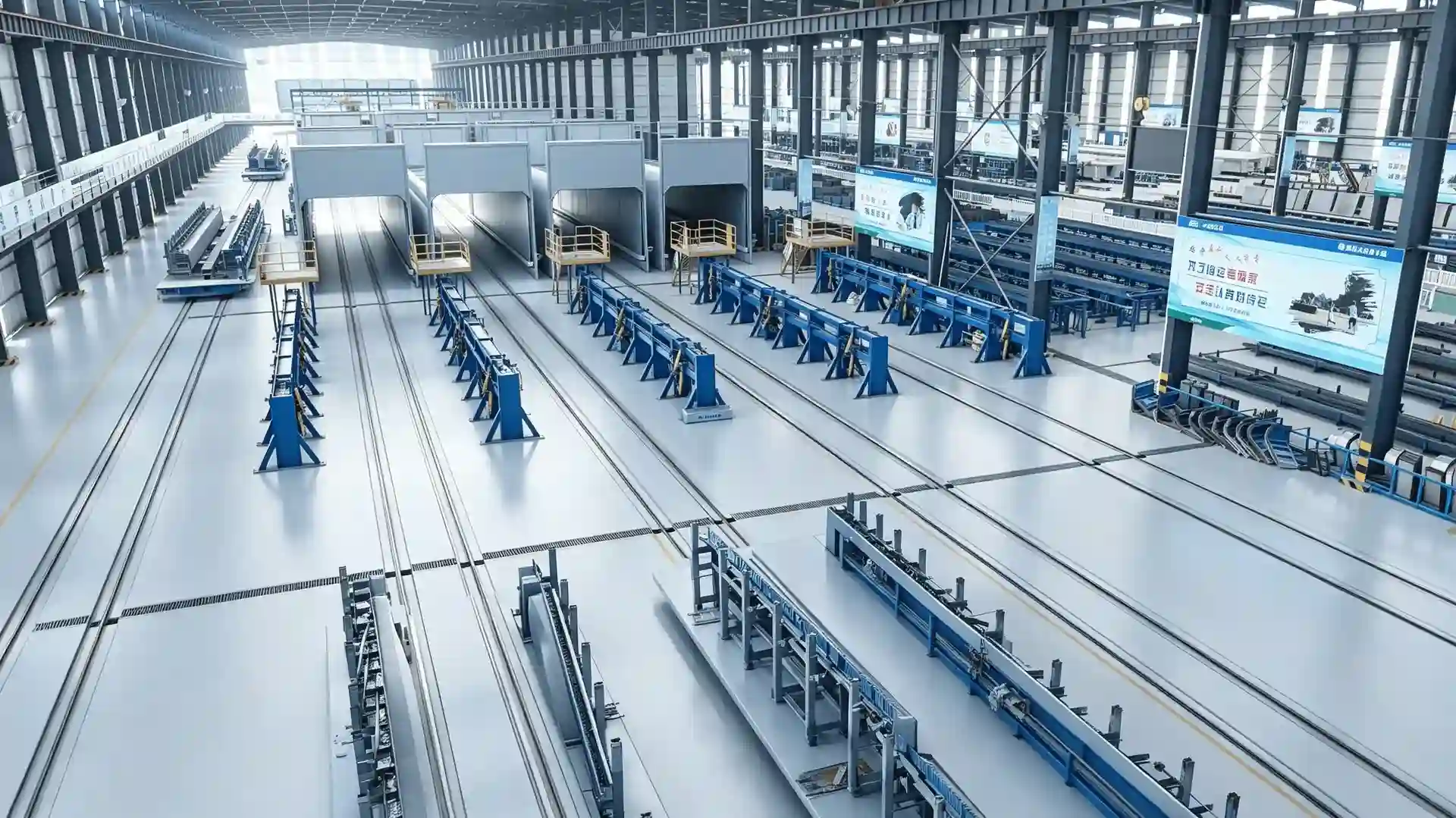
What a sleeper production line makes
A precast concrete railway sleeper production line turns steel, concrete and embedded fittings into the transverse members that hold rail to gauge. Sleepers may be monoblock or twin block, pre tensioned or post tensioned, and they are made to regional standards such as EN 13230 in Europe, AREMA Chapter 30 in North America, AS 1085.14 in Australia and IS 15086 in India. The line does not make the track; it makes the components that a track contractor installs.
Buyers usually evaluate this kind of line when they plan a new plant, expand capacity, or localise production for a rail programme. The decision is less about a single machine and more about which production method fits the volume, floor area and operating team.
Long-line and carousel methods
Two layouts dominate. In a long line plant, a stressing bed runs 80 to 120 metres down the hall. Tendons are tensioned across the full bed, concrete is cast in a row of moulds, cured, then detensioned and cut into individual sleepers. WEGH Group, a supplier of sleeper plants, lists long line capacity from about 120 to 4800 sleepers per day depending on the number of parallel lines.
In a carousel plant, short moulds move through fixed stations: cleaning, tensioning, casting, vibration, curing, detensioning and demoulding. Carousel capacity is often quoted in sleepers per hour, with WEGH listing roughly 25 to 150 sleepers per hour. Carousel moulds are smaller and easier to trace, and there is no cutting at the end of the cycle.
The practical difference is what moves. Long line buys you lower capital and a simpler plant your crew can run and maintain with less specialised support. Carousel buys you automation and throughput per square metre of floor, at higher capital cost. Neither is universally better; the choice follows the annual volume, gauge mix and available building.
Pre-tension versus post-tension
Most sleepers are pre tensioned, with the tendons bonded to the concrete after detensioning. Post tensioned sleepers use ducts and anchored tendons, then grout. The method changes the stressing equipment and the mould or frame, so state which the project requires. For pre tensioned lines, the length of the stressing bed or the length of the carousel mould sets how many sleepers come from one cast.
Process steps buyers should map
A complete line strings together several stations. A typical sequence runs from raw material storage and batching, through concrete distribution, casting and vibration, into mould handling on the wet side, steam curing, demoulding and sleeper handling, then mould handling on the dry side with cleaning and fitting of embedded parts, and finally tensioning and detensioning. Each station is a capacity node, and the slowest one sets the line rate.
Curing deserves attention because early strength drives how fast moulds and stressing frames return to use. EN 13230-1 notes that curing should control core temperature, keep the internal and external difference within about 20 degrees C, and limit the heating rate, so the curing chamber and its controls are a real part of the equipment package.
Standards and tolerances that shape the equipment
Regional standards decide the sleeper geometry and the acceptance limits. EN 13230-2, for prestressed monoblock sleepers, sets dimensional tolerances such as total length at plus or minus 10 millimetres and support point spacing at plus or minus 1 millimetre, with rail seat inclination controlled tightly. The mould, the tensioning and the handling system must hold these across thousands of cycles, so the standard you quote against belongs in the equipment specification.
Capacity, floor space and utilities
Capacity is not a single number. It follows from the method, the cycle time, the number of moulds or beds, the curing strategy and the share of the day the plant runs. Floor space differs sharply: a long line bed is long and narrow, while a carousel fits a compact loop. Utilities include power for mixing and vibration, steam or another heat source for curing, and water for batching and cleaning.
Confirm the local standard and the sleeper family before the layout is fixed. Rail seat inclination, support point spacing and overall length each have stated tolerances in the applicable standard, and the production equipment must be selected to meet them repeatedly.
What to confirm with the supplier
Before you ask a supplier to quote, collect the annual volume, sleeper type and gauge, the applicable standard and axle load or speed category, the building footprint, the automation level you want, and the division of responsibility for installation, commissioning and training. Realjet supplies project specific production lines for precast concrete components and can discuss how a sleeper line would fit your scope, but the sleeper family and local certification are items you should confirm in the contract.
Where to read more
The precast concrete production line solutions page covers the kind of equipment and project scope provided. For the commercial side, the note on production line equipment package scope lists the items buyers often overlook when comparing quotations.