
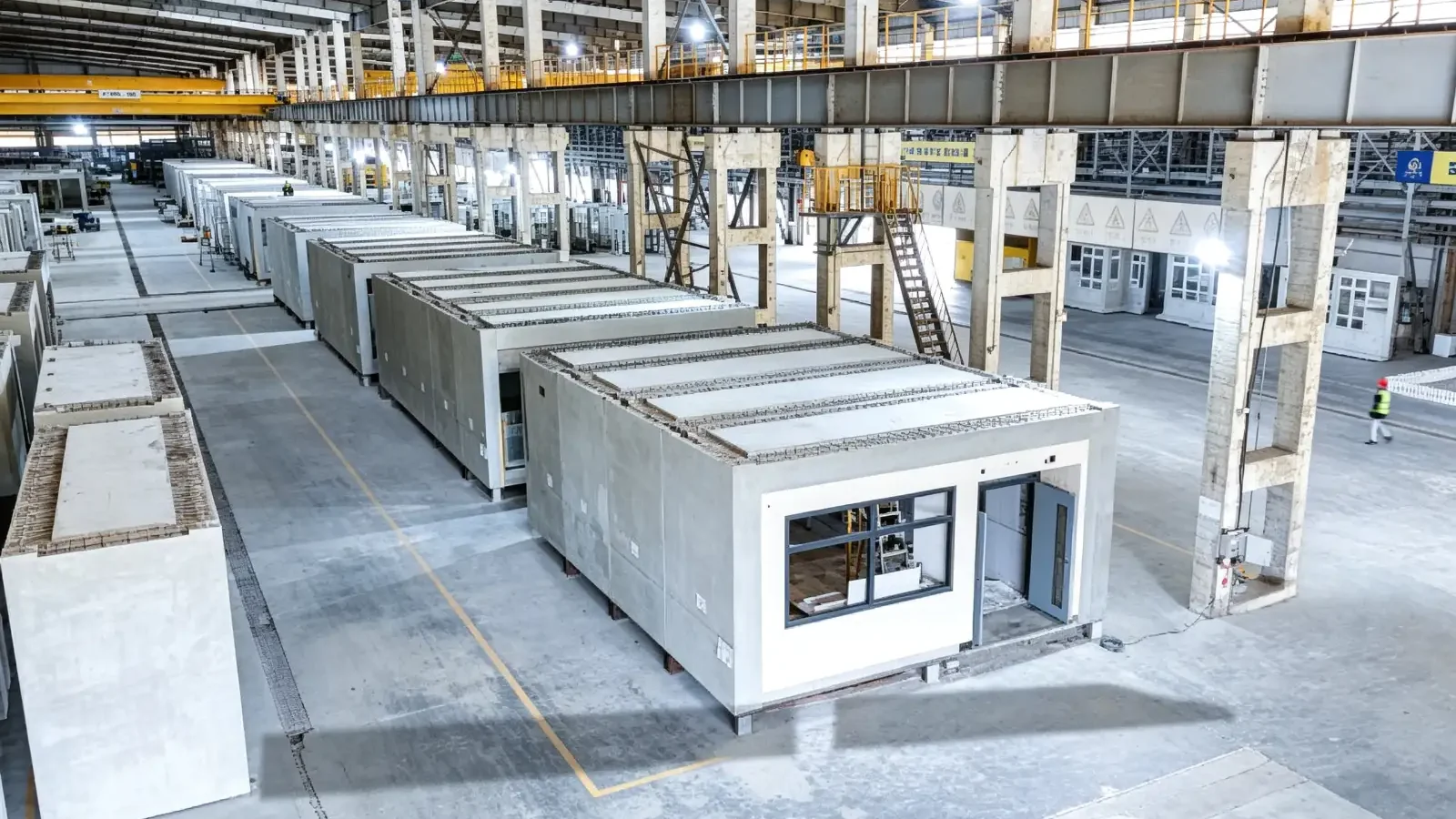
What PPVC and MiC mean for a plant owner
PPVC and MiC describe the same construction method under two regional names, and both start from a room-sized box rather than a panel. Singapore's Building and Construction Authority defines PPVC as a method in which free-standing volumetric modules, complete with finishes to walls, floors and ceilings, are built and assembled in an accredited fabrication facility and then installed in a building (BCA PPVC guidance). In Hong Kong, China, the Buildings Department uses the term MiC for modules with finishes, fixtures and fittings that are manufactured off site and transported to site for assembly (PNAP ADV-36).
The unit of production is what changes the equipment brief. A volumetric module has walls, a floor and a ceiling that must hold position relative to each other, plus openings for doors, windows and building services. It is also heavy enough that lifting and transfer between stations become the spine of the plant rather than a support activity.
Both authorities attach approval conditions to the method, and those sit with the project team rather than with the equipment supplier. BCA reports that PPVC raised productivity by up to 40 percent in manpower and time savings on suitable projects, with average time savings of one to two months against conventional construction and some projects saving four months or more. Those are project outcomes, not equipment performance figures, and they depend on how well the design and the plant are coordinated.
What a volumetric line has to produce
Start from the module schedule, because the envelope drives almost everything downstream. Realjet publishes planning envelopes of roughly 6.0 to 9.0 m in length and 2.8 to 3.6 m in width for a standard volumetric configuration, with a heavier arrangement reaching 12.0 m by 4.5 m, and transfer payloads of 25 to 60 tonnes (volumetric line configurations). For scale, a Singapore residential project built with concrete PPVC used 1,866 six-sided modules weighing 26 to 31 tonnes each (BCA PPVC guidance).
Two numbers shape the plant more than the rest. Module weight decides crane capacity, transfer payload and the site lifting plan. Module length decides casting station footprint, mould stiffness and the distance the box has to travel between stations. Add module height to the list, since a core that has to shrink and release from a tall box behaves differently from a short one.
The production sequence in a volumetric plant
A volumetric plant runs as a sequence of stations rather than a single casting bed:
- reinforcement cage assembly and positioning of electrical, plumbing and mechanical services in a jig;
- casting in a box mould that forms the external faces and the internal core;
- controlled curing inside an enclosure, with temperature logged and release strength verified by testing;
- stripping and transfer of the finished box to the next station;
- fit-out, including prefabricated bathroom units and building services connections, before dispatch.
Each of those stations is a project engineering decision. A plant that cures inside a heated enclosure needs a different layout from one that cures on the floor, and the transfer arrangement between casting and fit-out sets the daily output the plant can actually reach. The equipment package scope for a precast production line is a useful cross-check when a bidder's offer stops at the casting station.
Why a three-dimensional mould changes the equipment brief
A volumetric mould forms five faces plus an internal core. Dimensional control therefore runs in three axes at once, and diagonal measurement matters because modules stack and connect on site. A wall panel can be checked against a flat reference; a box has to be checked for squareness, twist and opening positions together, and the mould structure has to hold that geometry through repeated cycles.
Realjet publishes design targets for a standard volumetric line of ±1.5 mm on length and width and ±2.0 mm on diagonals, with tighter laser-calibrated targets on a heavy-duty arrangement. Treat those as design targets to be reviewed against your module and fixed in an agreed acceptance plan, not as figures that apply to every project.
Demoulding is the second consequence of the shape. A large contact surface resists stripping, and uneven release damages corners. The mould concept therefore decides how the core is released, whether by a synchronized shrinking core or a telescopic linkage system, and how much preparation the stripping operation needs before the lift. Ask each bidder to show the release path at the corners, where damage tends to start.
Lifting, transfer and delivery to site
Volumetric work moves weight repeatedly. A module may be lifted or transferred several times between casting, curing, fit-out and dispatch, so cart payload rating, the rail or route layout, and the lifting points cast into the module are best designed as one system. Interlocks and travel speed matter as much as payload when a loaded cart crosses a working area.
Delivery closes the loop. BCA advises just-in-time installation instead of storing many large modules on site, and notes that cranes on site must be sized and positioned for the module weight. That external constraint returns to the plant design, because the weight a site crane can lift sets an upper limit on the module the line produces.
Space, utilities and staffing
Volumetric plants are long and heavily loaded rather than intricate. Floor area per station, curing enclosure footprint, crane coverage, foundation loads for loaded carts, and the travel distance between the reinforcement station and the casting station all belong in the layout before civil works are priced.
Utilities to confirm early include power for hydraulic packs, steam or heating for curing, water for mixing and washing, compressed air, and drainage able to take slurry and wash water. Staffing follows the station sequence: reinforcement and services positioning, casting, curing control, stripping, fit-out, plus lifting and inspection functions. A plant that also assembles prefabricated bathroom units carries a wider skills mix than a mould yard, and the layout has to place those teams where the module goes next.
Where approvals sit relative to equipment supply
Building approval for a volumetric system is a project matter. In Hong Kong, China, the Buildings Department operates a pre-acceptance mechanism for MiC systems and components, with a determination issued within 45 days of an application that carries the required information (PNAP ADV-36). In Singapore, PPVC adoption is tied to buildability requirements and to accreditation of the fabrication facility.
Equipment supply does not confer any of that. A supplier can support the project with technical documentation, dimensional records and test evidence, and the project team still has to satisfy the local authority. Buyers who treat the line purchase and the approval process as one item usually find out where the boundary sits late in the programme.
What to send before an enquiry
The starting material for a first review is short:
- module types with drawings or a model, including openings and service routes;
- target output per day and the shift pattern it assumes;
- module envelope and weight range, including the heaviest unit;
- site lifting plan and the crane capacity available for installation;
- factory site dimensions, headroom and any civil constraints;
- utilities available on site, or those that would need to be added;
- the standards and approval framework that apply to the project;
- whether the enquiry covers a complete line or a defined package, for example moulds and handling equipment only.
Projects that produce bridge beams, columns or slabs rather than room modules follow a similar planning logic on a different equipment set. The production line overview for precast beam factories describes that route, and the mould range for volumetric and special precast components covers work where openings, inner form withdrawal and transport limits need project review.
A volumetric line is bought as a production system, so the enquiry is strongest when it describes the module, the output and the site rather than a list of machines.