
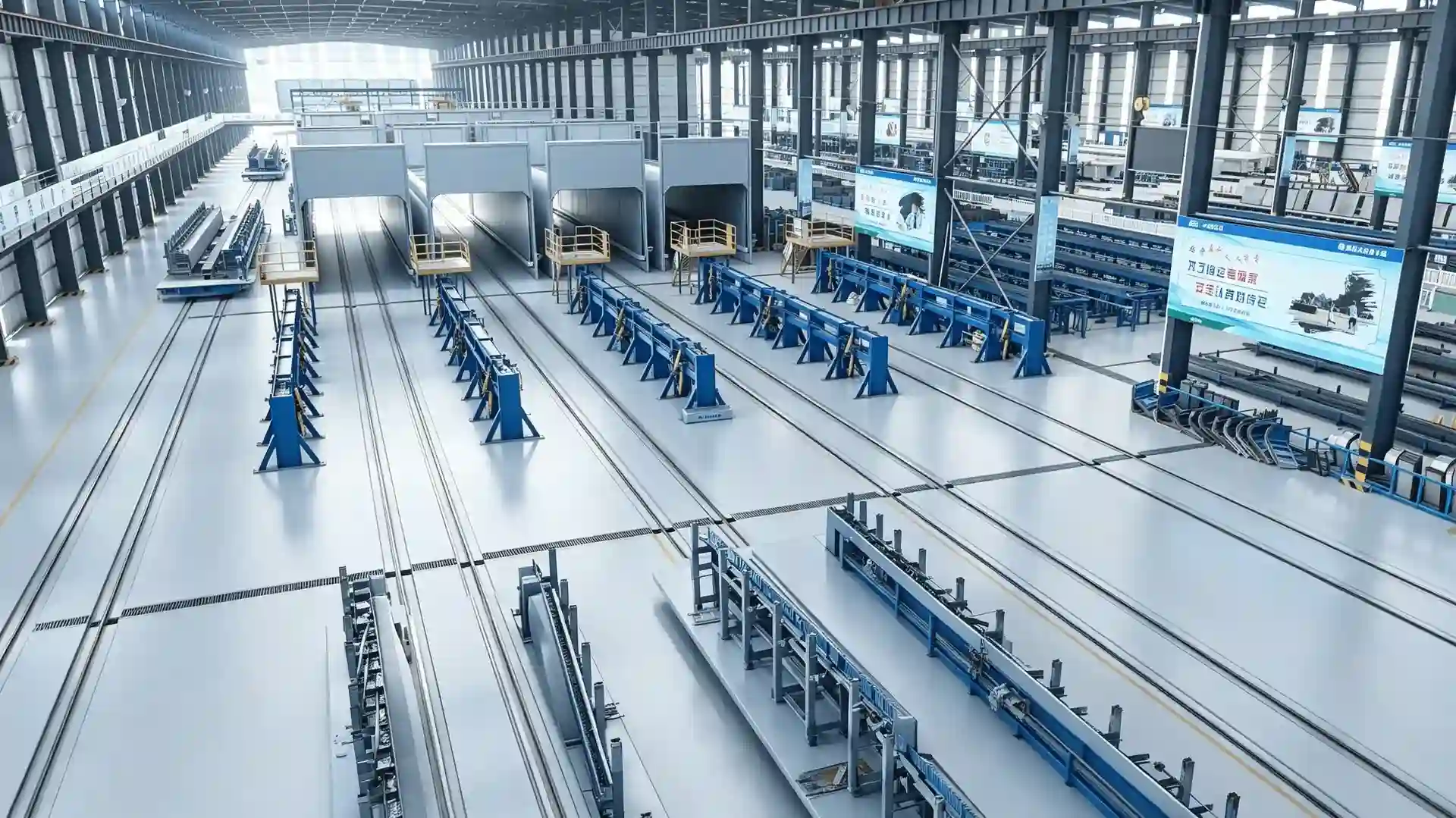
What the machine has to produce
A spun pile cage is a cylinder of longitudinal prestressing bars with a spiral wire welded around it. The cage welding machine positions those longitudinal bars, feeds the spiral wire and welds the two together, cage after cage, to the pile reinforcement drawing. Everything the machine does is judged against that drawing: a cage that is accurate but late holds up mould loading, and a cage that is fast but out of tolerance causes problems further down the line.
The reinforcement design behind the cage is governed by the pile standard. GB/T 13476-2023 defines pretensioned spun concrete piles in China, where the longitudinal reinforcement is low-relaxation prestressing bar and the spiral is drawn wire, and EN 12794 plays the same role for precast foundation piles in European markets. The machine does not set the design; it has to reproduce it at production rate, which is why selection starts from the drawing rather than from a catalogue figure.
Cage geometry sets the machine
Four numbers on the reinforcement drawing decide most of the machine specification. The cage diameter sets the forming ring size. The usable production length sets the machine length and the handling around it. The longitudinal bar count and bar sizes set how many bar positions the machine must hold and load. The spiral pitch range sets the wire feed and welding behaviour, because a cage welded at a tight pitch is a different duty from one welded at a wide pitch.
Diameter alone is not enough to compare machines. Two cages of the same diameter can differ in bar count, pitch and length, and the machine that handles one comfortably may struggle with the other. State the full cage schedule, including which families share the machine, so that the forming tooling, bar positioning and discharge arrangement can be reviewed against every cage you plan to run rather than against the most common one.
The welding setup and the discharge supports deserve their own check. Welding behaviour changes with wire condition and pitch, so the machine should be reviewed against the wire specification you will actually run rather than a demo setting, and the discharge arrangement has to land the finished cage where the next operation can pick it up without re-handling. A cage that leaves the machine bent or unsupported is harder to load into the mould, and straightening it costs time the cycle does not have.
Production rate and changeovers
The output question is not the machine's rated cages per hour but the cages per shift the line actually needs. The cage demand follows the mould schedule: every pile cast needs one cage, so the machine has to keep pace with the casting rhythm, not with an average. A machine that outruns the bar and wire supply stands idle; one that lags the moulds becomes the bottleneck that caps the whole line.
Changeover matters as much as rate when several cage families share the machine. Moving from one cage diameter or length to another takes time, and that time lands inside the shift. Ask how the forming rings, bar holders and discharge supports adapt between families, and compare quotations on the changeover method, not just on the peak output figure.
Shift pattern shapes the answer too. A line that casts across one long shift spreads cage demand evenly, while a line that feeds many moulds in a short morning window asks the cage machine for a burst it must be sized for. Storage between the cage machine and mould loading can absorb part of that burst, but only if the cages are supported and handled in ways that keep them straight.
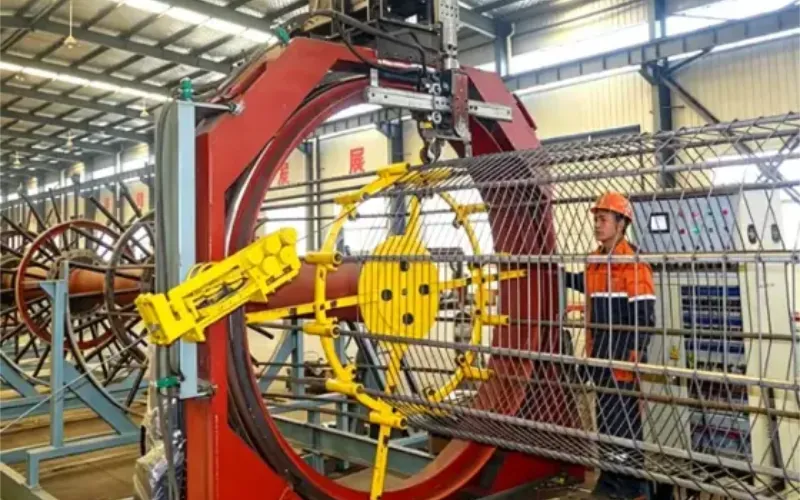
Cage Welding Machine for Spun Concrete Piles
The cage welding machine turns the pile reinforcement drawing into cages at production rate, so its geometry and output decide what the line can cast each shift.
View equipment detailsInputs that make quotations comparable
Prepare five inputs before requesting offers: the cage drawings with diameters and lengths, the longitudinal bar sizes and counts, the spiral wire specification, the pitch schedule, and the cages per shift the line must produce. Add the cage families that will share the machine and any limits on workshop space or handling height around the machine.
With these inputs, quotations can be compared on the same basis: which cage families the machine covers, how changeovers are made, and how the discharge suits the next station. Without them, each supplier fills the gaps with different assumptions and the lowest price usually means the narrowest cage range.
Where the cage machine fits in the line
The cage welding machine sits in a feeding sequence. Upstream, the PC bar processing machine cuts bars to length and forms the anchorage heads, and a wire drawing machine may supply the spiral wire where drawn wire is not purchased ready-made. Downstream, the cage receives its end plates, is loaded into the steel mould and is tensioned later at the mould end. The cage itself does not apply prestress; it only has to leave room for those interfaces.
Review the machine together with its neighbours so that bar supply, coil format, cage discharge and mould loading meet at the same station. The spun pile production line planning page is the place to raise that review with a supplier, and it is more useful to arrive with the cage schedule in hand than with a machine output figure.