
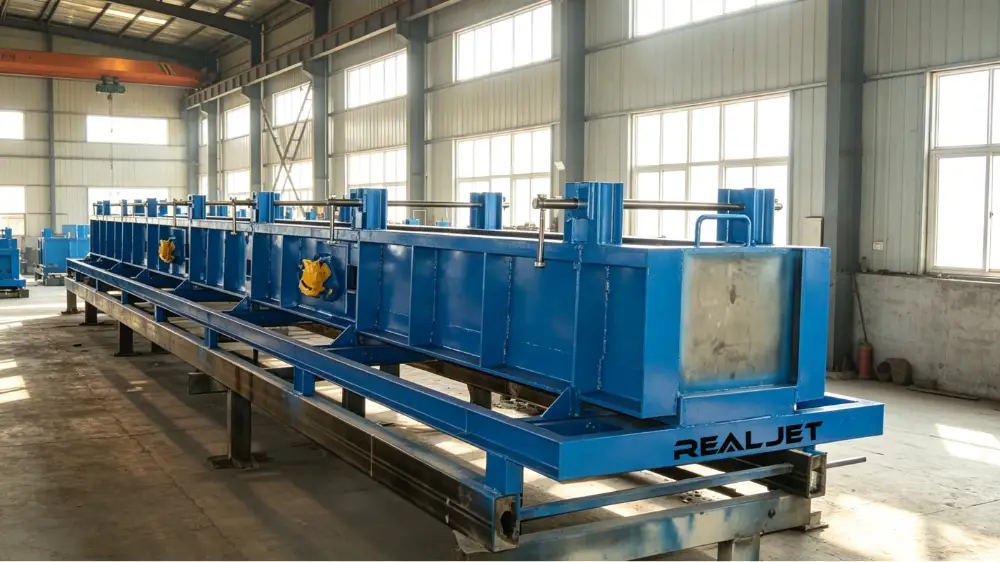
Why the casting rate changes the mould design
Buyers spend time on column section, length schedule, corbels and connection details, and relatively little on how fast the concrete will go into the mould. That is the input the mould manufacturer needs to size the side forms, the stiffeners and the clamps, and it is the one most often left out of an enquiry.
Fresh concrete pushes outward on the form face while it is still fluid. The pressure is highest near the base of the pour and it rises with the rate of placement, so a mould that is adequate at one casting rate can be inadequate at another while the geometry, the mix and the drawings stay exactly the same.
What sets the pressure on the form face
The upper bound is hydrostatic. Normal weight concrete weighs roughly 24 kN per cubic metre, so a column poured to 3 m would exert about 72 kN per square metre at the base if the mix stayed fully fluid. Real concrete does not: the lower lifts begin to stiffen and start carrying themselves, so the maximum pressure is usually lower than the hydrostatic value.
Five variables drive how much lower:
- unit weight of the mix, which is fixed by the design;
- rate of rise in metres per hour, which is the lever the plant controls;
- concrete temperature, because cold concrete sets more slowly and keeps more of the column liquid;
- consistency and workability, since high slump and self compacting mixes behave more like a fluid;
- vibration, which temporarily fluidises the mix around the poker and produces short pressure spikes.
The last two matter more in a precast plant than on many sites. Congested reinforcement and thin sections push producers towards flowing mixes, and a mix that is designed to spread without vibration can develop pressure close to the hydrostatic bound regardless of how slowly it is placed.
What the design routes allow
Two established design routes are used to set a pressure lower than hydrostatic when the mix and the placing rate are known.
In North America, ACI 347R-14, the guide to formwork for concrete, gives an empirical expression for the maximum lateral pressure on wall and column forms as a function of the placement rate and the concrete temperature, with coefficients for unit weight and for cement and admixture chemistry. The expression is bounded: it has a minimum design pressure, it is capped at the hydrostatic value, and it only applies to conventional mixes within stated slump and rate limits. Above those limits, including for self compacting concrete, the guide directs the designer to full hydrostatic pressure.
In Europe, DIN 18218 sets maximum pressure by consistency class and final setting time, and CIRIA Report 108 in the United Kingdom uses a pressure envelope that is hydrostatic up to a maximum limited by stiffening and arching effects. Both take account of the rate of rise and the concrete temperature, and both are widely cited in research on pressure prediction for self compacting mixes.
For a precast column mould, the practical consequence is simple. The hydrostatic bound and the reduced pressure allowed by a code can differ by a large factor, and the difference lands directly in the steel: face plate thickness, stiffener spacing, clamp capacity and the deflection of the side form during the pour.
What happens when practice does not match the stated rate
Where the assumed basis is wrong, the mould does not fail quietly. The side form bows between stiffeners, the joint line between the side form and the end plate opens, and fines appear as fins on the face of the column. In the worse case a clamp or tie is overloaded. Published reviews of form pressure prediction and monitoring for self compacting concrete continue to report measured peak pressures above the design envelope when the pour rate, the mix or the vibration practice differs from the assumption used in design, which is why the casting data has to be stated rather than inferred.
The consequences are not limited to formwork safety. A bowed side form produces a column whose section varies along its length, and the dimensional result may fall outside the tolerance class the project specified, whether it is referenced to EN 13369 or to a precast tolerance manual such as PCI MNL-117. Repairs to a face, or rejection of a unit, cost more than the stiffener the design would have needed.
What to write into the mould RFQ
The casting data belongs in the enquiring package beside the drawings. State:
- the casting orientation and the pour height for each column type, including the deepest section;
- how the column will be filled: in one lift, or in layers, with the layer depth and the time between layers;
- the assumed rate of rise in metres per hour, as a maximum rather than an average;
- the concrete class with the consistency actually specified, whether that is a slump, a slump flow or a consistency class;
- the concrete temperature range at placing, including the winter and summer extremes;
- the compaction method, including the poker diameter and the vibration duration to be used;
- the release criterion, since early stripping and a fast cycle limit how much the concrete can stiffen before the form is opened;
- the tolerance class for the finished member and the allowable deflection on the visible face.
Two further items save arguments later. Say which dimensions must not be exceeded if the form face deflects, and say whether the plant intends to change the mix or raise the rate later in the project. A mould sized for the current mix is not automatically suitable for a self compacting replacement.
What the supplier should return
A quotation should show the pressure basis it was priced on, not just a steel weight. Ask for the assumed maximum lateral pressure and the head of concrete behind it, the resulting face plate and stiffener design, the capacity and spacing of the clamps or ties, the deflection limit adopted for the side form, and how the joint between side forms and end plates is sealed at that pressure.
Where the supplier proposes a design based on a lower pressure than hydrostatic, the basis has to be traceable to the casting data you provided. If it is not, the quotation is assuming a plant behaviour you have not agreed to.
Trial assembly is the point to check that the mould closes, seals and opens as described, and it is worth asking what distortion check is carried out on the side forms before delivery. The general RFQ checklist for this product family is set out in our note on column and beam mould RFQ inputs, and the connection and corbel details that interact with side form stiffness are covered in our article on corbels in precast column moulds.
Where responsibility sits
The division is straightforward when it is written down. The buyer's design and production team own the column design, the mix, the placing plan, the casting rate, the release condition and the tolerance class. The mould supplier owns the formwork design that carries the stated pressure within the stated deflection limit. Production owns the execution, and any rise in casting rate or change of consistency beyond the agreed basis is a change that should go back to the supplier for review before it happens.
Pressure design is not a warranty that the plant may cast the member in any way it chooses. Stating the basis protects both sides: the supplier prices a mould that is adequate for the agreed process, and the buyer gets a form that holds section through the pour.
Next step
If you are scoping this product family, start from the casting data rather than from a mechanism. The mould range for precast concrete components is grouped by component family, and column and beam moulds sit within the building component moulds category. The published product page for column and building beam moulds shows the configuration directions available for this family. Realjet engineers moulds around the approved component geometry and the production process, and confirms final dimensions, functions and delivery scope against the project documents. Sending the pour rate and the consistency with the drawings is the fastest way to get a mould that matches how the plant actually casts.