
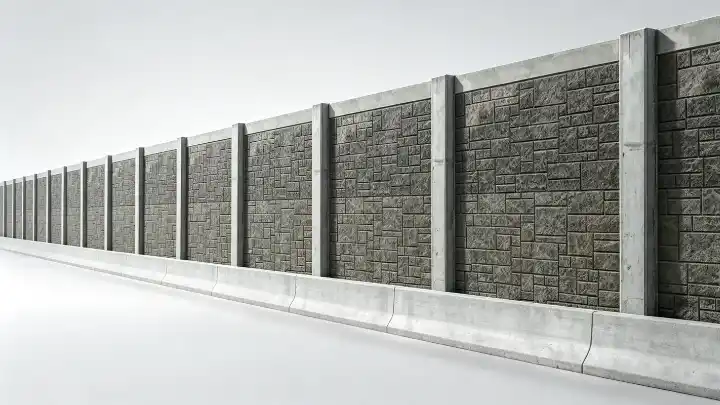
What a noise barrier panel production line produces
A precast concrete noise barrier production line makes the panels, and in some layouts the posts, that form a sound wall along a road, railway or industrial boundary. The line casts concrete into steel moulds, cures the units to a handling strength, strips them and moves them to storage or dispatch. It does not build the wall, set the posts or certify the acoustic result.
The distinction matters when a buyer starts looking for equipment. A noise wall is a system: posts, foundations, panel to post connections, joints and, where required, an absorptive element. Only part of that system is concrete, and only that part is produced by the line you buy.
The Federal Highway Administration noise barrier handbook describes the common arrangement as post and panel, where panels are manufactured away from the site and mounted between foundation supported posts. That description is a good starting point for defining what a line has to produce.
Panel types and what they change in the line
Three choices set the shape of the production line long before equipment is selected.
Full height panels span the clear height between posts as a single unit. They reduce the number of joints in the finished wall, which helps both acoustics and appearance, but they are long, slender and awkward to transport. The FHWA guidance notes that tall panels shipped upright may have to lie on their sides, which in turn affects where the lifting inserts are cast.
Stacked panels use shorter units placed one above another between the posts. They are easier to handle, store and ship, and they allow a manufacturer to serve several wall heights from one mould. The cost is that every horizontal joint has to be designed and built to avoid sound leaks, and the joints become part of the visual pattern.
Posts are usually steel or reinforced concrete, and the panel type is not dictated by the post type. A concrete panel line may therefore produce only panels, while the posts are bought in.
The panel family also decides how the line is laid out. A single repeating panel size suits a small number of moulds worked in a simple cycle. A project with several panel heights, textures and frame details needs more mould sets, more changeover work and more storage area, which is the same trade off that appears in any precast production line type comparison.
The form face decides the finished look
Noise barrier panels are visible structures. Most projects ask for a texture, a pattern, a colour or an exposed aggregate finish, so the form face is a design decision rather than a detail.
A textured or patterned finish is produced by a form liner placed on the mould face. The FHWA handbook makes a practical observation that matters to anyone planning a stacked panel wall: where panels are stacked, a deeper pattern helps hide the horizontal joints, and an exposed aggregate finish tends to emphasise the differences between one panel and the next. Both points feed into the mould and liner specification, not just into the architect's palette.
Panels that include a recessed frame for an absorptive element, or that carry fixing castings and conduits, need a mould that forms those details accurately and releases them without damaging a finished face. Where the absorptive element is a separate product, such as a mineral wool cassette, the mould forms the recess only and the element is bought in.
Casting, stripping and handling tall thin panels
Noise barrier panels are thin relative to their length, which shapes the whole process. They are normally cast horizontally on steel tables, with side forms for the panel outline and end forms for reveals, post pockets or rebates. Vertical casting in a battery mould is an alternative for high volumes of a single panel type, and it saves floor area at the cost of more complex core handling.
Because the panels are slender, stripping strength and lifting method both need to be confirmed before the line is sized. The concrete mix, the curing regime and the release criterion belong to the buyer's design and production plan; the line supplies the equipment that reaches that criterion on a predictable cycle. Curing chambers and their controls are usually scoped as part of the line, and the choices are similar to those in our note on curing system scope.
Handling equipment is selected around panel mass and length rather than around output. Vacuum lifters, tilting tables, spreader beams and the position of lifting inserts all interact with the stacking and transport plan, and inserts placed for shipping may not be the best ones for factory handling.
What sets daily output
Panel output is decided by the slowest step in the cycle, and in practice that is usually curing plus the time a mould is occupied before stripping. A one day cycle with a fixed number of tables or moulds gives a daily panel count close to the number of casting positions, less the panels that fail inspection. Adding tables raises output, but only if the crane, the concrete supply and the storage area grow with them.
Two errors recur in early scoping. The first is to size the line from a peak monthly wall length while assuming a cure cycle shorter than the mix allows. The second is to count the casting tables but forget the space and handling needed for the finished panels, which for this product family is substantial because the units are long and kept in storage until they reach full strength. Our note on floor space and storage planning covers how that area is estimated.
Plant and utility inputs
A panel line is a fixed installation with real site demands. Plan for a covered casting hall with crane coverage over the tables and the curing area, three phase power for the line and the curing system, steam or hot water for accelerated curing, water and drainage for mixing and washdown, and enough yard for storage and for loading long units.
Transport deserves early attention. Noise barrier panels move as indivisible loads, which sets a limit on panel length related to the permitted vehicle envelope and the route to site. That limit is a project input, and it belongs in the enquiry alongside the production volume.
What the buyer must settle before an enquiry
The line supplier can plan equipment, but several items are the buyer's design responsibility and cannot be guessed. These include the barrier height and module, the post spacing, the panel type, the declared acoustic requirement for the project, the applied loads, the surface finish and colour, the lifting and fixing arrangement, and the standard the product must satisfy.
For European projects, the product characteristics of road traffic noise reducing devices are set out in EN 14388, with acoustic test methods in the EN 1793 series and non acoustic performance such as wind load, self weight, snow clearance loads and stone impact in the EN 1794 series. For projects in the United States, the structural design is normally governed by AASHTO requirements, and state guidance can be specific: the Colorado DOT bridge design manual requires new systems to meet AASHTO Test Level 3 and recommends two mats of reinforcement in concrete panels to limit shattering in a vehicle collision. The FHWA handbook chapter on structural considerations lists the load cases a wall is designed for, including dead load, ice, wind, snow storage and impact.
Those requirements govern the panel, not the mould or the line. A line supplier sizes equipment around a panel that has already been designed; it does not decide the acoustic class, the reinforcement, the embedment depth of the posts or the barrier height.
Where the line scope ends
A production line enquiry should state the boundary explicitly. Typical line scope covers the casting tables or battery moulds, the concrete distribution and vibration equipment, the curing system, the handling and transfer equipment, the control and recording system, and the project support that goes with them. Foundations, the building, the electrical supply to the line, the storage yard, the posts, the site erection and the acoustic verification of the finished wall normally sit outside it.
Realjet plans and supplies precast concrete component production lines around the component, the output target and the site, and does not sell the panels or the finished wall. A mould for this product family is developed around the approved panel geometry, which is the same principle described in our explainer on what a precast wall panel production line produces.
Next step
Start the enquiry with the wall system rather than with a machine list: the barrier height and module, the panel type, the finish, the loads and standard that apply, the annual quantity and the site. With those inputs a supplier can propose a line layout, a mould count and a curing regime that meet the project, and can state clearly which items remain in the buyer's scope.