
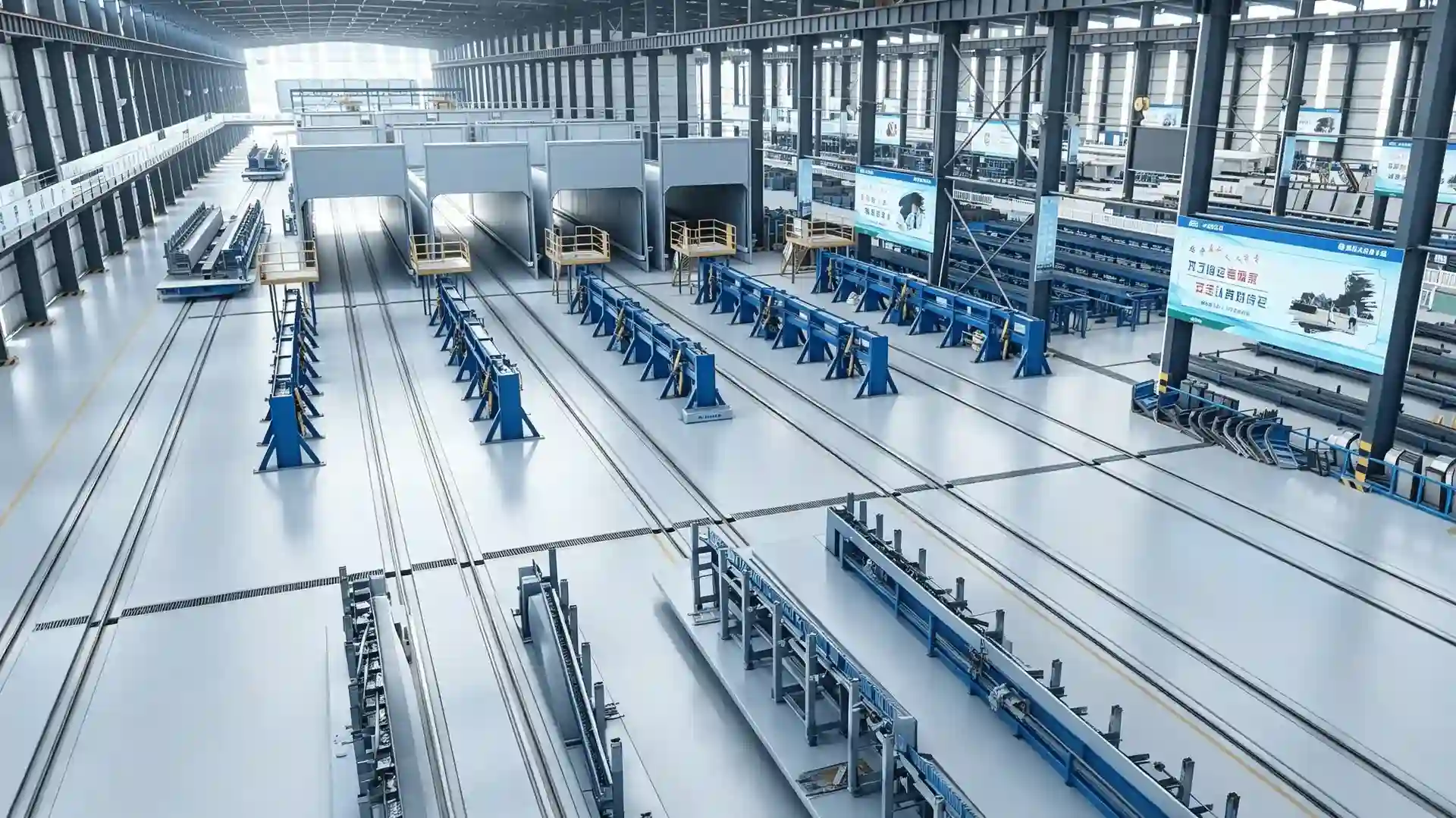
Why line type is the first decision
Before you ask for a quote for a precast concrete production line, you need to know which configuration matches the product, the volume and the site. The same components can be produced on very different equipment. A line built for hollow-core slabs will not convert into a segmental bridge girder line by adding a few moulds, and a carousel line for wall panels is not the cheapest way to make a small run of pier segments.
This article compares the main line families from a buyer's point of view. It is about production-line equipment and project delivery, not about buying precast concrete components themselves. Realjet supplies production lines for precast concrete components; the beams, panels or girders are the output of your plant, not Realjet's product.
Long-line pretensioning beds
Long-line beds are the classic choice for prestressed linear elements: T-girders, I-girders, hollow-core slabs and double-tee floor units. Steel strands are tensioned along the full length of a fixed bed, concrete is placed, cured and then the element is cut to the required length after the prestress is transferred.
The main advantage is output per metre of bed for long, repetitive elements. The main constraint is geometry. Because the bed is straight and long, the product family is limited to elements that share the same basic section. If your project needs many different spans or frequent section changes, the bed changeover time and strand layout work add up. Long-line systems also need a straight, level hall with enough length for the bed plus stressing abutments and cutting equipment.
For bridge and building projects, long-line pretensioning is well documented in PCI and ACI guides for precast, prestressed concrete design and production.
Stationary casting beds and fixed formwork
Stationary beds suit larger, more irregular components: box girders, pier segments, retaining-wall panels, culverts and special architectural units. A mould or formwork assembly sits in one place, reinforcement and embedded items are fixed, concrete is placed and cured, and the finished element is lifted out before the next cycle begins.
The system is flexible. Each bed can carry a different mould, so you can run several product families in the same hall. The trade-off is lower automation and higher crane dependency. Mould cleaning, release-agent application, reinforcement placement, concrete placing and demoulding are often partly or fully manual. Floor space per unit of output is higher than on a carousel or long-line system, but so is the ability to handle variation.
This is the usual approach for project-specific bridge components and heavy civil precast, where every element may differ and the production run is measured in hundreds, not thousands.
Carousel and pallet circulation lines
Carousel, or pallet circulation, lines move the product, not the equipment. Pallets or tables carry moulds through fixed stations: cleaning, set-up, reinforcement placement, concrete placing, vibration, pre-curing, curing chamber, demoulding and return to the start. The system is common for wall panels, solid and sandwich floor slabs, stairs and other building components that repeat within a project.
The benefit is controlled cycle time and compact layout. Because each station does one operation, automation is easier to justify at higher volumes. The downside is product standardisation. A carousel pays back fastest when the product mix is narrow and the production target is high. Frequent mould changes and one-off specials reduce the effective capacity and complicate scheduling.
If your output is measured in thousands of square metres per month and the geometry is stable, a carousel is worth evaluating. If every panel is different, a fixed-bed line is usually more practical.
Specialised beam and girder lines
Bridge and rail projects often need their own line geometry. T-girder, U-girder, box-girder and segmental girder lines are project-specific arrangements that combine mould systems, concrete distribution, prestressing, curing, handling and sometimes match casting. These lines may be stationary, semi-mobile or built around travelling formwork.
Segmental match casting is a special case. Each segment is cast against the previous one to ensure a matching face for the final bridge span. The mould is not just a container; it is part of the geometry control system. This approach needs survey towers, casting geometry records and a clear responsibility split between the mould supplier and the contractor's survey team.
The fixed-vs-circulation-precast-beam-production-lines article looks at one of these choices in more detail.
How to choose
Filter by product, volume and site.
| Factor | Long-line bed | Stationary bed | Carousel/pallet |
|---|---|---|---|
| Typical products | Prestressed beams, hollow-core slabs, double-tees | Box girders, pier segments, wall panels, special units | Wall panels, floor slabs, stairs, repetitive building components |
| Geometry flexibility | Low | High | Low to medium |
| Output at volume | High | Medium | Very high |
| Floor space per unit | Low for long runs | High | Low for high volumes |
| Automation potential | Medium | Low to medium | High |
| Best fit | Long runs of one section | Project-specific or variable geometry | High-volume, narrow product mix |
Your local codes also matter. A line designed for one country's load standards or concrete grades may need changes to reinforcement handling, curing cycles and control software for another market. Ask the supplier how the line will be adapted to your design code and concrete mix, not only how many pallets per day it can cycle.
What changes in the equipment package
The line type drives the rest of the package. A long-line system needs abutments, strand tensioning, side forms, concrete placer, curing cover and a cut-off saw. A carousel needs pallet conveyors, cleaning machines, plotting and side-form stations, distribution equipment, vibration tables, curing chambers and stackers. A stationary bed line needs cranes, moulds, concrete buckets, vibration and curing covers more than it needs automated conveyors.
Common interfaces that appear in every package are the batching plant connection, the concrete distribution method, the curing system, the mould or pallet count, the prestressing equipment where applicable, and the control system. The precast beam production line equipment package scope guide explains how to separate included scope from buyer scope.
If you are planning a new or expanded precast concrete component production line, start by asking which line geometry turns your product mix into a reliable output, not only which one is cheapest. Realjet develops project-specific production lines for precast concrete components and can review your product family, target capacity and site constraints before proposing a configuration.