
Choose the production method before choosing the equipment list
A precast beam factory can keep each mould in one place while people, materials and equipment move to it. It can also move moulds through specialised workstations for preparation, reinforcement, casting, curing and release. Both approaches can produce acceptable components, but they create very different requirements for space, handling, labour, moulds and controls.
The buying decision is therefore not “manual or automatic.” It is whether the product programme is better served by fixed-mould production, mould circulation or a hybrid of the two. Selecting the wrong method can leave a buyer paying for transfer equipment that the product mix cannot keep busy, or operating a fixed arrangement that cannot support the required production rhythm.
Before asking for a precast beam production line, compare the alternatives against the same drawings, production schedule and site. The supplier should show how the chosen method handles the buyer's actual beams rather than presenting one system as universally superior.
What fixed-mould and circulation production mean
In a fixed-mould system, the mould or casting position remains stationary through most or all of the production cycle. Reinforcement, concrete, vibration equipment, curing services, inspection and crews are brought to the mould. Several moulds can operate in parallel without following exactly the same sequence or timing.
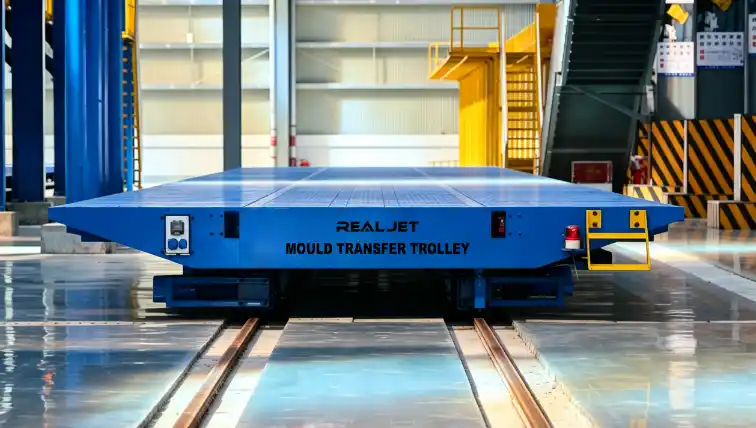
In a circulation system, a mould or mould-carrying unit moves between defined workstations. Each station performs a limited set of operations, and the line depends on coordinated transfer, station timing and route availability. Some beam lines move complete long mould assemblies on rails rather than using the smaller pallets common in wall and slab factories.
A hybrid system combines these principles. For example, long or highly variable products may remain at fixed positions while selected operations use shared mechanised equipment. Alternatively, moulds may move through the main production route while special products, rework or low-volume variants use separate stationary positions.
Research on precast production commonly distinguishes stationary and travelling or flow-shop systems. A 2024 open-access study on precast production sequencing and layout describes fixed production as bringing work to a stationary mould and flow production as moving mould tables between specialised stations. Its models concern general precast components, not a purchasing rule for long prestressed girders. Beam length, transported mass and prestressing method must be checked separately.
Start with product repeatability, not headline output
Circulation becomes easier to justify when products repeat often enough for workstations, tooling and routes to remain stable. A programme dominated by one beam family, a narrow length range and a predictable casting sequence can support specialised stations and repeatable transfers.
Fixed production can be more adaptable when the order contains large geometric differences, frequent engineering changes, unusual embedded items or low quantities of each variant. A mould can remain occupied without forcing every other product through the same station sequence. The trade-off is that crews and shared equipment may travel farther and compete for access around several fixed positions.
Buyers should provide a product-mix table with quantities by beam family and length, not only the maximum beam drawing. Ask each supplier to classify the products as:
- suitable for the base production route without change;
- requiring mould adjustment or replaceable parts;
- requiring a different workstation sequence or handling method; or
- outside the proposed line and needing a separate production position.
This classification makes flexibility measurable. A claim that a line can produce “multiple beam types” is incomplete unless the proposal states how each type changes moulds, station time, transfer conditions and usable output.
Compare both systems on the same buying criteria
The following matrix is a starting point for supplier discussions, not a universal ranking:
| Buyer criterion | Fixed-mould tendency | Circulation tendency | Evidence to request |
|---|---|---|---|
| Product variety | Easier to separate unlike products and cycles | Strongest with repeatable families and defined routes | Product-by-product compatibility matrix |
| Material movement | People and inputs travel to each mould | Moulds travel to specialised stations | Movement map and shared-resource schedule |
| Workstation use | Flexible crew allocation but possible travel and congestion | Specialised work can be balanced by station | Station times, staffing and bottleneck |
| Space | Multiple fixed positions plus access around each | Transfer routes, buffers and return or bypass provisions | Dimensioned concept layouts for both options |
| Capital scope | May use fewer transfer systems and controls | Adds transfer, rails, positioning and coordination | Itemised base scope and option prices |
| Expansion | Additional positions may be added if utilities and access permit | Expansion must preserve route and station balance | Phased-capacity plan and reserved interfaces |
The buyer should use the same output definition in both alternatives: accepted beams available for the next required step under a stated shift calendar and product mix. Comparing a conservative fixed-mould case with an ideal circulation cycle produces a misleading result.
Test whether the beam can be moved through the proposed route
For long precast beams, the circulation decision is also a load-handling decision. The proposal should state what moves at every stage: an empty mould, mould with reinforcement, freshly cast component, cured component or another defined combination. Record the maximum transported mass, centre of gravity, dimensions, support condition and permissible deformation.
Ask suppliers to show rail alignment, transfer interfaces, clearances, swept envelopes, stopping and positioning method, crossing points and recovery space. The route must remain usable when other cranes, vehicles and workers need access. A layout that shows arrows without the full transported envelope does not prove feasibility.
Prestressing can be a decisive constraint. The approved method determines where force is resisted, when strands or tendons are handled and whether the operation can move with the mould or requires a dedicated position. The choice cannot be made from component weight or desired output alone. Buyers should coordinate this comparison with the detailed precast beam prestressing buying questions.
If moving the beam and mould demands extensive structural reinforcement, complex transfers or large unused return space, a fixed or hybrid arrangement may be the better purchase even when circulation looks more automated.
Compare labour by task and shift
Fixed production often relies on mobile teams that repeat a trade across several moulds. This can suit a workforce with broad skills and products whose daily sequence changes. It can also create travel, setup repetition and access conflicts when concrete, reinforcement, inspection and mould work converge on the same position.
Circulation concentrates tools and skills at stations. It may reduce repeated setup and make responsibilities clearer, but only when the work content can be balanced. If one station regularly takes much longer than the others, moulds queue before it while downstream staff wait. Adding transfer automation does not remove that bottleneck.
Request a staffing table for each operating case. It should identify the task, people per shift, hands-on time, shared roles and activities that cannot occur simultaneously. Separate direct production labour from crane operators, maintenance, quality, laboratory, yard handling and supervision. Then test the proposal against the skills and shift pattern available at the destination site.
Do not accept labour savings stated without a boundary. A supplier may reduce people at one workstation while assuming that the buyer provides more crane, logistics or inspection resources elsewhere.
Model variability before buying a tightly balanced line
Circulation depends on coordination, so variability matters. Concrete delivery, reinforcement readiness, curing occupancy, product changeovers, quality holds and unavailable shared equipment can all disturb the planned sequence. Fixed positions may isolate some delays, but they can also accumulate unfinished work and compete for mobile resources.
Ask suppliers to model at least four cases:
- the main product mix at planned output;
- the peak mix with the highest share of slow or complex beams;
- a product change or drawing-driven mould adjustment; and
- one credible unavailable resource, such as a transfer unit, curing position or shared crane.
NIST's Manufacturing Extension Partnership explains that manufacturing simulation can be used before capital-intensive line decisions to examine bottlenecks, throughput, layouts, product-mix changes and operator assignments. This is general manufacturing guidance, not a precast capacity guarantee. For a beam project, the model still needs validated process times, curing assumptions, handling constraints and buyer-supplied resources.
A simple spreadsheet may be sufficient for a stable low-complexity case. A line with shared resources, several products and tight output requirements may justify discrete-event simulation. In either case, require the assumptions and results, not only a rendered animation.
Use a hybrid option when the programme has two different needs
Some purchases are forced into a false choice between a fully stationary factory and a complete circulation line. A hybrid may be more practical when most demand comes from a repeatable core product but the contract also includes low-volume specials.
Possible hybrid decisions include:
- circulating standard moulds while keeping special beams at fixed positions;
- using rail-mounted transfer for selected stages but retaining flexible work zones;
- sharing concrete placing, curing energy or prestressing equipment across separate routes; or
- purchasing the initial fixed positions with defined interfaces for later transfer automation.
Every hybrid saves one dependency and creates another. Shared equipment needs a booking and priority rule; future expansion needs space, utilities and control provisions; separate routes need safe crossings and clear responsibility. Ask the supplier to show the hybrid as a complete operating case rather than a collection of optional machines.
Request two concept offers before fixing the method
If the correct method is not obvious, issue one production brief and ask shortlisted suppliers for two concept offers: the recommended base case and the strongest alternative. Both should use the same product mix, shift calendar, output definition, site boundary and commercial assumptions.
Require each offer to include:
- a process map and dimensioned concept layout;
- product coverage and mould quantities;
- station, crew and shared-resource assumptions;
- handling loads and transfer boundaries;
- curing and prestressing concept;
- base equipment, options and buyer-supplied items;
- achievable output under each stated operating case; and
- the changes needed for the next capacity stage.
Compare the technical basis before comparing prices. The separate precast beam production line price guide explains how to align delivery, installation, utilities, spares and other commercial boundaries after the production method is defined.
Select the method that fits the purchasing case
Choose fixed-mould production when its flexibility, independent positions and simpler transfer boundary fit the actual product programme. Choose circulation when repeatable products, sufficient volume, balanced station work and a feasible movement route justify the extra coordination and equipment. Choose a hybrid when the core and special products genuinely need different production logic.
Realjet develops project-specific production-line solutions rather than prescribing one factory format for every buyer. Share the beam drawings, quantities, delivery sequence, target output, site plan, utilities and staffing assumptions through the precast beam factory production-line page. Those inputs allow the first proposal to compare production methods before the moulds, transfer route and equipment package are fixed.