
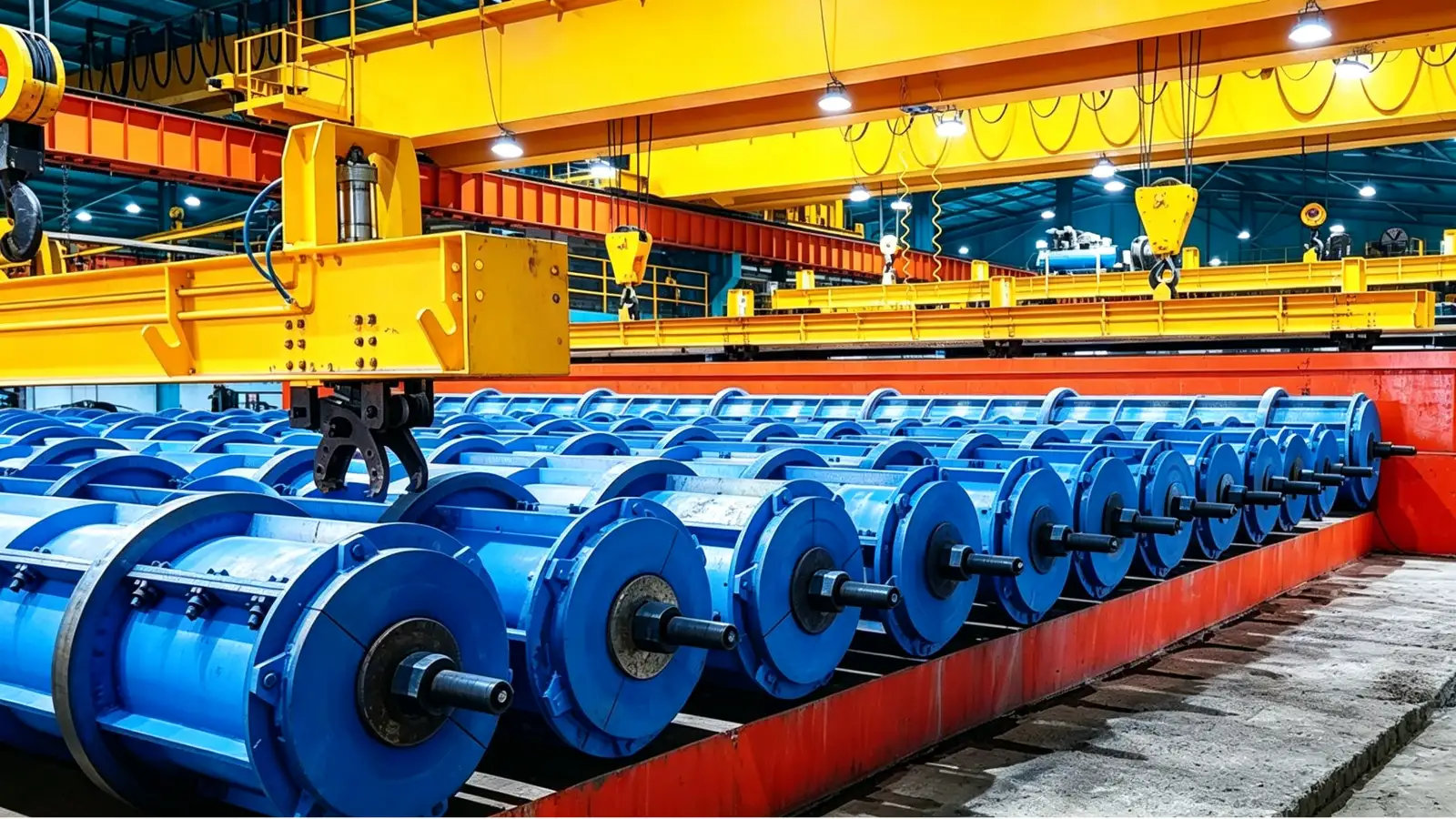
Start from the pile sizes you will make
A spun pile steel mould is not a catalogue item you pick by diameter alone. Start with the pile schedule: the diameters, lengths and end geometries you intend to produce, and how often the product mix changes. The mould shell defines the external pile shape, so every size you plan to make needs a matching mould or an agreed adjustable arrangement.
If your market uses a small set of standard diameters, the mould list is short. If you expect a wide range of lengths and diameters, the number of moulds and the changeover effort grow, and that affects both the equipment cost and the daily output.
Match the mould to the spinning machine
The mould runs on the centrifugal spinning machine through its running rings, so the two must be specified together. The roller spacing, running-ring diameter and loaded mould length have to fall inside the spinning machine's range, and the drive must handle the mass of the filled mould at the speeds your forming recipe needs.
A matching pile diameter does not by itself prove compatibility. Confirm the running-ring positions against the spinning rollers and check the loaded mass against the machine's rated range for each product family you plan to run.
Check running rings, end connections and lifting points
The running rings link the mould to the spinning rollers, and the end assemblies carry the tensioning connections and the end plate. Both must suit the reinforcement and the prestressing design, not just the outer diameter. The lifting points also need to match your crane and the mould handling plan, because a long mould is moved at two defined points.
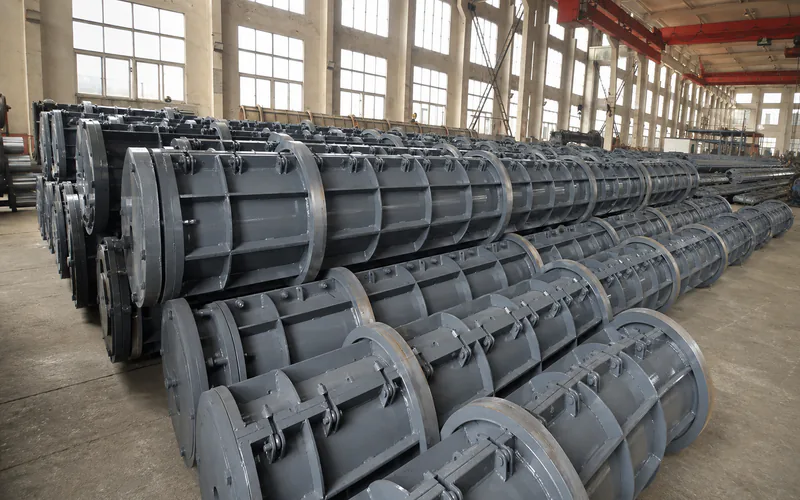
Steel Mould for Prestressed Spun Concrete Piles
The split steel mould defines the pile shape and carries the cage through tensioning, spinning and curing. Its diameter, length, running rings and end connections must match the line equipment you select.
View equipment detailsWhen you add moulds to an existing plant, do not assume a new mould fits the current line. Check the running-ring dimensions and spacing, the mould-end connections, the loaded mass and the curing-space clearances before you confirm the order.
Account for taper, wall thickness and joint sealing
Most spun piles are straight, but some projects call for a tapered section or a special end. The mould must produce the wall thickness the applicable standard requires for the pile class, and the joint between the mould halves must seal well enough to stop concrete leaking during spinning. A leaking joint wastes material and marks the pile surface, so the closure design and the fastener pattern matter as much as the outer diameter.
Confirm the end detail against your pile drawing before ordering, because the mould that makes a straight pile is not automatically the one that makes a tapered or socketed end.
Decide how many moulds the cycle needs
Mould count is a production decision, not just a tooling list. Each pile occupies a mould from concrete filling through spinning and curing until it reaches release strength, so the number of moulds sets how many piles you can have in process at once.
A line that cures in place needs more moulds than one with separate curing pits, because the mould is tied up during curing. Balance the mould quantity against the curing cycle, the spinning machine capacity and the available floor space so the line does not stall waiting for a free mould. Also confirm the mould manufacturing lead time, because a shortfall of moulds at startup limits output until the balance arrives.
Keep the mould compatible with curing and handling
The mould travels through tensioning, spinning and curing, then to demoulding and storage, so its geometry has to work at every station. Check that the mould length and lifting points clear the crane span and the transfer route, and that the end details survive repeated opening and closing without leaking concrete.
Split-shell moulds close with fasteners along the joint. The closure method should suit the pneumatic tools or handling you use, and the joint alignment should hold through many cycles without drifting out of tolerance.
Over many cycles the running rings and the joint faces wear, and the mould needs cleaning, inspection and occasional re-machining to hold its tolerance. Ask the supplier how the mould is serviced and which parts are treated as consumables, and include a spare set of fasteners and seals in the initial order so a worn item does not stop the line.
Confirm the mould scope with the supplier
Because the mould is the shared interface across the line, its supply scope should be stated with the other equipment, not as a separate afterthought. Realjet can include the spun pile steel mould in a coordinated package and confirm its dimensions, running rings, end connections and lifting points against your pile drawings and the selected line equipment before the proposal is finalised.
For a new line, review the spun pile production line solution and share your product size schedule so the moulds are matched to the spinning machine, tensioning equipment and handling plan from the start.