
The equipment most buyers forget to scope
When a production line is planned, the moulds, the casting equipment, the curing system and the handling gear get most of the attention. Compaction is often treated as something the casting crew does with a hand tool. On a line that runs to a daily output, compaction is not an accessory. It is the operation that determines whether the section is fully formed, whether the face is sound, and how long each casting position is occupied.
The earlier article on concrete placing for a beam production line makes the point that placing and compaction are separate operations that still have to be coordinated. This article covers the compaction side: what has to be decided, what it demands of the moulds, and what belongs in the equipment enquiry.
What compaction actually has to achieve
Fresh concrete arrives in a mould carrying entrapped air and internal friction between particles. Vibration fluidises the mix briefly so gravity can close the voids, fill the corners and bring mortar against the form face. ACI 309R, the guide to consolidation of concrete, describes the mechanism and separates the equipment families: internal vibrators, form vibrators, vibrating tables and surface vibrators, each treated as a distinct case with its own recommendations.
Two things follow. First, compaction is a designed operation, not a gesture. Second, the method has to match the component and the mould, because the same mix behaves differently in a deep narrow section and in a wide flat panel.
The three parameters that govern vibration
Consolidation guidance treats frequency, amplitude and acceleration as the variables that set effectiveness. Frequency is how fast the mould or the head oscillates, amplitude is how far it moves, and acceleration combines the two into the force that actually does the work.
In precast practice the numbers sit in a fairly narrow band. External form vibrators are commonly applied in the range of roughly 3,000 to 6,000 vibrations per minute, with some units running higher; vibrating tables usually fall in a similar band, with higher frequency used for finer mixes and thinner sections. Equipment suppliers commonly quote an effective reach of about 0.9 to 1.5 metres per unit, and generally recommend spreading several smaller units across a mould face rather than relying on a single large unit, because coverage matters more than the force of one vibrator.
For the buyer, the practical point is not the motor plate. It is that frequency, amplitude and spacing have to be chosen together for the section being cast, and that the choice depends on the mix. A self-consolidating mix, as covered by ACI 237R, may need little or no vibration at all, which changes the equipment list, the cycle and the mould design. Deciding the concrete system before the vibration system avoids buying capacity that the mix makes unnecessary.
Form vibrators, vibrating tables and internal vibrators compared
| Method | Where it suits | What it demands | Watch points |
|---|---|---|---|
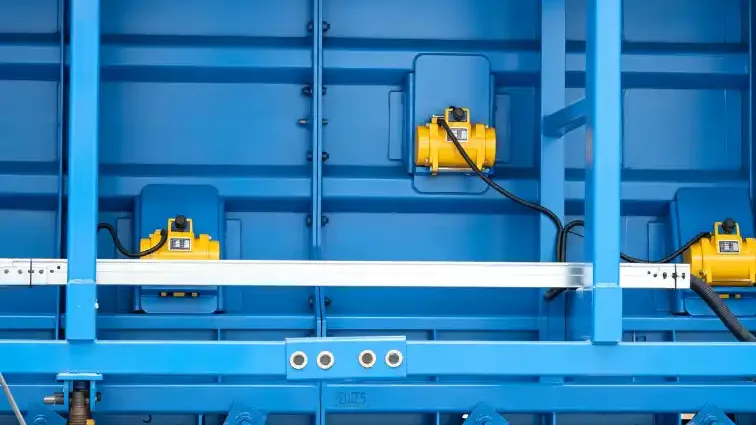
| External form vibrators | Deep or closed sections, dense reinforcement, faces that must be clean | A mould stiff enough to carry the units, with mounting points on the ribs | Mounting points, bolted connections working loose, noise |
| Vibrating tables | Flat components, pallet or table based production | Rigid clamping of the mould to the table, and a table frame designed for the duty | Clamping discipline, table wear, transmission losses |
| Internal vibrators | Open sections that a head can reach, on site or in a pit | Access for the operator, and a workable spacing pattern | Operator control, over-vibration, marks left in the face |
ACI guidance notes, in its answer on consolidating concrete around reinforcement and into the forms, that vibrators attached to the form or to the reinforcement can be used to advantage where an immersion vibrator cannot be applied, which is the normal situation in a closed precast mould. That is why form vibration dominates in precast works, and why the mould, not only the line, is part of the decision.
What external vibration does to the mould and to form pressure
Consolidation guidance is explicit that external vibration raises the pressure the fresh concrete exerts on the mould. A form that is going to be vibrated should be designed for the full fluid head of the concrete plus the effect of the vibrator, and ACI 309R treats forms for external vibration as a separate design case.
That has three practical consequences for a project.
The mould structure has to be stiff enough that the panels do not flex under the combined load, because a face that moves during casting produces a wavy surface and thickness variation.
The units have to be mounted where the vibration transfers efficiently. In practice they are clamped or bolted to the stiffener ribs rather than to the thin face plate, and the fixing has to survive thousands of cycles without loosening. Quick release brackets are convenient, but they still have to hold position.
The interface between the mould and the vibration system has to be agreed by someone. Who provides the mounting plates, who drills the holes, who supplies the cabling and the isolators, and who confirms that the mould was designed for the vibrator force, are all questions that belong in the enquiry rather than in the installation phase.
Sizing the vibration system for a line
Once the method is settled, the equipment package can be defined. The items that usually have to be specified are the number of units per mould, their positions, the mounting arrangement, the supply voltage or air pressure, the control method, and the spares philosophy.
Electric units running at higher frequency often need a frequency converter, and variable frequency drives are increasingly specified because they allow the vibration force to be adjusted to the mix and to the filling stage. Pneumatic units avoid electrical equipment at the mould and are used where that matters. Both have maintenance implications: electrical units need protection appropriate to a wet casting environment, and pneumatic units need a reliable air supply and dry air quality. The equipment package scope article covers how those items are grouped and bounded in a line contract.
There is also a capacity question that buyers ask early. Compaction sits on the critical path of every casting cycle, so the number of positions that can be vibrated at once sets a ceiling on output. On a line with a fixed number of stations, under-provided compaction shows up as longer cycles or as short-cut vibration, which usually means entrained air in the finished unit.
Safety, controls and the responsibility boundary
A vibration system is machinery, and it has to be assessed as machinery. The framework in ISO 12100 covers the hazard identification and risk reduction that a supplier should be able to demonstrate, and on a production line the assessment extends to how the vibrators are started and stopped, what prevents them running with the mould open or a person at the face, and how the equipment behaves when the casting station is shared with other operations.
Four boundaries should be written into the contract. The electrical or pneumatic supply point and its capacity. The control interface, meaning whether the vibrators run from the line control system or from a local panel. The responsibility for mounting the units on the moulds and for verifying that the fixing suits the mould structure. And the noise and vibration limits that have to be met in the casting hall, which affect both unit selection and any isolation required.
What to put in the vibration equipment enquiry
The enquiry becomes answerable when it carries the product, the process and the constraints together. In practice that means the component and its section, the concrete system and its consistency, the mould mass and construction, the target cycle time and daily output, the number of casting positions, the vibration method preferred or open to proposal, the available power and air, the control expectations, and any noise limit.
It also helps to state what the supplier is expected to prove. A performance demonstration on the first castings, with the acceptance criteria agreed beforehand, moves the discussion from "the vibrators are installed" to "the compaction achieves the required surface and density".
Next step
Fix the concrete system first, then the compaction method, then the mould provisions that the method requires. Confirm that the moulds will be designed for the vibration forces, decide the mounting and control interfaces, and set the acceptance test for the first units. With those decisions made before the equipment is ordered, compaction stops being the forgotten operation at the end of a line project and becomes a specified part of the equipment package.
The production line solutions offered through the precast beam factory programme are engineered around the component, the casting method and the output target, which is the level at which the compaction decision has to be taken.