
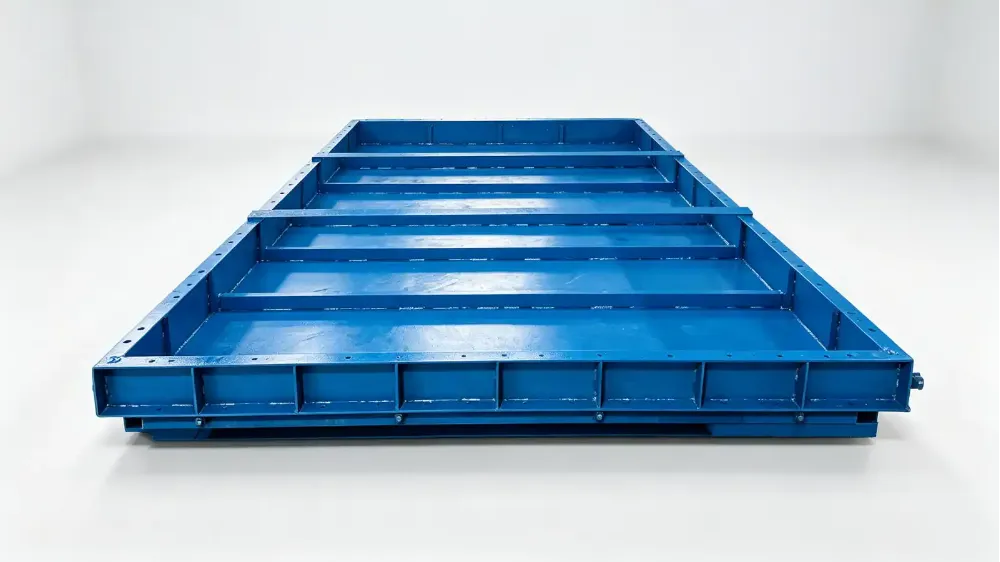
The face that decides the finished slab
A slab mould enquiry usually describes the plan dimensions, the side and end forms, the openings and the release method. The casting face, the surface the concrete is placed against, is often left to the supplier to interpret. It is the one part of the mould that transfers itself onto every unit the line produces.
On a floor or roof slab the casting face is normally the soffit, the face a building user sees from below. Its flatness sets how much the slab thickness varies. Its levelness affects roof drainage and the amount of screed the site has to place. Its condition, its joints and its finish grade decide how much repair the producer has to carry out after stripping, and whether the unit meets the finish the project specified.
This article deals with the face alone, because on a slab mould the face specification is a buying decision rather than a workshop detail. The mould is built around the component and the production arrangement, and the face is the part of that geometry a buyer is least likely to see stated. The precast concrete moulds range shows how mould systems are grouped by component, and slabs sit in the building component moulds family alongside walls, columns and beams. The configuration for this component type is set out on the floor and roof slab moulds page.
Why the face decides flatness, thickness and appearance
Product tolerances for precast units are set by the project and by the industry standard the project names. In North America, PCI 135, Specification for Tolerances of Precast Concrete, was issued in 2025 and its tolerance values supersede those in MNL 135; it also adds production tolerances for precast solid flat slabs. A slab mould that cannot hold the stated flatness will not produce units inside that tolerance, whatever the mix and the casting crew do.
The face is where those limits are held or lost, and it fails in two directions. A face that is flat but not level produces thickness variation and poor roof drainage. A face that is level but not flat leaves a wavy soffit that reads as a workmanship problem on an exposed underside, and no amount of surface patching removes a wave.
The practical rule is arithmetic rather than optimistic. The mould cannot be less accurate than the product tolerance plus whatever movement the face sees during casting, and that movement includes the concrete head and the vibration.
Plate thickness, ribbing and the stiffness that matters
A casting face is a steel plate carried on ribs or beams. Two variables set its behaviour: the plate thickness and the distance between the members that support it. Stiffness is the result of both, so a heavier plate on widely spaced ribs can deflect more than a lighter plate on closely spaced ribs. Thickness quoted in isolation says little about how the face will perform.
That distinction is worth probing in a quotation. External vibration loads the mould, and consolidation guidance treats forms that will be vibrated as a design case of their own, with the pressure of the fresh concrete increased by the vibrator effect. A face that moves between supports during casting leaves the wavy soffit described above and adds variation to slab thickness.
Two questions move this from opinion to evidence. What deflection limit was used for the face under the design concrete head and the vibrator load, and which plate grade and thickness were selected. A supplier who has calculated both will answer quickly.
Flatness and levelness are separate requirements
Flatness is the deviation of the face from a plane, measured locally. Levelness is the deviation from the horizontal reference the project set. They are checked differently and they fail differently, so the enquiry has to name both rather than asking for a flat table.
General formwork guidance classifies formed surfaces by the irregularity allowed within a straightedge: ACI 347R-14 sets classes from A, at 1/8 inch within a 5 foot straightedge, through to D at 1 inch. The companion document ACI 347.3R, Guide to Formed Concrete Surfaces, classifies a face by three properties that a mould buyer can actually control: the form facing itself, the void ratio of the concrete surface it produces, and the characteristics of the facing material.
For the RFQ, the useful additions are the check itself and the datum. State whether flatness will be verified with a straightedge of a given length or with a survey, whether levelness is measured against a laser plane or a reference point, and which datum the producer will use on site when the slab is installed. Without that, the mould is built to one reference and the slab is installed against another.
Surface finish and the grade the project specified
The condition of the face plate transfers to the concrete. Mill scale, pitting, undressed weld runs, dents and grinding marks all print onto the soffit, and they do so on every unit the mould produces. A mill finish plate gives one appearance, a ground or polished face gives a smoother and more uniform one, and a liner or mat gives a deliberate texture that is chosen rather than inherited.
Projects rarely specify this condition directly. They specify a finish grade, and the grade carries numbers. In PCI architectural precast guide specifications the allowable form joint offset is 3/16 inch (5 mm) at commercial grade and 1/8 inch (3 mm) at standard grade, with offsets above the limit ground back at the higher grades; the grade also sets tolerable air hole sizes and the extent of patching. A mould ordered against a named grade can be fabricated and inspected against it. A mould ordered against the word smooth cannot.
For a slab that will be painted or receive a textured coating, the finish grade also fixes how much of the face has to be airtight and mark free, because absorbed paint shows every fin and pore.
Seam layout and the marks that print onto every slab
Every joint in the casting face prints a line onto every unit. A transverse seam across a roof slab with a drainage fall can become a step at the joint. A longitudinal seam on a soffit that stays exposed is repeated on hundreds of slabs, and it will look like a defect even when it is within tolerance.
Seam position is therefore a design decision rather than a fabrication detail. The enquiry should state where seams may fall on the exposed face, whether they may run across the visible area or only parallel to an edge, and whether they may coincide with a real detail such as a construction line or a support position. Where a seam is unavoidable, the treatment matters as much as its position: machined flush, ground, or sealed, and tight enough that no fin is cast into the face.
This is also the point where the exposed face has to be named explicitly. A mould designed so that the soffit is the architectural face carries different face requirements from one where the soffit will be hidden by a suspended ceiling.
Wear, re-facing and the thickness decision
A casting face wears in normal production. Cleaning, scraping, release agent, repeated stripping and local damage around inserts all affect it, and the producer eventually has to choose between re-machining the face, repairing it, or replacing panels.
Whether the face can be re-machined is settled at order, not later. It depends on the plate thickness and how much material the rib arrangement can give up before stiffness suffers. A face specified to the drawing minimum leaves no allowance for a machining pass; a heavier plate costs more at order. That trade-off belongs in the comparison, so the RFQ should state whether the face has to be re-machinable and how much metal may be removed.
The same question applies to how the face is built. A face assembled from replaceable sections is easier to renew than a single plate welded to the frame, and it changes the fabrication route and the cost. Neither choice is wrong, but the enquiry should ask for it, because a supplier will otherwise supply whichever it normally builds.
Decisions and who holds them
| Decision | Design team | Mould supplier | Producer |
|---|---|---|---|
| Which face is exposed | Defines | Confirms casting orientation | Casts to it |
| Product tolerance class | Specifies | Holds it in the face | Protects it in handling |
| Finish grade | Specifies | Provides the face condition | Repairs only inside the grade |
| Flatness and levelness check | States the reference | Builds and inspects to it | Verifies the first units |
| Seam positions on the exposed face | Approves | Lays out the panels | Accepts the marks |
The table keeps design authority with the project and face engineering with the supplier. The slab mould RFQ inputs article covers the wider package, and the note on column mould casting rate and form pressure explains how the casting rate affects the load the face has to resist.
What to send with the casting face specification
A supplier can price the face properly when the enquiry carries:
- which face is exposed, and how the slab is oriented in the building
- the product tolerance the project requires, with the standard and edition it comes from
- the finish grade, and any area where a different grade applies
- the reference used to check flatness and levelness, and the site datum
- the concrete head, and whether the mould will be vibrated externally
- where seams may and may not fall on the exposed face
- whether the face has to be re-machinable or built in replaceable sections
Where those answers do not exist yet, they are faster to settle before the order than after the first units are stripped.
Next step
Fix the exposed face, then the tolerance it has to hold, then the finish grade that face must produce. Those three answers set the plate, the ribbing and the seam layout, and they let two suppliers be compared on the same face rather than on two interpretations of the word flat.
Realjet engineers project-specific steel moulds around the approved slab geometry and production arrangement, connecting process review, mechanical design, steel fabrication, surface finishing, workshop assembly and inspection within the agreed scope. Final dimensions, tolerances and interfaces are confirmed in the approved project documents before manufacturing, and for buyers who are specifying the moulds as part of a new line, the precast production line programme covers the casting and curing sequence the mould has to fit.