
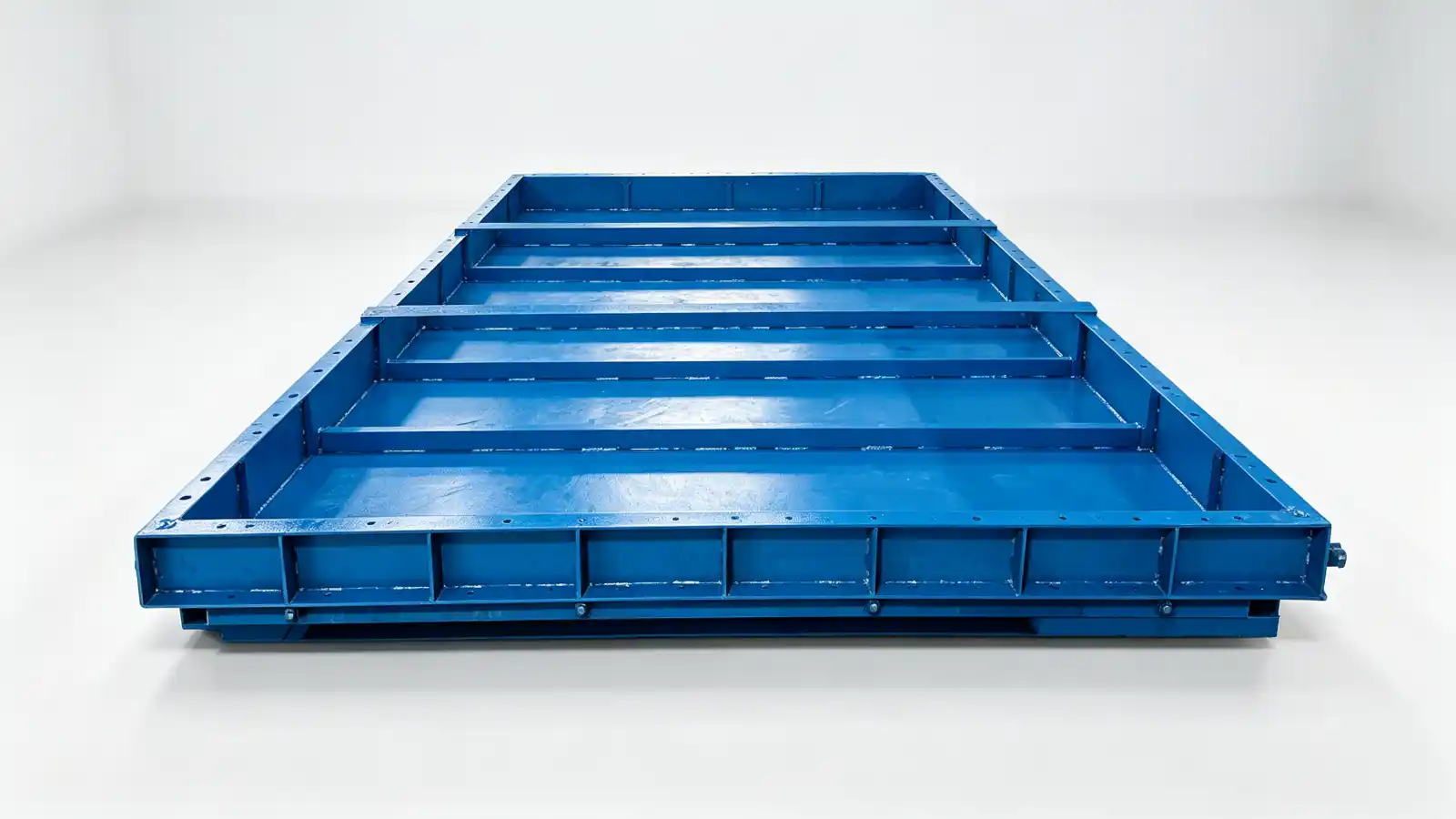
What a slab mould actually produces
A floor or roof slab mould forms precast concrete slabs used in buildings and civil structures. The slab type decides the mould shape. Solid slabs are flat plates. Hollow-core slabs use longitudinal voids to cut weight. Double-tee slabs carry shaped ribs. Composite and sandwich slabs add a topping or insulation layer. Each type needs a different mould internal form, so the RFQ must name the slab family before the supplier can quote.
Realjet engineers project-specific steel moulds around the approved section and production arrangement. Browse the precast concrete moulds range to see how mould systems are configured by component family. A slab mould is one work station of a broader production line; buying the mould does not by itself deliver a complete line.
Geometry and section inputs the supplier needs
The supplier works from your approved slab section, not from a generic shape. Send the span, overall width, thickness, rib profile and end details, plus the positions of any openings, blockouts and cast-in items such as lifting sockets, inserts and weld plates. The building component moulds family covers slabs, walls, columns and beams, and the slab section you supply sets the mould division into bottom, side and end forms.
Proprietary void or core shapes are often licensed geometry. If your project uses a specific hollow-core core profile, the geometry and any name authorisation must come from you or the licensor; the mould engineer builds to that approved section. Stating this early avoids a mould that cannot produce the unit you specified.
Surface, finish and demoulding choices
Slab moulds run in conventional, hydraulic or movable configurations. A fixed table is simple and suits lower output. A hydraulic mould speeds demoulding of shaped soffits. A movable or tilting system helps handling and finishing. The soffit (bottom) finish, any top nib or screed, and the drainage or fall on a roof slab all change the formwork, so list the visible-face requirement and the tolerance class in the RFQ.
The floor and roof slab moulds page shows the configurations Realjet offers for this component family. Pick the operation method from your output target and factory workflow rather than from a catalogue default.
Output, mould count and factory layout
Daily slab volume sets how many moulds you need. One mould produces one slab per cycle; more moulds in parallel raise output but need more bed space, handling and casting crew. For a target of, say, forty slabs per day with a one-day cycle, the line needs roughly that many casting positions, which may be several moulds used in rotation rather than forty identical sets. The exact mould count follows from your cycle time, not from a fixed rule.
State the daily and monthly volume, the slab length range and the factory footprint in the RFQ. The supplier returns a mould quantity and layout that meets the target. Keep the mould count linked to the production line plan, because the mould is only one part of the casting, curing and handling sequence.
Tolerances and standards
Slab product tolerances follow EN 13369, the common rules for precast concrete products, and PCI MNL-117, the PCI tolerance manual for precast and prestressed concrete. These standards give dimension and position limits by unit size and exposed face. Your project may tighten them, so the RFQ should state the tolerance class and any face-specific limits, then let the supplier confirm the mould can hold them.
Tolerances are a shared responsibility: your design sets the class, the supplier builds the mould to hold it, and the production process (concrete, stripping, handling) must not exceed it. Write the limit in the RFQ so the mould review measures against a stated number.
Dividing responsibility in the RFQ
| Item | Your design | Mould supplier |
|---|---|---|
| Slab type and approved section | Provide | Engineer to it |
| Openings, cast-in items | Define positions | Build forms and cores |
| Finish and tolerance class | Specify | Confirm achievable |
| Operation method | State output target | Recommend configuration |
| Mould count and layout | Give volume and footprint | Return plan |
| Production line scope | Define boundary | Engineer equipment |
This table keeps the design authority with you and the mould engineering with the supplier. A slab mould RFQ that names section, finishes and volume gets a usable quote faster than one that asks for "a slab mould".
What to send with the RFQ
A complete slab mould RFQ includes the approved slab section drawing, the span and width range, the slab type, the opening and cast-in item schedule, the finish and tolerance class, the daily volume and the factory footprint. Realjet reviews the package against its mould engineering and returns a configuration with the mould count and operation method matched to your output.
Start the RFQ from the section drawing. A clear approved geometry is the input every later decision depends on, and it is the one item only you can supply.