
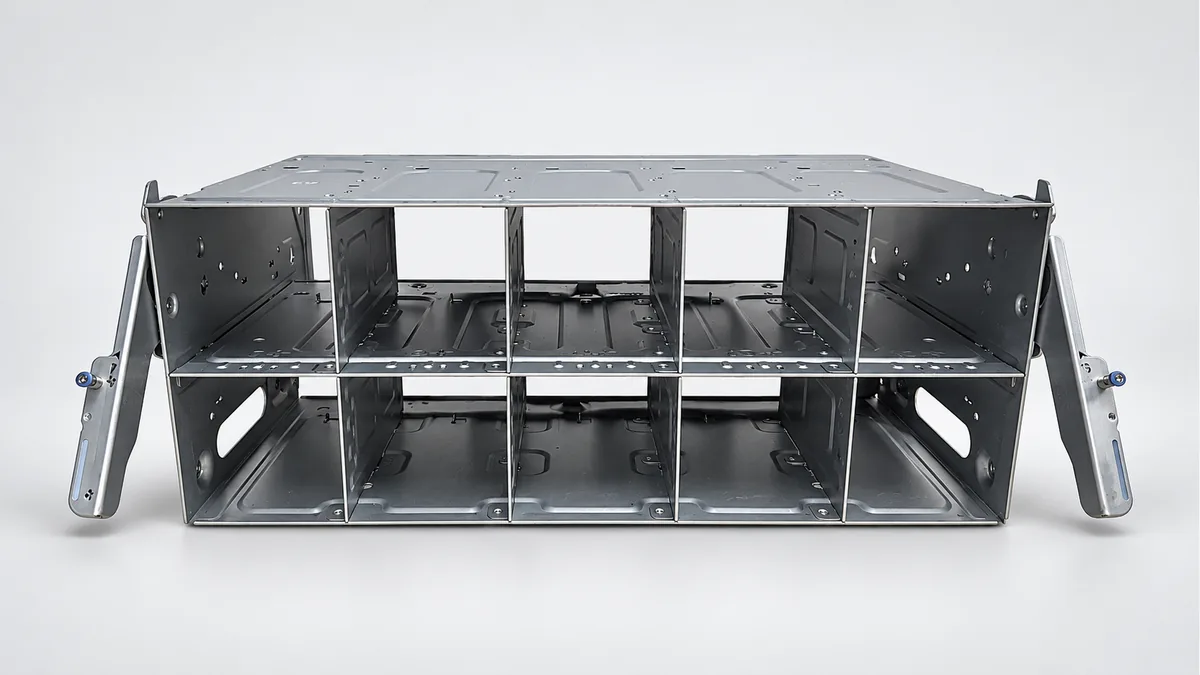
Fan Cages for GPU Servers to your design
Order the metal frame that locates fan modules in your air-cooled or hybrid-cooled GPU server. REALJET makes the cage to your aperture layout, connection details and chassis mounting drawing.
Choose the part and delivery condition
| Your order | Information that sets the scope |
|---|---|
| Formed fan cage frame | Slot layout, frame profile and connection details |
| Frame with specified supports | Support drawings, hardware and assembly condition |
| First article for module fitting | Fan module or approved gauge and acceptance checklist |
Supply is the metal cage and listed supports or fasteners. Fan motors, wiring, control electronics and plastic ducts are included only under a separate agreed scope.
Fit it to the equipment around it
Small slot errors can accumulate across a multi-fan cage. Define each aperture, slot pitch, seating stop and chassis fixing point. Show the module removal path and the space needed to operate its latch.
| Intended installation | Equipment interface to supply |
|---|---|
| AI equipment | Air-cooled or hybrid-cooled AI GPU server |
Plan the manufacturing around these features
The steps below are proposed for the drawing review. Your material, geometry and acceptance requirements determine the final route, tooling and inspection provision.
Establish the complete slot layout
Review aperture webs, bend access and the common pitch datum before blank preparation. Keep all fan slots tied to the same drawing reference.
Form and connect the cage
Plan forming before obstructing returns are joined. Review how frame connections and local restraint may move the narrow aperture walls.
Check after finishing
Deburr module entry edges and review coating on stops and sliding-contact areas. Inspect the finished cage, not only the uncoated blank.
Manufacturing capability for your component
| Your component feature | Existing process and its use | Confirm for your order |
|---|---|---|
| Fan apertures | Laser/plasma/flame cutting routes and deburring. Select the cutting route for aperture webs and module entry edges before forming the cage. | Narrow-web behaviour, edge quality and the relevant cutting setup. |
| Cage profile | CNC bending and fabricated connections. Review bend access before adding connections that close the frame. | Pitch change after forming and joining. |
| Finished module seats | Surface treatment and assembly coordination. Review coating on stops and contact areas before every fan slot is trial-fitted. | A per-slot inspection setup and nominated fan module/gauge. |
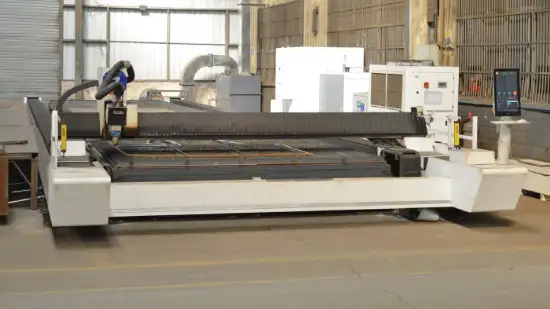
The manufacturing overview provides several cutting routes. The shown plate-cutting equipment is process evidence, not proof that every narrow fan aperture meets the required edge or pitch limits.
Define what the first article must demonstrate
| Feature | Proposed check | Record to agree |
|---|---|---|
| Slot pitch and aperture | Measure each aperture and its location from the common datum; do not add separate slot-width checks as a substitute for cumulative pitch. | Per-slot dimensions and datum-based positions. |
| Module seating | Use the specified fan module or gauge in every slot; check stop engagement and fixing alignment. | Slot-by-slot fit checklist identifying the module/gauge. |
| Maintenance removal | Check module removal and latch access with the neighbouring slots occupied as defined in the test arrangement. | Removal observations, edge condition and test arrangement. |
Identify the drawing revision, measurement datums and pass/fail limits before the sample is made. The quote confirms the available measuring setup, any mating fixture and whether a specialist test needs an external provider.
Packing for your next assembly step
Support the frame so narrow aperture walls and seating tabs do not take transport loads. Identify the fan-module variant on the part and packing list as agreed. State the quantity and delivery city so packing volume and the requested delivery terms can be included.
Questions before you send drawings
Why check every fan slot?
A module can fit one slot while another is affected by pitch, forming or joining variation. The first-article plan should record each aperture and position, then check seating in each slot with the nominated module or gauge.
Do you supply the fans with the cage?
The standard enquiry scope is the metal frame. List any purchased fan modules or hardware separately if you want them included in the quotation.
What should I send for the drawing review?
Send the dimensioned PDF, available STEP/DXF/DWG files and assembly view. Include material, finish, quantity, delivery city and drawing revision. Mark the features in the inspection plan that control acceptance.
Can we approve a sample before ordering repeat quantities?
Request a sample or pilot batch with the agreed dimensional report and any mating checks. Scope, timing and test provision are quoted after review; repeat supply follows the accepted drawing revision and any agreed sample changes.
Discuss your GPU server fan cage
Send the part and assembly drawings with your quantity and required delivery condition. Highlight the interfaces and checks listed above that matter to your order.
Attach files in your email application. To arrange file transfer first, use the enquiry form.