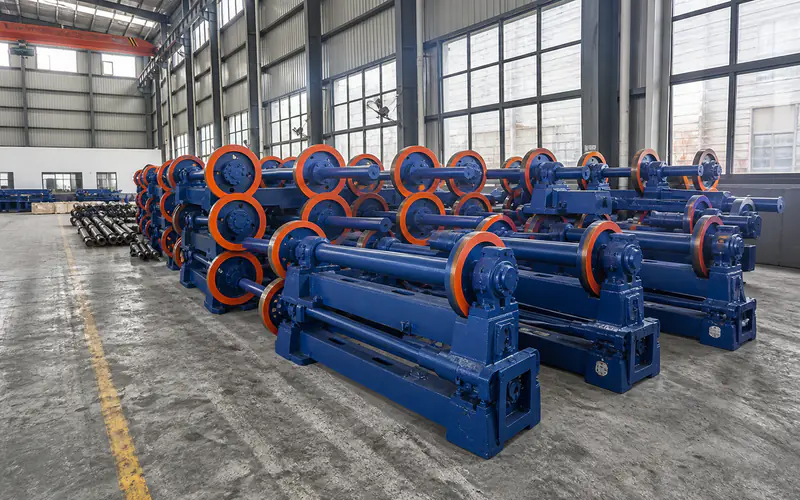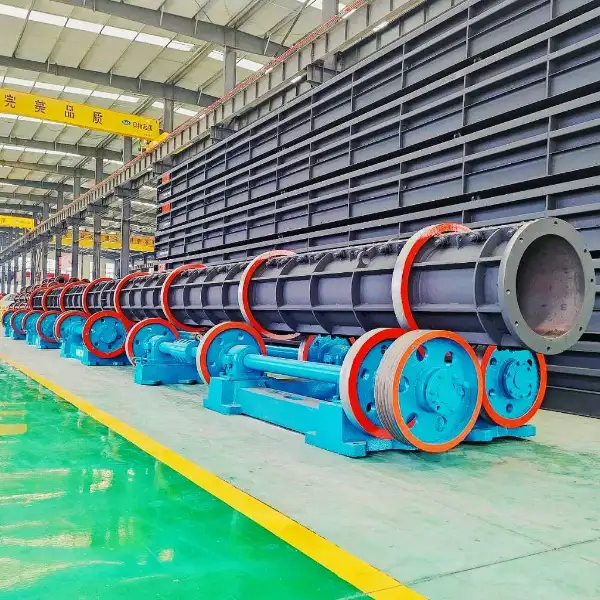
What the spinning machine actually does
The centrifugal spinning machine rotates a filled steel mould so that centrifugal force packs the fresh concrete against the outer wall and pushes excess water and air toward the hollow core. It is the step that gives a spun pile its dense wall and its circular void. The pile geometry is set earlier, by the mould and the cage, but the density and the inner surface finish are set here.
This is the same centrifugal casting method used for concrete pipe, and ASTM C76 describes that pipe process. The method transfers directly to spun piles, but the pile product, the design standard and the buyer are different, so do not treat a pipe reference as a pile specification. The spinning machine is a process machine, not a source of pile strength on its own.
Match the machine to your mould family
The first selection question is whether the spinner fits the moulds you will run. Moulds are defined by outer diameter, length, wall thickness and the running-ring profile that rides on the rollers. A spinner is normally specified for a diameter and length range and for a particular running-ring geometry, because the rollers must support the mould safely through the full speed range.
If your plan covers several diameters, confirm that one spinner family covers them or that changeover stays practical. Very long piles need a longer roller bed and careful support at the ends, and that changes the foundation and the drive layout. State the full diameter and length range in the enquiry rather than the most common size, because the machine will be sized to the extremes.
Roller arrangement and the drive
The rollers carry the mould and transmit the rotation. Their spacing, diameter and surface condition affect how the mould rides and how vibration builds at high speed. Spun pile spinning typically runs through low, medium and high speed stages: a low-speed stage distributes the concrete along the mould, a medium stage transitions, and a high-speed stage compacts it. Published process descriptions put the high-speed centrifugal force at roughly 30 times gravity and the top speed in the region of 800 to 1000 revolutions per minute, though the exact profile depends on diameter, mix and machine.
The drive is commonly a friction-wheel arrangement that contacts the mould running rings, or a driven-roller set built into the spinning frame. The choice affects maintenance, speed control and how the mould is loaded and discharged. Match the drive to the mould mass and to the line layout, and confirm the stopping points if the spinner sits on a transfer route rather than a fixed bay.
Speed stages and process control
Modern spinners are usually controlled through a variable-frequency drive with a preset speed recipe rather than a fixed motor speed. The recipe holds the low, medium and high stages and their durations, and it protects the mould from sudden speed changes that could disturb the concrete layer already on the wall. Vibration monitoring matters at high speed, because an out-of-balance mould will show up there first.
Ask how the speed recipe is set and changed, whether recipes are stored per pile type, and what happens if a mould runs outside the agreed range. These are operating questions, not sales points, and they decide whether the machine fits your product mix day to day.
Inputs the supplier needs to size the machine
A useful enquiry for a spinning machine includes the mould diameter and length range, the running-ring profile, the number of spinning frames required, the target cycle time and the drive arrangement you prefer. Also state the pile types that will share the machine and any future diameters you expect, so the supplier can confirm the roller bed and the drive are not sized too tightly. Keep the enquiry tied to the mould data and the cycle, because those two inputs decide most of the machine size and the rest follow from them.
Concrete charging, pretensioning and curing sit around the spinner, so the enquiry should also say how the filled mould arrives at the spinner and where it goes afterwards. A spinner specified in isolation often conflicts with the feeding and curing rhythm of the line.
How spinning connects to the rest of the line
The spinner is one station in a connected system. Its output is limited by how fast moulds are filled and how fast they clear after curing, and its capacity must track the mould cycle rather than a standalone rating. When you compare offers, put the assumed cycle, the mould count and the handling method next to the spinner specification so the numbers mean the same thing across suppliers.
For project preparation, review the spun pile production line planning page and send your pile drawings and cycle targets. A spinning machine chosen against the full line, not against a single speed figure, is the one that actually raises output.