
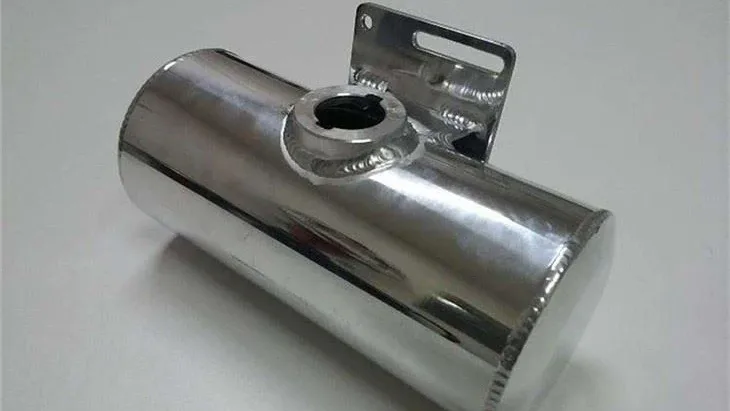
A stainless enquiry carries different risk
A buyer who has sourced carbon steel fabrications for years will recognise most of the RFQ template: drawings, quantities, delivery, inspection. Stainless keeps the template and changes the risk. The material costs several times more per kilogram, it cannot be protected with paint, and every weld leaves a thermal record on the surface that the client will see and a corrosion engineer will judge.
That changes what the supplier needs to be told. On carbon steel a fabricator absorbs many small process decisions because the coating hides the result. On stainless the same decisions become visible defects: heat tint that will not clean up, a weld that rusts in a humid store, a panel that has bowed between stiffeners.
So the useful enquiry says what the material must resist and what the surface must look like, and it states the process limits that are not open to negotiation.
Grade and finish belong on the drawing
304 or 316L is a starting point, not a specification. The grade decides what the part resists, and the surface condition decides how long it keeps resisting. Neither can be recovered later by a coating.
For welded assemblies the low carbon variants, 304L and 316L, are usual. The L grades carry a carbon maximum low enough to reduce chromium carbide precipitation in the heat affected zone. Where chlorides are present, as in coastal air, process water or de-icing salt, 316L is the common choice, and duplex grades such as 2205 appear where higher strength and stress corrosion resistance are needed.
Finish is the second half of the same decision. A 2B mill finish, a brushed No. 4 finish and a polished surface imply different fabrication sequences, because welding the wrong side of a brushed sheet leaves a direction change that cannot be dressed out. The order should name the finish standard, which faces are visible, the grain direction, and whether welds are dressed flush or left as welded.
Where the part is in food, pharmaceutical or potable water contact, add the requirement that will actually decide acceptance: a roughness value, a surface treatment, or both. Without it, two suppliers deliver two different products at two different prices and both claim compliance.
Heat input replaces preheat as the control
On carbon steel the shop controls cracking with preheat and minimum interpass temperatures. Stainless inverts the logic. Preheat is normally only needed to drive off moisture, and the governing limit is a maximum interpass temperature, because the risk is too much heat rather than too little.
AWS D1.6, the structural welding code for stainless steel, sets a maximum interpass temperature of 175 C for prequalified austenitic procedures. Duplex grades fall outside those prequalified provisions and are welded to a qualified procedure, with project specifications commonly holding interpass to 150 C or lower to protect the balance between ferrite and austenite.
Two consequences for the buyer. First, "no preheat required" in a quotation is not evidence of care, so ask what the interpass limit is and how it is measured. Second, the visible result of excess heat is heat tint, and its colour works as a rough thermometer: pale straw at the low end, through gold and blue, to dark oxide scale at the top. A blue weld on a visible face is a process signal, not a cleaning problem.
Filler metal, ferrite and the dissimilar joint
Austenitic weld metal is deliberately not fully austenitic. A small amount of delta ferrite, commonly 3 to 10 ferrite number in the deposit, interrupts the solidification structure and reduces hot cracking. That is why a filler such as ER308L or ER316L is selected to match the base metal rather than its strength alone.
The number that matters commercially is the ferrite number recorded on the consumable certificate, together with the batch traceability of the wire or electrode. Requiring both costs almost nothing at order stage and removes an argument later.
Joints between stainless and carbon steel are the other place where filler choice is a decision rather than a default. A 309L or similar higher alloy filler is normally used on the transition, while the carbon steel side may still need preheat for its own reasons. The two requirements have to be resolved at procedure stage, not averaged on the shop floor.
Contamination is the failure nobody inspects for
Stainless loses corrosion resistance where free iron is embedded in the surface. The sources are ordinary: a carbon steel wire brush, a grinding wheel used on mild steel an hour earlier, a sling, a storage rack, a fork lift tine.
A shop that handles stainless properly segregates it. Dedicated brushes and abrasives, a separate cutting area or at least a cleaned down one, protective interleaves in storage, and no galvanised or painted steel stacked above it. None of this appears in a dimensional report, and all of it appears within weeks in a humid climate as rust spots that the buyer then has to argue about.
The enquiry can require the segregation practice, an inspection for free iron before packing, and a final cleaning step that removes marking ink and adhesive residue. On visible work these are the last operations performed and the first ones dropped when a delivery date slips.
Pickling and passivation are separate steps
Heat tint removal and passivation are routinely written as a single line and treated as a single operation. They are not the same. Pickling removes the chromium depleted oxide layer left by welding. Passivation then rebuilds the passive film on a surface that is already clean. Passivating over heat tint leaves the weld zone as unprotected as it was.
ASTM A380 covers cleaning, descaling, pickling and passivation practice, and ASTM A967 covers the chemical passivation treatment with its acceptance tests. A usable order names the standard, the method within it, whether citric or nitric, and the acceptance test, whether water immersion, humidity, salt spray or a free iron check. "Passivate as required" gives the supplier no defined basis and the buyer no basis to reject.
Where a mechanical route is used instead, the same discipline applies. Specify the finish that must be achieved, not only the operation that must be performed.
Distortion, work hardening and the machining sequence
Stainless moves more than carbon steel when it is welded, and it cuts harder when it is machined. Both facts shape the order of operations, and a buyer who fixes the sequence on the drawing avoids a rework discussion.
For a welded frame with machined interfaces, the usual route is to weld, let the assembly settle, then machine the interfaces in one set-up. Machining before welding takes the distortion into the joint. Machining after welding takes it out of the part. Where the drawing demands a flat mounting face across a large weldment, that sequence has to be stated or it will be settled by workshop convenience.
Machining stainless also needs a note on galling and work hardening: sharp tooling, adequate feed rather than light rubbing passes, and, for threads or sliding fits, a decision on lubricant and on whether the mating part is stainless too. Two stainless surfaces in a clamped joint can cold weld themselves together in service.
Inspection that suits the material
Inspection plans written for carbon steel are often transferred unchanged, and one item in them does not work. Magnetic particle testing is close to useless on austenitic stainless because the material is essentially non-magnetic. Surface examination is done with penetrant testing to ISO 3452-1 instead, with radiographic or ultrasonic methods where the joint type and the consequence justify them.
The rest of the evidence set is familiar: welding procedure qualification to ISO 15614-1, welder qualification to ISO 9606-1, a quality management system for welding to ISO 3834-2, material certificates to EN 10204 3.1, consumable certificates and a dimensional record. The stainless specific additions are the corrosion related records: confirmation that heat tint was removed, the passivation method used, the acceptance test result, and the free iron check.
What to put in the RFQ
| Item | What to state | Why it matters |
|---|---|---|
| Grade | 304L, 316L, 2205 or project grade, with the material standard | Decides corrosion performance and filler selection |
| Finish | Standard designation, visible faces, grain direction | Cannot be recovered after fabrication |
| Welding code | AWS D1.6, ISO 3834-2 level, or project specification | Fixes interpass limits and acceptance criteria |
| Interpass limit | Value and measurement method | Controls tint, distortion and sensitisation |
| Filler | Classification and ferrite number, with certificates | Hot cracking resistance and traceability |
| Joint treatment | Dressed flush, as welded, or ground and polished | Labour hours and final appearance |
| Surface restoration | Pickling, passivation, method and acceptance test | The difference between passivated and merely clean |
| Contamination control | Segregation, dedicated tools, free iron check | Prevents in-service staining |
| NDT | Penetrant in place of magnetic particle, coverage | Suits a non-magnetic material |
| Machining sequence | Weld, settle, then machine the interfaces | Protects flatness and fits |
Who owns which decision
| Decision | Owner | Note |
|---|---|---|
| Grade and corrosion duty | Buyer or designer | Comes from the service environment |
| Finish and visible faces | Buyer | Architectural or hygiene requirement |
| Weld procedure and interpass control | Supplier | Part of the qualified procedure |
| Filler classification | Supplier, agreed by buyer | Recorded on the certificate |
| Surface restoration scope | Negotiated and stated | Decides whether it is inside the price |
| NDT method and coverage | Buyer specifies, supplier executes | Forms the inspection basis |
| Fabrication sequence | Supplier | Needs the functional interfaces explained |
| Packing and protection | Negotiated | Stainless arrives marked or it arrives scratched |
Where to take the question
Realjet manufactures stainless steel fabrications and welded assemblies to customer drawings as part of its contract manufacturing work, with grade identity, joint condition and the specified finish as the inspection focus. The contract manufacturing overview explains how drawing review and scope confirmation are handled, and the stainless steel sheet fabrication page sets out the forming and finishing inputs a quotation is built from. A drawing set with the grade, the finish standard and the surface restoration requirement attached is enough to price the work on a common basis.