
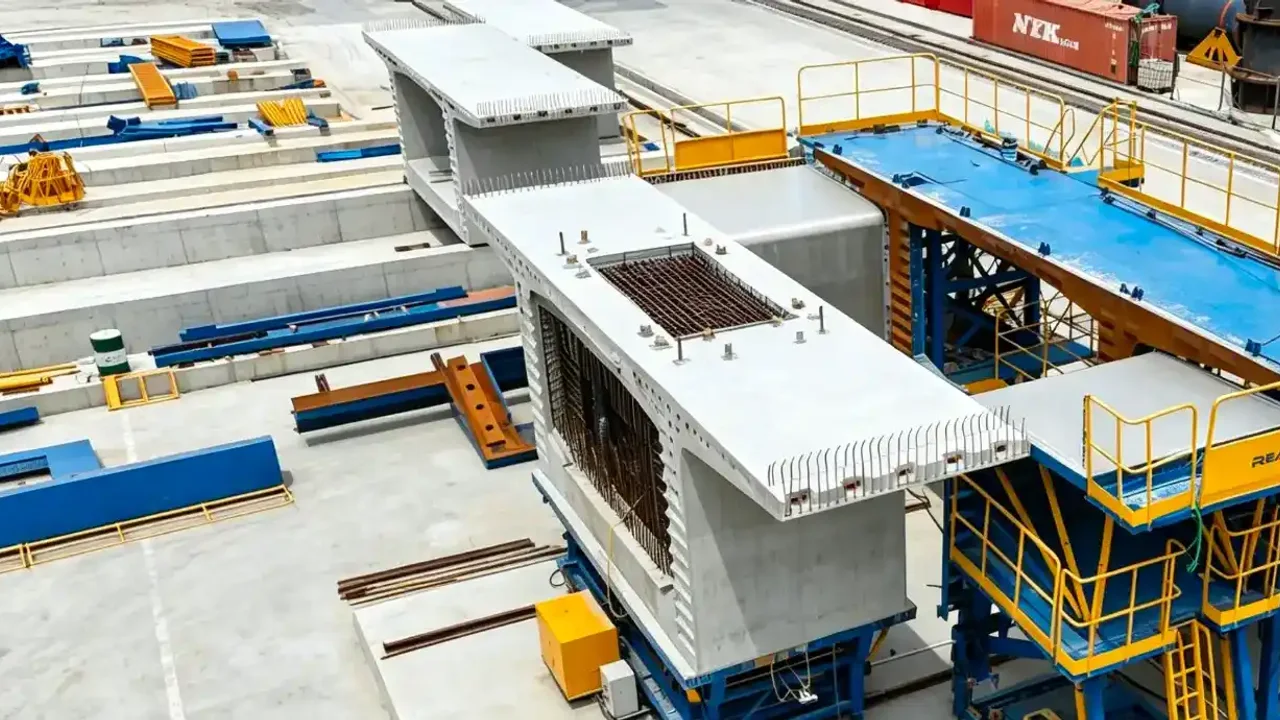
Two quotes, one component, a wide gap
A buyer sends the same component drawing to four mould suppliers and receives four prices that differ by a factor of two. The immediate assumption is that someone is overcharging. The more common explanation is that the four quotes describe four different products.
One quote prices a welded shell with a ground casting face and manual wedges. Another prices a machined face, a hydraulic opening system and a spare set of corner inserts. A third excludes trial assembly and leaves transport to the buyer. None of them is wrong, and none can be compared until the scope is normalised.
Mould price is not a rate per square metre of casting face. It is engineering hours, steel mass, machining hours, bought-in components, assembly and testing, and the cost of moving a large steel object. Each moves independently, so the useful question is not what a mould costs but what is included at this price.
Steel mass comes first, plate thickness second
Steel is the largest single cost line in most project-specific moulds, and mass is driven by two decisions that buyers often treat as supplier preferences: plate thickness and framing density.
The casting face plate has to resist the pressure of fresh concrete plus the local loads from vibration and from any internal form. ACI 347R-14, the guide to formwork for concrete, sets out how those pressures are derived for formwork design, and the answer changes with pour rate, concrete temperature and section depth. A tall wall panel poured quickly loads the mould differently from the same panel poured in lifts.
Thickness follows from that calculation plus the deflection limit. A face plate that deflects between stiffeners produces a visible ripple on the concrete, and the defect is not repairable after demoulding. That is why two moulds of the same plan area can carry very different steel mass: one has closer stiffeners, the other heavier plate, and both can be correct.
What a buyer can do is ask for the mass breakdown by assembly, the plate thickness schedule, and the deflection criterion used for the casting face. A supplier who cannot produce those numbers is pricing by habit.
The casting face decides the finish and the hours
The casting face is the part of the mould the buyer looks at every day for the life of the plant, because its condition is printed on every component.
Three levels are common. A plain welded and dressed face suits components with a fair finish requirement. A machined or ground face suits exposed concrete and tight flatness tolerances. A face fitted with stainless or wear plate suits high-cycle production and aggressive stripping. Each step adds machining hours, which are expensive because they tie up a large machine.
Finish specification therefore belongs in the enquiry. A buyer who asks for an architectural finish after the mould is built is buying a second mould or a rework campaign.
Surface treatment of the steel behind the face is a smaller line, but blasting and a protective system before assembly keep internal cavities from rusting in transit.
Stiffeners and framing, the part buyers cannot see
The frame carries the pour load from the face plate to the ties, the base and the lifting points. A cheap quote usually saves its money in the frame.
Light framing shows up in service. The mould works under load, joints open, grout escapes, and the component gains a fin that has to be ground off. After a few hundred cycles the geometry has gone, and the buyer is measuring components instead of producing them.
Two practical checks in the quotation review: the section sizes of the main bearers and ribs, and whether the design accounts for lifting and stripping loads rather than only the pour. A mould is lifted, tipped and stacked, and those cases often govern the frame.
How the mould opens and closes
The operating system is the clearest example of a price difference that is also a productivity decision.
Manual wedges and hand-operated screws are the cheapest first cost and the slowest cycle. Hydraulic opening with a small power unit costs more and cuts stripping time, and it becomes close to essential on large side forms where manual release damages edges. Tilting and rotating arrangements add more again, and they pay back only where the component is heavy or the crane is the bottleneck.
The honest comparison is cost per component. Multiply the cycle time difference between manual and hydraulic operation by the number of components in the contract, then compare that with the price gap. On a short contract with a few hundred components, manual operation frequently wins. On a multi-year plant, it rarely does.
Maintenance matters too. Hydraulic systems need clean oil, spare seals and someone who can diagnose a creeping cylinder, and a plant without that capability should think twice.
Geometry variation and mould count
The number of moulds is a commercial decision that the mould supplier cannot make for the buyer, and it changes the unit price through volume and through repetition.
Several identical moulds lower the price per mould, because the engineering is done once and the jigs are already set up. Moulds that differ in one dimension keep much of that engineering but add parts that cannot be shared. A family of fully different components is close to buying separate moulds each time.
Adjustable and modular designs sit in between. A base mould with interchangeable end forms or inserts covers a range of lengths for less than a set of fixed moulds, at the price of more set-up time and more joints to maintain. That trade suits a varied mix with low volume per variant.
For a multi-year order book, set the mould count from takt time and curing time rather than the first contract. One mould too few is a permanent constraint; two too many is dead capital.
Trial assembly and dimensional proof
A large mould is built in pieces and assembled in the supplier's workshop before dispatch. That trial assembly is where the geometry is proven: overall dimensions, diagonals, joint alignment between side forms, and the fit of the internal form in its fully withdrawn and fully closed positions.
Trial assembly costs floor space and crane time, and it is the first item a low quote removes. A mould shipped without it is proven on site, with the buyer's crane and schedule at risk. The enquiry should require the trial assembly, the dimensional record, and the buyer's right to witness it or to receive photographs and measurements.
For moulds with moving parts, the trial should include a full open and close cycle under power, not just a static fit. A cylinder that binds at the last twenty millimetres will not appear in a dimensional report.
Delivery, site support and the boundary of the order
A large mould travels as an abnormal load. Transport cost depends on the number of loads, their dimensions and the route, and it can be a meaningful share of the order value on a bridge mould. Quotes that exclude transport are not cheaper, only incomplete.
Three delivery boundaries appear in practice: ex works, delivered to port, and delivered to site with installation supervision. Each carries a different risk allocation. Installation supervision and first-cast support are usually priced as days, and the number of days assumed should be stated, because a mould that needs three weeks of site support instead of one changes the total.
Customs, lifting at the receiving port, storage before erection and a crane of adequate capacity are usually the buyer's scope, worth writing down rather than assuming.
Spares, wear parts and the second order
Wear items on a mould are known before it is built: seals and hoses on a hydraulic system, wedge bolts and pins on a manual one, edge strips, locating pins, and the fasteners that get lost on site. Buying them with the mould costs far less than buying them later as urgent single items.
A spare parts list with part numbers and a recommended first-order quantity is a reasonable requirement in the enquiry. So is a drawing set with the as-built dimensions marked. A plant that cannot identify a part without calling the supplier loses production time on every breakdown.
For repeat orders, ask whether the mould drawings are archived and for how long, because the second order for the same component should not need a new design.
Comparing quotes before comparing price
| Item to compare | Why it changes the price | What to ask for |
|---|---|---|
| Casting face plate thickness and grade | Main driver of mass and stiffness | Thickness schedule and steel grades |
| Stiffener spacing and section sizes | Controls deflection and service life | Framing drawing with section sizes |
| Casting face finish | Machining hours | Finish specification and flatness tolerance |
| Opening system | Purchased components and cycle time | Type, stroke, power unit, spares |
| Mould count and modularity | Engineering amortisation | Unit price per mould and per variant |
| Trial assembly | Floor space and crane time | Dimensional record and witness option |
| Transport and site support | Abnormal loads and supervision days | Incoterm, load count, supervision days |
| Spares and documentation | Small cost, large downtime effect | Parts list, drawing set, archive period |
| Price validity and steel basis | Steel prices move | Validity period and index clause |
Who decides what
| Decision | Owner | Why it sits there |
|---|---|---|
| Component geometry and tolerances | Designer | Comes from the structural or architectural design |
| Casting face finish | Buyer, with supplier advice | Tied to the visible concrete requirement |
| Plate thickness and framing | Supplier | Part of the structural design of the mould |
| Opening system | Buyer chooses from options | Balance of first cost and cycle time |
| Mould count | Buyer | Set by takt time, curing and contract volume |
| Trial assembly and records | Supplier, required by buyer | Part of the delivered evidence |
| Transport and site support | Negotiated and stated | Depends on route and site capability |
| Spares and drawing archive | Negotiated and stated | Affects the cost of the next five years |
Where to take the question
Price becomes comparable once the component, finish, operating method, mould count and delivery boundary are fixed. That is a two-page specification, and it is what a mould supplier can actually price.
Realjet designs and manufactures project-specific steel moulds, with the operating method and the level of finish selected against the component and the production target. The precast concrete moulds overview explains how the families are organised, the bridge and transportation moulds category covers the large structural moulds where steel mass dominates the price, and the segmental bridge moulds page shows the type of assembly where trial fit and match-cast geometry set the cost. Sending a component drawing with the finish, the cycle target and the mould count attached is enough to start a comparison on equal terms.