
Wear is an order-scope question
Mould wear is usually discovered in the second year, when a clamp no longer pulls the two halves together, a cone seat leaks grout, or the joint face has been dressed so many times that the chamber no longer lines up with its neighbour. By then the mould is in production, the drawings are archived, and the replacement part is being reverse-engineered in a workshop that has never seen the original.
The alternative costs almost nothing at the point of purchase. A mould order can list the parts that are expected to wear, fix the material and the interface for each one, and specify how many spares come with the first delivery. That is a scope decision inside the mould purchase, not a maintenance programme afterwards, and it is the difference between a two-day changeover and a two-month one.
This applies to every steel mould, but it matters most where the same mould runs at high cycle counts with a small number of operators and no spare capacity in the yard.
What actually wears in a steel mould
Wear in a precast mould is concentrated in a small number of places, and almost none of them are the large plates that dominate the price.
| Item | What drives the wear | What it looks like when it fails |
|---|---|---|
| Hinge pins and bushes | Cycle count, grit, missed lubrication | Slack in the opening motion, panel droop, misalignment at the joint |
| Clamps, toggles and wedge bolts | Load per cycle, thread condition | Grout loss at the joint, panel gap, concrete finning |
| Joint faces and seal grooves | Cleaning with the wrong tool, grout build-up, dressing | Stepped joint, leakage, visible misalignment between units |
| Cones, collars and insert formers | Pull-out force, concrete adhesion, lost parts | Distorted opening, insert position drift, water ingress |
| Gasket and seal strips | Compression set, chemical attack, storage | Grout runs, voids at the joint face |
| Vibration mounts and fixings | Loosening under repeated excitation | Uneven compaction, local surface defects, noise |
| Lifting lugs and shackle points | Inspection regime, overload | Rejected lifts, unplanned repair before the next cast |
| Casting face | Abrasion from concrete and cleaning | Surface marks transferred to every unit thereafter |
Only the last item is expensive to replace. The rest are small parts with long lead times relative to their price, which is exactly the profile that argues for holding them.
The high-cycle case: chambers, manholes and rings
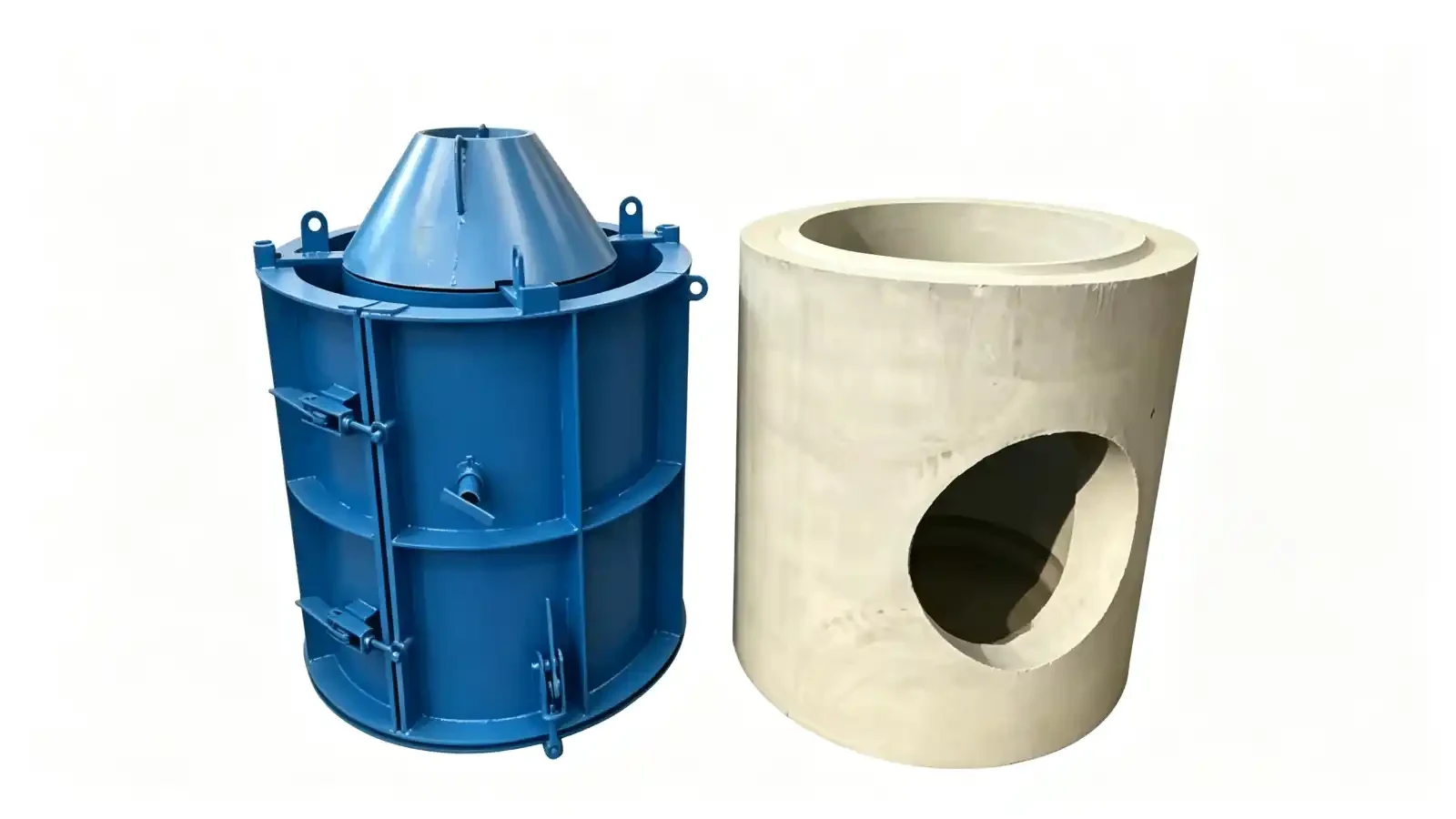
A manhole and inspection chamber mould is a good example because the geometry forces several of these parts to do real work. The body is usually split into two or more segments joined by clamps, the top carries a cone or reducing section, and the wall has openings for pipe connections that are formed by removable inserts. Every cast involves opening the body, removing the core or inner form, pulling the opening formers, cleaning the joint faces and re-assembling.
That is a lot of small-part activity per unit, and the cycle count per year can be high because chambers are a standard product rather than a project item. The parts that suffer are the clamps, the cone seat, the opening formers and the joint faces, in roughly that order.
The manhole and inspection chamber mould range shows the configuration this discussion refers to: a split body with lifting lugs, a clamped closure, and a separate top section. Buyers comparing suppliers on that range will get more value from asking what is replaceable than from comparing plate thickness alone. Broader options across drainage, utility and road components sit under the municipal and infrastructure mould category, which groups the families by component type rather than by mould size.
How many spares to order
There is no universal number, and any supplier who offers one without asking about cycle count is guessing. The workable method is arithmetic on four inputs.
Start with the planned cycle count over the period you want to cover, typically the first year. Multiply by the expected life of the part in cycles, which the mould maker should state per item rather than as a single figure for the mould. The result is how many replacements you will consume. Add the number of units that have to be in place at any moment, which for clamps and seals is every position on the mould, not one. Then compare that total against the lead time for a replacement and the cost of holding stock, and set the order quantity.
Two rules keep this practical. Parts that stop the mould when they fail should be held at full-set quantity plus one. Parts that only degrade quality, such as casting face inserts or nosing profiles, can be held at the expected consumption for the period.
Where the buyer runs several identical moulds, the calculation changes completely: spares become a shared pool and the per-mould quantity falls, but the pool needs a location, a log and someone responsible for it.
Keep the interfaces interchangeable
A spare is only useful if it fits. The most common way a sensibly stocked spare becomes scrap is that the replacement was made to a drawing revision that no longer matches the mould on the floor.
The order should therefore require that wear parts are defined by interface, not only by shape: pin diameter and length with tolerance, clamp throat and pin centres, seal cross section and groove dimensions, cone taper angle and seat diameter, insert former fixing centres. Where a part is machined to fit a specific mould, the drawing number and the mould serial number belong on the part and in the spare parts list.
It is also worth deciding at order stage whether the wear part is a catalogue item the buyer can source locally, or a proprietary item that only the mould maker supplies. Both are defensible; not knowing which one you have is not.
What the order should say about the casting face
Surface care has a documented basis. ACI 347R-14, the guide to formwork for concrete, recommends that forms be cleaned of dirt, mortar and foreign matter and coated with release agent before each use, and it adds a point that reads directly across to a steel mould: where surface appearance matters, forms should not be reused if damage from previous use would impair the concrete surface. The ACI 347R-14 document listing is the reference.
Translated into a purchase document, that means the mould order can legitimately require a written cleaning and release agent procedure, a named release agent compatible with the specified coating, and a definition of when the casting face is considered worn. Without the last item, the decision to replace or re-machine a face is made by whoever is standing next to the mould at the time.
Marking and documentation
A mould that arrives with a spare parts list, part numbers stamped on the parts, and a drawing set that includes the wear items is a different asset from one that arrives with a general arrangement drawing only. The documentation to ask for is short:
- A bill of materials that separates structural parts from wear parts.
- An interface drawing for each wear item, dimensioned to the mould, not to the product.
- Material specification for pins, bushes, clamp bodies and seal strips.
- The recommended spare quantity per item, with the assumption behind it stated.
- A maintenance schedule tied to cycle count rather than calendar time.
This is the same discipline that a mould RFQ for chambers needs in order to be answerable at all, and it overlaps with what drainage and channel mould buyers should specify about profile inserts and joint formers.
Who owns which decision
| Decision | Owner | Comment |
|---|---|---|
| Cycle target and product mix | Buyer | Drives every life and quantity figure |
| Which parts are wear parts | Mould designer | Should be listed, not implied |
| Spare quantity | Buyer, using supplier life data | Needs the assumption stated |
| Interface dimensions | Mould designer | Must be frozen before spares are made |
| Release agent and cleaning method | Buyer, with supplier recommendation | Affects face life and finish |
| Replacement threshold | Agreed at order stage | Otherwise decided by default, in production |
Getting it into the purchase
The parts that stop a precast mould are cheap, small, and almost entirely predictable. Listing them in the mould order, with interfaces frozen and quantities justified by cycle count, converts an unplanned stoppage into a stocked item on a shelf.
Realjet designs and builds steel mould systems for precast concrete components, including chamber and manhole moulds with replaceable cones, opening formers and clamped bodies. The mould section of the site sets out the product families, and an enquiry that includes the cycle target, the element schedule and the spares expectation will get a more useful answer than one that asks for a price per mould.