
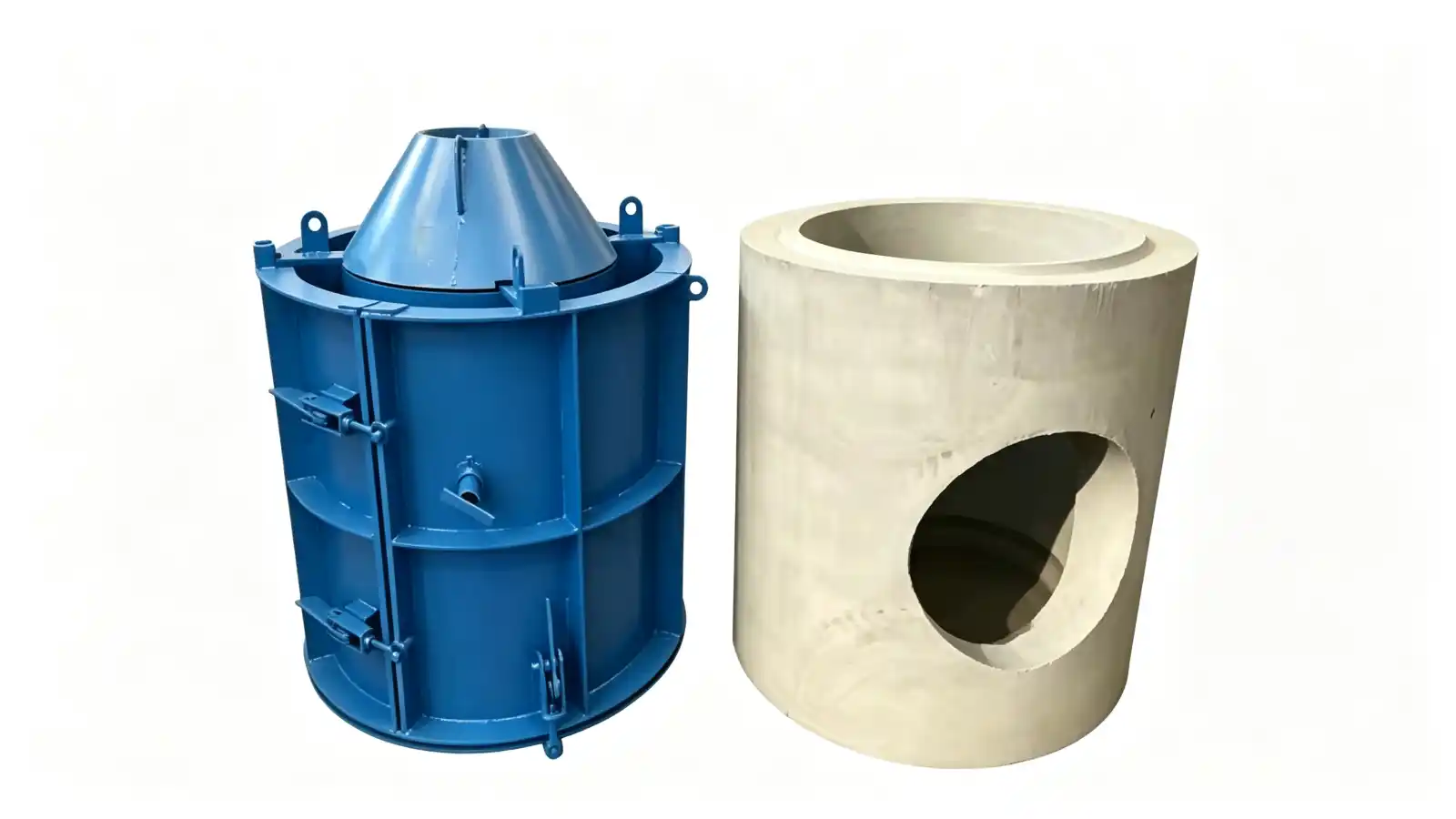
What a manhole and inspection chamber is and where the mould fits
A precast manhole or inspection chamber provides vertical access to sewer, drainage and utility networks. It may use circular or rectangular base units, risers, conical tops, flat slab tops and grade rings. The project design sets the internal diameter or plan size, wall thickness, height, steps, benching, channel and joint profile. The mould must form that geometry and release the unit without damaging the concrete or visible faces.
Manhole and inspection chamber tooling belongs in the precast concrete mould range. Within that range, the municipal and infrastructure mould category groups tools for drainage and utility components. The published manhole and inspection chamber mould family is the exact product reference for this enquiry. It is still a starting point: the RFQ must define the geometry, production cycle and handling arrangement for the buyer's chamber system.
Geometry, steps and joint inputs the mould must follow
The mould has to follow the approved chamber drawing, not a generic circular form. The buyer should send the controlled drawing, size schedule, wall and base thickness, riser and cone geometry, benching and channel profile, reinforcement arrangement, embedded items, casting orientation, lifting points and dimensional tolerance basis. For US projects, the active ASTM committee listing identifies ASTM C478/C478M-22 as the specification for circular precast reinforced concrete manhole sections. European projects may reference EN 1917 for concrete manholes and inspection chambers. The buyer must state the applicable edition and project additions; the mould supplier should then review how the proposed geometry and manufacturing method support those requirements.
Steps, also called rungs or ladder rungs, are a frequent source of mould complexity. Their position, angle, load class and cast-in anchors must be coordinated with the side-form reinforcement and the demoulding route. Joint details may be governed by standards such as ASTM C443-21 for rubber-gasket joints. Connections between manhole structures, pipes and laterals may instead bring ASTM C923/C923M into the project specification. The controlled drawing must show the selected gasket groove, connector seat and tolerances so the mould does not rely on a generic joint assumption.
The geometry review must check reinforcement access and the release path before fabrication. If bars have to be forced past the form face, or the cone strikes fresh concrete during release, the cycle slows and the unit may be marked.
Core and shell concept, demoulding clearance
Chamber moulds are typically built as a core and shell, where the outer shell forms the external profile and the inner core forms the internal wall and base. The core concept is selected from the geometry and the cycle. A fixed core suits simple chambers and low output. A collapsible or retractable core folds to release the internal wall without dragging on the concrete. A movable core can be extracted to a cleaning station, which suits higher output and deeper chambers.
Demoulding clearance is the space required to withdraw the core without contact. It depends on internal diameter, wall taper, embedded items and lifting inserts. Too little clearance lets the core drag on the concrete. The supplier therefore needs the chamber dimensions and wall taper before selecting the withdrawal concept.
The casting method also sets the concrete placement sequence, the vibration access and the surface acceptance criteria. The RFQ should state the approved placement method, the vibration method, the access envelope and the visible face requirements. Where joint marks are permitted in defined areas, those areas should be marked on the drawing rather than left to the mould supplier to decide.
Mould quantity, cycle and trial assembly
Mould quantity follows the target output and the time each mould remains occupied. Map preparation, reinforcement and insert setting, closure, concrete placement, curing, opening, lifting, cleaning and inspection. Some work happens outside the mould, but other work keeps the tool unavailable. A cycle that ignores cleaning and inspection will understate the mould count.
For a project with more than one chamber size, list the quantities and the casting sequence for each type. The quotation should state the assumed cycle and show which buyer inputs support it. Concrete strength development and demoulding approval remain with the project's authorised concrete and quality personnel. The mould supplier can design around a stated release condition but should not invent one to make the equipment count look smaller.
Trial assembly checks the workshop-built mould against the geometry, joint forms and reinforcement layout before shipment. The records should include dimensions against the approved drawing and a fit check between the core and shell. If the buyer omits this stage, fit problems may first appear at the production site.
What to send with the RFQ and how to compare proposals
A useful manhole and inspection chamber mould enquiry package includes:
- authorised 2D and 3D drawings, with revision and status;
- chamber configuration, size schedule, benching and channel details, gasket or sealant standard;
- reinforcement arrangement, embedded items, step or ladder specification and lifting inserts;
- casting orientation, concrete placement method, vibration method and curing method;
- authorised release condition and the standards the section has to satisfy;
- target accepted output, working calendar and the planned mould quantity basis;
- approved lifting points, unit mass, crane data and the route to storage;
- dimensional and surface acceptance requirements;
- preferred mechanical or hydraulic operation where already decided;
- required workshop assembly, inspection, documents and delivery scope.
Ask each bidder to list assumptions and deviations. The proposal should separate mould supply from foundations, cranes, concrete equipment, curing, installation and production support. It should also say whether trial assembly, functional checks, spare seals, special tools and site supervision are included. Similar mould prices can hide different delivery boundaries.
Realjet reviews project-specific manhole and inspection chamber moulds from the approved chamber geometry and production plan. Send the chamber arrangement, size schedule, required output, drawing status and handling concept through the precast concrete mould enquiry route so the response can address the selected mould family and the requested project boundary.