
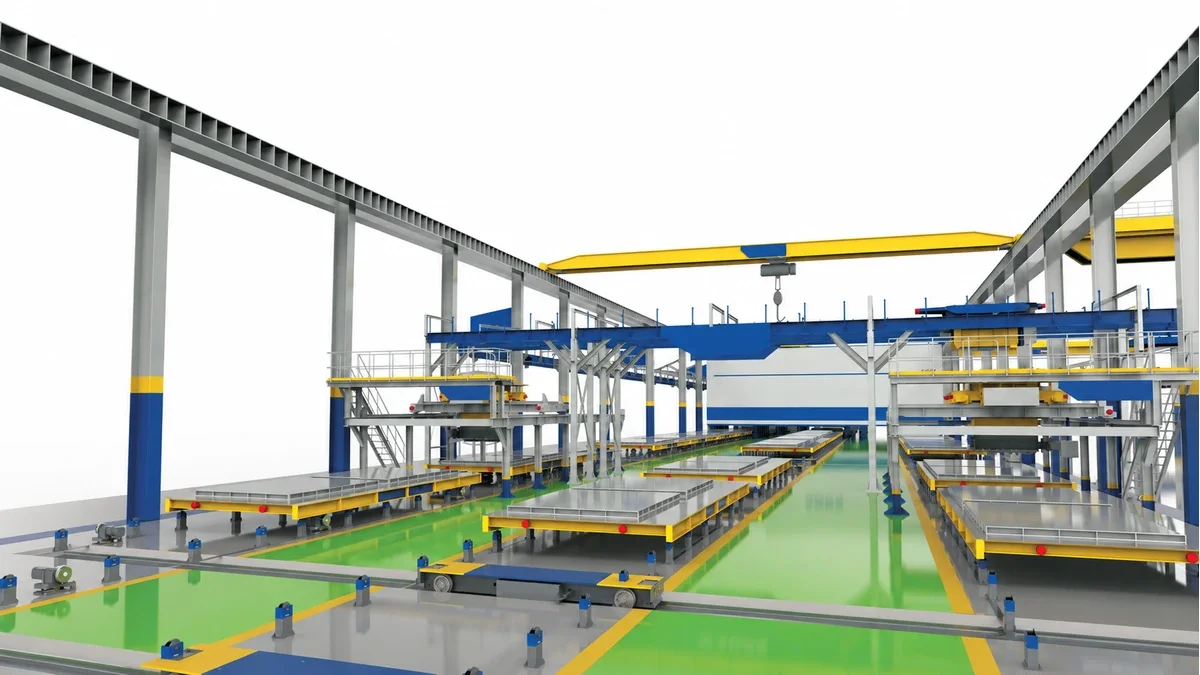
The second line is an interface project
A plant that has run one production line for five years knows how to make its products. That knowledge is the strongest asset in an expansion and the main reason expansions disappoint. The new line is not a copy of the first one placed next to it. It is a set of new interfaces with a plant that is already running, and the interfaces are where the money and the months go.
Three questions separate a straightforward expansion from an expensive one. What limits output today? Which of those limits does a second line relieve, and which does it tighten? What has to stop, even briefly, for the new line to be connected?
Buyers who answer those before requesting equipment quotations usually need less equipment than they expected, and they buy it in a different order.
Find the constraint before you buy anything
Daily output from a precast line is set by the slowest recurring step, and in most plants that step is mould occupancy rather than concrete supply. A mould is unavailable from preparation through casting, curing and stripping. The arithmetic is simple:
Mould positions required = accepted units per day × mould occupancy in hours ÷ productive hours per day.
Run it per product family rather than as a plant average, because a long bed element and a small unit in a reusable steel mould behave nothing alike in the same average. If the answer is eight positions and the plant has six, the second line does not need a bigger mixer. It needs more positions or a shorter occupancy time.
The same audit should cover stripping and lifting, finishing and patching, and dispatch. A line that can cast more than the yard can store has not added capacity, it has added work in progress.
Batch plant and concrete supply
The existing batch plant is the first shared resource, and it is often the one assumed to have spare capacity because it looks oversized. Two checks decide whether that assumption holds. Hourly demand during a pour window, not the daily total, and the batching accuracy and discharge arrangement for each mix the new line will use.
Pour windows are short and demanding. A line casting a large element may need the whole batch delivered within a period measured in tens of minutes, then nothing for an hour while reinforcement and inserts are placed. ACI 304R, the guide to measuring, mixing, transporting and placing concrete, treats batching, transport and placement as one chain for exactly this reason: capacity that cannot be delivered at the moment of placing is not capacity.
If the second line sits in a separate bay, add transport to the calculation. A crane-served bucket, a pump or a shuttle has its own cycle time, and that cycle interacts with the first line's pours. Two lines drawing on one mixer at the same hour is the most common cause of a slow first month.
Crane coverage decides whether two lines are really two lines
Lifting is where expansions are most often under-planned, because the crane that serves the existing line already looks busy rather than saturated.
The constraint is hook coverage and time, not total tonnage. If one overhead crane spans both lines, the two lines share a queue, and the queue is governed by the slowest lift, usually a stripped element moving to storage. Extending a runway is civil work with a structural consequence for the building; adding a second crane on a shared runway is a duty class decision, because the crane duty rises with the number of starts per hour, not with the tonnage lifted.
Write down the lifting tasks the new line creates, with weights, heights and hook positions: mould handling, cage placement, casting, stripping, turning if the product needs it, and transfer to curing or storage. Then check each one against the existing crane's coverage envelope. Where a task falls outside it, the choice is a different handling concept for that task, such as a transfer cart or a dedicated station crane, not a bigger crane on the same runway.
Curing capacity and the storage yard
Curing is a capacity in its own right, and it is easy to buy casting capacity that curing cannot absorb. Heated curing chambers, insulated covers and accelerated mixes shorten mould occupancy, but the chamber has to have space, and the steam or hot water supply has to have headroom.
Outdoor or covered storage is the second half. A saturated yard holds elements that should have been dispatched, which keeps moulds occupied, which makes the plant look short of casting capacity. The symptom points at the mould fleet and the cause sits in dispatch or stacking.
When planning the second line, size storage from the dispatch pattern rather than from daily output. A plant producing for stock needs weeks of yard; a plant producing to a delivery programme may need days. The difference changes both the land take and the crane span.
Utilities, building and civil constraints
The services that a second line needs are unglamorous and hard to add later: power for machines, heating and mixers, steam for curing, compressed air for tools and clamps, water for curing and cleaning, and drainage for wash water.
Check the transformer and switchgear capacity first, then the steam main size, then compressed air. Each has a diversity assumption built in when the plant was built, and a second line changes the peak rather than the average.
On the building, the constraints are the column grid, the clear height under the crane, the floor slab loading, and the foundation arrangement for rails, beds and machine bases. Long casting beds are sensitive to differential settlement, and a new line added on ground that was previously yard or hardstanding needs its own settlement assessment rather than an assumption that the old slab detail will do.
European projects will reference EN 13670 for execution and its tolerance provisions; the point for the buyer is that the new line's beds and rails must be set out to a stated tolerance, not to the foreman's eye.
Phasing without stopping the first line
Every expansion has tie-ins, and tie-ins are the part of the schedule that affects revenue. Common ones: extending a runway, cutting into a steam or air main, re-routing an access road, joining a new drainage run, and re-configuring the yard.
Two planning rules help. Separate the work that can be done while the plant runs from the work that needs a shutdown, and price the shutdown separately in the programme. Then decide what the plant will do during that shutdown before agreeing the date: a planned stock build is cheaper than an unplanned stoppage.
Commissioning is the other phasing trap. A new line can be commissioned while the old one runs if the two are physically separated by screening and if the concrete supply can be diverted for test pours. If they cannot be separated, plan a quieter production week rather than discovering the conflict on the day.
Staffing and the learning curve
A second line needs people, and the people who know how to run the first line are already busy. That is a resourcing decision, not a training detail.
The realistic plan covers the second shift or the additional crew, the supervision ratio during ramp-up, and the specialists the new equipment needs: hydraulics, controls, curing and prestressing. A line that is technically complete but staffed by operators learning on the night shift will not deliver its rated output in the first quarter, and the business case should say so.
Scope split between the package and the plant
| Item | Usually in the equipment package | Usually retained by the plant |
|---|---|---|
| Line equipment and controls | Yes, with installation and commissioning where agreed | Operating consumables and spares |
| Moulds | Per order, counted against the output target | Mould maintenance and wear parts |
| Foundations and rails | Design interface and setting-out data | Civil works, excavation, concrete |
| Utilities to the line | Connection requirements and terminal points | Supply capacity, transformers, mains |
| Curing system | Equipment and control where specified | Steam or hot water generation |
| Handling equipment | Cranes or carts where in scope | Runway structure and building strengthening |
| Operator training | Classroom and on-machine where agreed | Release of staff for training |
| Trial production | Support during first casts | Mix design approval and dispatch |
The table is a starting point for negotiation, not a default. What matters is that each line is marked as included or excluded before the price is compared, because two quotations that look 15 percent apart are often identical once the boundary is aligned.
Expand, debottleneck or add a shift
| Option | When it fits | Main cost | Main risk |
|---|---|---|---|
| Debottleneck the existing line | One step limits output and the rest has slack | Targeted equipment and layout changes | Disruption with modest capacity gain |
| Add a shift | Demand is there but capital is not | Labour and maintenance | Quality drift and supervision load |
| Add a second line | The constraint is mould positions or curing across families | Equipment, civil works, people | Interface and commissioning overrun |
| Relocate to a new plant | Site, utilities or yard are the real limit | Land and full build | Programme length |
A second line is the right answer when the constraint repeats across product families and cannot be removed by adding moulds or curing capacity. It is the wrong answer when one machine, one crane or one yard is the true limit, because the new line will queue behind the same bottleneck.
Where to take the question
Realjet supplies production lines for precast concrete components, covering the engineering, equipment and project scope agreed for each plant, and does not sell the components themselves. The precast beam factory overview describes the line types and the project inputs a supplier needs. Two related guides go deeper on the numbers behind this decision: layout planning for a precast production line and cycle time and daily output. A plant layout, the product mix and the output target are enough to start a useful conversation about what a second line would have to connect to.