
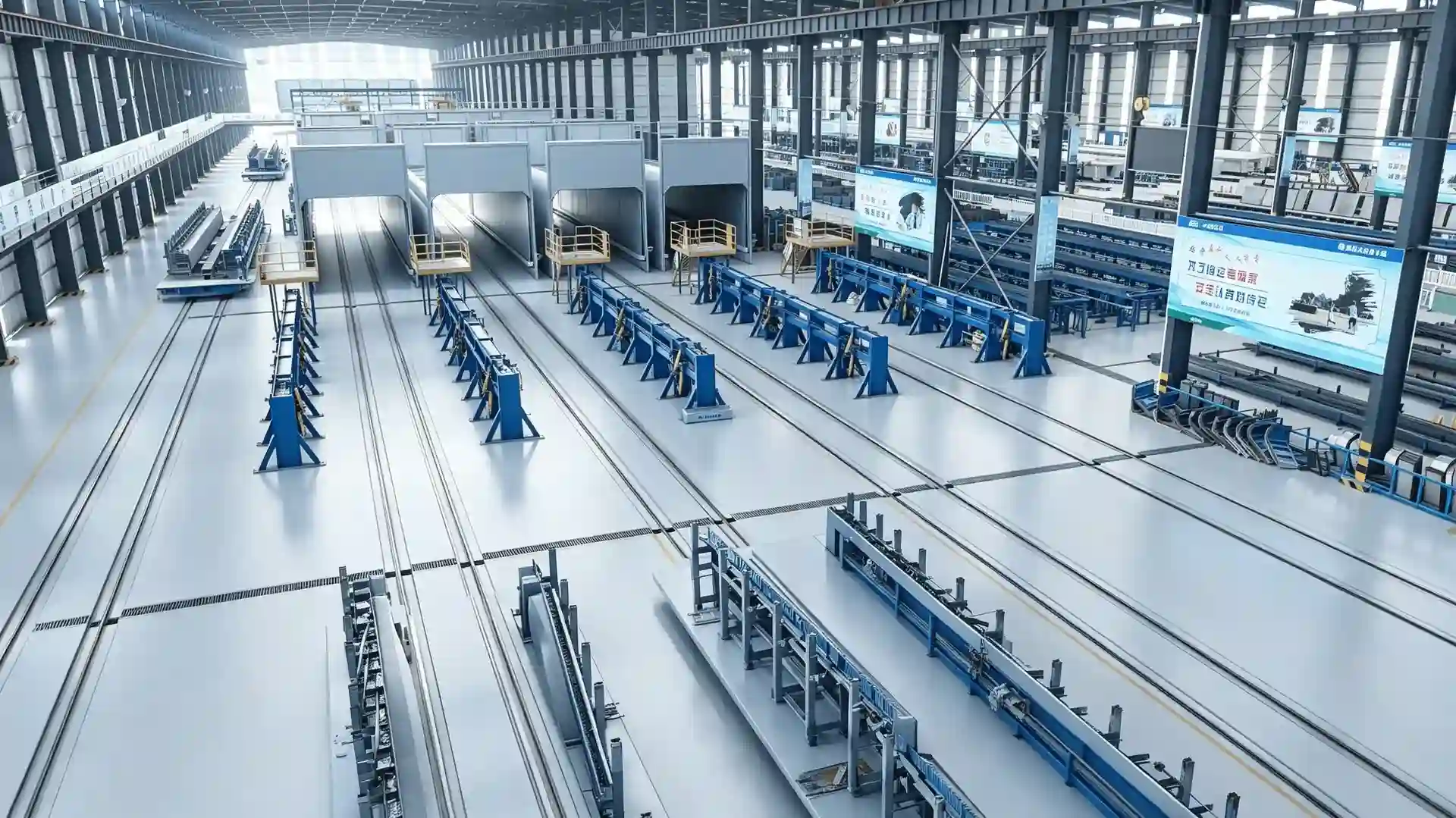
What daily output actually measures
Daily output is the number of beams a production line completes in one working day. It is not the same as installed capacity, which is a nameplate figure, and it is not the same as takt time, which is the rate a line must hold to meet a schedule. Buyers comparing suppliers should ask for daily output under a stated shift pattern, because that number drives how many beds and moulds the project needs.
Realjet supplies precast beam production lines that engineer, build and commission the equipment to make the components you specify. Realjet does not sell the beams themselves. This article helps a procurement or planning team estimate daily output before requesting a quote, so the RFQ states a target the supplier can engineer to.
The cycle that limits a casting bed
A fixed casting bed runs in a repeating cycle: place reinforcement and embedded items, cast concrete, cure to stripping strength, demould and strip the beam, then clean and reset the bed. The slowest step sets the bed cycle time. For most precast beam lines, curing dominates. Concrete must reach the strength at which a beam can be lifted and demoulded without damage, and that depends on the mix, temperature, prestressing sequence and curing method.
PCI MNL-116, the PCI manual for precast concrete structures, and EN 13369, the common European rules for precast concrete products, describe production and product requirements but do not fix a curing time, because that is set by the mix and site climate. Treat any single-day cure figure as project specific. The supplier should state the achievable cycle for your mix and climate, not a generic number.
From bed length to beams per cycle
A bed holds as many beams as its length allows. A 100 metre bed casting 30 metre spans fits three beams per cast if the formwork is set that way; a 25 metre bed fits four. The number per cycle is a layout decision, not a property of the beam. Longer beds and moveable formwork raise pieces per cycle but need more floor space and more handling equipment.
When you write the RFQ, give the beam length, the typical span range and the bed length you have or plan to build. The supplier returns how many beams each cast produces and how the bed is divided. This input drives both output and the mould count discussed below.
Shifts and bed turns
Output per day equals beams per cycle multiplied by the number of cycles the beds complete in the working window. If one bed needs a full cure day, a single-shift operation gets roughly one cycle per bed per day. Adding a second shift does not speed curing, but it lets crews place reinforcement, strip and reset while another bed cures, raising effective turns.
A line with several beds staggered in their cycle behaves differently from one long bed. More beds mean more parallel curing and higher daily output, at the cost of floor area, formwork and labour. The trade is why floor space and output are planned together, not separately.
A worked example
The following numbers are illustrative and meant to show the math, not to state a Realjet performance figure. Suppose a bed holds three beams per cast and needs one full day to cure and reset. With a single bed on one shift, daily output is about three beams. With four staggered beds and crew working the placing, stripping and resetting while beds cure, the line can reach roughly eight to twelve beams per day, limited by the slowest bed and the handling crew.
Change any input and the answer moves. Faster curing (accelerated steam, warmer climate, a mix designed for early strength) shortens the cycle. Longer beams lower pieces per cast. More shifts add turns only if beds and crews are available. The estimate is a planning tool, and the supplier confirms the real number against your mix, climate and layout.
What changes the number
Prestressing adds stressing and release steps that extend the cycle for pretensioned beams. Segmental match casting, where segments are cast against a reference segment to guarantee fit, ties one cast to the next and changes how beds are sequenced. Fixed long-line beds and circulation lines (where forms move between stations) organise the same steps differently, so the same daily target can come from a different equipment layout. Fixed versus circulation trade-offs are covered separately on the production line pages.
What to confirm with the supplier
Ask the supplier for daily output at your beam length, mix and shift pattern, plus the bed count, mould count and floor space that output requires. Realjet scopes the line to the target you state and confirms the cycle against your concrete and climate during project engineering. Keep the responsibility split clear: you provide the beam geometry, volumes and schedule; the supplier engineers the equipment, curing and handling to meet it.
State the target as a number, not a hope. A line quoted to eight beams per day and run at twelve will miss its curing window, and a line quoted to twelve that you only need at eight costs more than the project returns. The RFQ settles that gap before steel is ordered.