
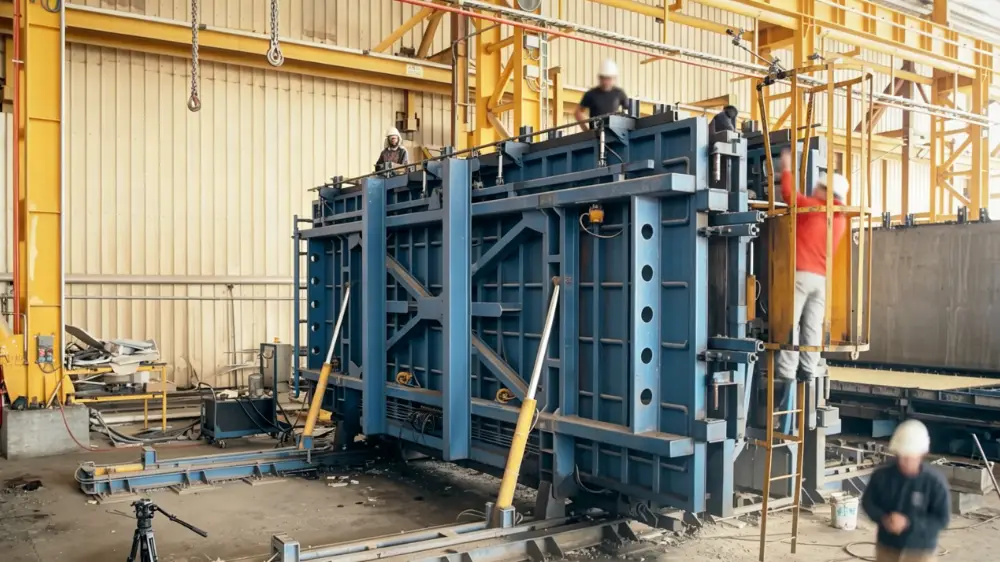
When a vertical battery mould is the right choice
A battery mould casts wall panels standing up. Instead of laying each panel flat on a table, the panels are formed between vertical steel leaves that are clamped together as a pack, with each gap between two leaves acting as one casting cell. Concrete is placed into the cells from the top, the cells are heated while the concrete gains strength, and the finished panel is lifted out standing, the way it will be installed.
The case for vertical casting is space and surface. A battery occupies a small footprint for the number of panels it holds, because the panels share the same floor area many times over. Both faces of the panel are formed against steel, so both can be specified as fair faced, and the panel never has to be tilted after stripping, which removes a handling step and a source of edge damage.
The case against it is that a battery mould is a machine. It has moving leaves, clamping forces, hydraulic or mechanical actuation, heating circuits and integrated vibration, and it constrains the panel range far more tightly than a flat table does. Panels taller than the cell cannot be produced in it, and a panel whose recesses cannot be withdrawn vertically does not belong in a battery at all.
Wall panel moulds sit inside the wider precast concrete mould range under the building component mould category. Realjet's wall panel mould systems cover both horizontal casting and vertical casting arrangements, with single or multiple casting cells and hydraulic opening and closing where the project requires it. The mould is a project-specific design; the product page is a starting point for the discussion, not a catalogue specification.
How the cells work and what the buyer must fix
A battery is a set of vertical forming leaves arranged on a common base, closed at one end against a fixed frame and pressed together at the other end by clamps or hydraulic rams. The gap between two adjacent leaves is a cell, and the panel is cast in that gap. Cell width is set by spacers or by the leaf arrangement, and cell height by the leaf height and the position of the base.
Three numbers lock the whole design, and all three belong to the buyer:
- the panel family, with a clear statement of whether one cell produces one panel or several smaller panels stacked side by side;
- the panel thickness range, because the adjustment system, the spacer set and the clamping force all follow from it;
- the panel height range, because it sets the leaf height, the closing force and the reach of the crane that lifts panels out.
If the panel family has several thicknesses or heights, the RFQ should say so and should state how often the changeover happens, because the answer decides whether adjustable soffits and movable or magnetic shutters are worth including.
Panel thickness, height and the adjustable soffit
Most battery designs allow the panel length and width to be adjusted by moving shutters or adding edge stops, and the panel height to be adjusted by raising or lowering the base. This is what makes a battery reusable across a building programme rather than dedicated to one panel type.
The adjustment range deserves the closest reading. A stated thickness range does not tell the buyer whether the changeover takes an hour or a shift, whether the spacers cover the full range, or whether the clamping force is adequate at the top of the range. Ask for the changeover method and the tooling included at each end of the range, and check that the panel family the project actually needs sits comfortably inside the range rather than at its limit.
For sandwich panels, the battery has to accommodate the insulation layer and the connectors between the two concrete leaves. That changes the casting sequence inside the cell and the shutter positions, and it is a different requirement from a solid wall panel. Buyers working on insulated panels should read the sandwich wall panel specification guidance before fixing the panel build-up, because the two decisions affect each other.
Clamping, opening and the hydraulic system
Clamping exists to stop the pack moving while concrete is placed. If the leaves move, the panel thickness varies, the joints open and grout leaks, and the finished element arrives out of tolerance. Battery systems use mechanical clamping, hydraulic clamping, or a combination, and the choice has consequences for the factory.
Mechanical clamping is simpler and needs no power unit, but the closing force depends on the operator and closing takes longer. Hydraulic clamping gives a repeatable force and faster cycles, at the cost of a power unit, cylinders, hoses, seals and a maintenance routine, plus the control system and any interlocks. Where the battery is opened several times a day, the time saved usually decides the question.
Either way, the buyer should ask for the clamping force basis, the cylinder stroke and the opening sequence, and should confirm that the moving leaves are guided rather than free to swing. A battery pack is a heavy moving mass, and the way it opens is a safety issue as well as a productivity one.
Heating, vibration and the stripping time
Two features separate a battery from a vertical wall form: heating and vibration, both built into the mould structure.
Heating runs inside the leaves so that heat reaches the panel from both faces at once. Water, steam and thermal oil are the usual heating media, and the choice is normally made on what the factory already has available. The heating capacity, the temperature range and the control scheme determine how quickly the concrete reaches release strength, and therefore how many casts per day the battery can support.
Vibration is normally built into the leaf structure so that the concrete is compacted while it is inside a narrow cell where an internal vibrator cannot reach. The buyer should state the concrete mix, the slump or flow, and the placing method, because a battery depends on concrete that can be placed into a narrow vertical gap without segregation.
The release criterion is not the supplier's decision. The strength at which panels may be stripped stays with the project's concrete and quality functions, and the mould supplier designs around a stated release condition. If that condition is not stated, the supplier will assume one, and the assumption is what the cycle time claim rests on. Curing control hardware is normally part of the wider curing system scope rather than the mould itself, so the interface between the two should be written down.
Service platform, guards and machine safety
A battery is tall, and the operators have to reach the top of the cells to place concrete, check inserts and release the clamps. That work happens on a service platform, and the platform and its guard-rails are part of the equipment.
The access is covered by the same family of standards that applies to machine access generally. ISO 14122-2 deals with working platforms and walkways, setting minimum loads and a deflection limit, while ISO 14122-3 covers stairs, stepladders and guard-rails. For a European project there is also a regulatory deadline worth noting: Regulation (EU) 2023/1230 replaces the Machinery Directive 2006/42/EC and applies from 20 January 2027, with machine conformity, guarding and instructions for use following the new rules.
Buyers should make the platform, the guarding, the access route and the control position explicit items in the scope, and should ask who is responsible for the conformity documentation. On a tall battery, the access arrangement is not an accessory.
Foundations, crane and factory interfaces
Three factory interfaces decide whether the battery works as intended.
The foundation carries the pack weight plus the concrete. A loaded battery is a heavy, tall, uniformly loaded block, and the base is designed to stay flat, so the floor has to be flat and strong enough to the supplier's stated bearing requirement. Settlement or a slope shows up as thickness variation in the panels.
The crane has to lift panels out of narrow vertical cells. Clearance above the battery, the position of the lifting inserts, the spreader or clamp used to grip the panel face, and the route from the battery to the curing or storage area all have to be checked against the panel weight. A panel that can be produced but not extracted safely is a line that stops.
Finally, the changeover area matters. Spacers, shutters, magnetic plates and cleaning equipment need somewhere to live near the battery, and panels stored flat after extraction need racking. Buyers often size the battery correctly and then run out of room for everything around it.
What to send with the battery mould RFQ
A battery enquiry that can be answered without assumptions contains:
- panel drawings and a schedule of the full panel family, with thickness and height ranges;
- the target output, expressed as panels per day or square metres per day, and the working pattern;
- the concrete mix, placement method and the release strength condition;
- the reinforcement and embedded item drawings, including openings and cast-in items that the leaves must form around;
- the insulation and connector details for sandwich panels;
- the available bay dimensions, floor bearing capacity, clear height and crane data;
- the services available for heating and vibration;
- the access and guarding requirement, and the standard to be applied;
- the finish requirement for each panel face, with the tolerance basis;
- the boundary of supply, including foundations, services, installation and commissioning support.
Compare offers on cells and cycles, not on price alone
Two battery quotations that look similar on price can offer very different production. Compare the number of cells and the panels per cell, the panel size and thickness range at each end of the adjustment, the clamping force basis and the opening method, the heating medium and heat-up capability, the vibration arrangement, and the platform and guarding scope. Then run the arithmetic with the buyer's own numbers: cells multiplied by panels per cell multiplied by casts per day gives the theoretical output, and that figure should be checked against what the site actually needs before the price is judged.
Realjet develops vertical and horizontal wall panel mould systems around the panel family, the factory conditions and the required output. Send the panel schedule, the target cycle and the plant data through the mould enquiry route so the battery configuration can be reviewed against the project.