
What a deck panel line produces, and why buyers ask
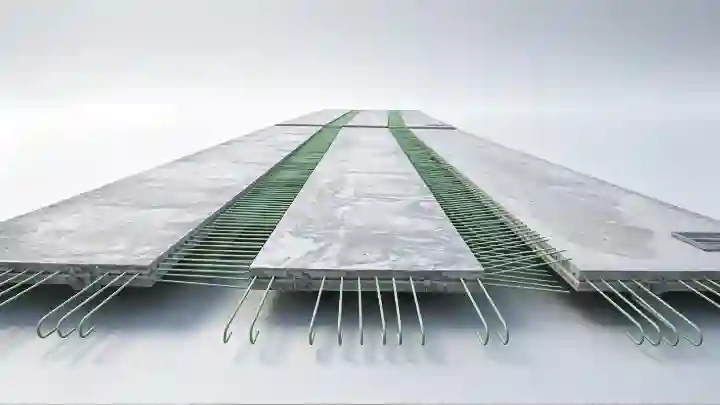
A precast bridge deck panel is a slab element cast in a factory to the full or partial thickness of the finished bridge deck, then transported and placed on the supporting girders. It is the deck itself, moved off the bridge site and into a controlled plant. For an owner or contractor, the attraction is that the deck, which is normally the slowest and most weather-exposed part of a bridge programme, is manufactured in parallel with the substructure and then installed in a short closure window.
A production line for these panels is therefore planned around a different question than a girder line. A girder line is judged on how many girders it can deliver to a casting yard schedule. A deck panel line is judged on how many panels can be cast, cured, stripped, stacked and matched to the erection sequence, because the panels have to arrive at the bridge in the order the crane needs them. This guide covers what the line has to include, which decisions belong to the buyer, and what to put in an enquiry. Realjet supplies project-specific production lines and equipment for precast concrete components through the precast production line service; the panels themselves are supplied by the precast producer.
Full-depth and partial-depth panels are not the same product
The first decision is the panel type, because it changes almost every piece of equipment downstream.
Full-depth panels are cast to the complete deck thickness and require no cast-in-place topping. They carry the riding surface directly, so the top face is a finished surface and the panel weight is at its highest. Partial-depth panels act as permanent formwork and leave a topping slab to be placed on site; they are lighter and easier to handle, but the line still has to form the interface that the topping will bond to.
Full-depth panels may be conventionally reinforced, or prestressed with pretensioned or post-tensioned reinforcement. This matters to the equipment package. A pretensioned panel needs a stressing bed, strand handling and a release sequence; a passively reinforced panel needs a casting table and no stressing hardware at all. The prestressing scope is one of the items that most often changes a quotation late, so it should be settled before the line layout is fixed.
Casting forms, beds and how the joint geometry is held
Deck panel forms are usually steel, and their stiffness is what protects the panel thickness and the edge geometry. Full-depth panels are heavy and are cast in panel-specific forms rather than on a long prestressing bed used for beams, although a stressed bed is used when the panels are pretensioned. The form has to hold three things accurately at the same time: the panel outline, the transverse joint face and the block-outs and pockets described below.
The joint face is where a deck panel line differs most from other slab production. Many projects require adjacent panels to be match-cast, so that the joint geometry of one panel is cast against its neighbour and the pair closes with a controlled gap on site. Match casting adds a sequencing constraint to the line: panel forms are used in an order that keeps neighbours together, and the production plan has to reserve form capacity for it. Where match casting is not required, panels are cast in a repeating form and the joint is completed with a wider field-cast detail.
Whichever route is chosen, the buyer should treat the joint as a designed element with its own dimensions and tolerances, not as an edge that the form happens to produce.
Shear pockets, block-outs and levelling devices
Three cast-in features decide whether a deck panel line can meet the bridge programme.
Shear pockets are the openings cast into the panel so that shear studs welded to the girder can later be embedded in grout, completing composite action between deck and girder. The pocket size, position and edge condition come from the connection design, and the form must produce them repeatably.
Levelling provisions allow the panels to be set to grade before the connection is grouted. A common industry detail is a threaded socket cast into the corners of each panel, with a bolt used to adjust elevation against the girder flange; levelling shims are the alternative. Either way the sockets, or the faces the shims bear on, have to be positioned and formed in the panel.
Lifting and handling inserts are the third. Full-depth panels are heavy, and panel weight drives the crane, the yard layout and sometimes the choice of lightweight concrete or corrosion-resistant reinforcement to reduce lifting loads. A line that produces panels the site crane cannot lift safely is a line that will not be used as designed.
Why the transverse joint decides deck quality
Deck joint performance is the recurring problem in this product family. The Federal Highway Administration's manual on connection details for prefabricated bridge elements and systems describes the main transverse connection types: grouted shear keys in female-female or male-female form, match-cast joints, post-tensioned joints, bolted and welded connections, and passively reinforced joints with a closure pour. Joint cracking, water leakage and consequent deterioration are identified as the most problematic aspect of panel systems, and post-tensioned joints are described as the best performing option and also the most complex to execute.
Field-cast ultra-high performance concrete has become a common way to complete both transverse and longitudinal joints, and FHWA has published a design guide for precast UHPC deck panel systems that covers formwork, casting, shear pocket voids and curing for that route.
For the buyer, the practical consequence is that the joint detail should be frozen before the line is specified. A joint that depends on match casting, on post-tensioning ducts or on a wet joint width with a specific surface profile places different demands on forms, sequencing and quality control than a simple grouted key.
Capacity, space and the erection sequence
Deck panel line output is not a single number. It is the number of usable panels released per day, and it is set by the number of casting positions, the number of panels per position, the curing and stripping time, and the hours available per shift. Line output also has to survive the reality that panels must be stored after stripping, and that storage is a stack of heavy flat elements occupying yard area.
Two constraints catch buyers out. The first is panel size against factory bay: a panel that is wider than the crane span or longer than the handling equipment can move will force either a change to the panel split or a change to the plant. The second is the erection sequence. Panels are rarely installed in cast order, so the storage plan and the marking system have to link each panel to its bridge location. The relationship between line output and site demand is the same arithmetic that governs how many moulds a beam line needs, and it deserves the same worked calculation rather than a rule of thumb.
What to send with a production line enquiry
A buyer who wants a comparable answer rather than a generic proposal should send:
- the panel schedule, with panel type, thickness, plan dimensions, weight and quantity;
- the approved section drawings and the joint details, including match casting requirements;
- the reinforcement scheme and whether the panels are pretensioned, post-tensioned or passively reinforced;
- the connection design: shear pocket size and position, levelling provisions and lifting inserts;
- the surface requirements for the riding face and the soffit;
- the target output and the site erection sequence, with the required delivery dates;
- the plant or yard available, including bay dimensions, crane capacity, storage area and the transport limit for each panel;
- the curing method and the concrete release condition;
- the tolerances and the standard the finished panel must satisfy;
- the boundaries of supply, from forms and handling equipment to installation support.
The equipment package scope should be divided explicitly between what the supplier manufactures, what the buyer supplies locally, and what is decided later. Storage and handling are also widely underestimated, and the planning logic in the finished beam storage and handling guide transfers directly to flat panels.
Where the line design starts
A deck panel line works when the panel type, the joint detail and the site sequence are decided before the equipment is sized. Once those three are fixed, the casting positions, curing capacity, handling equipment and storage area follow from a calculation that both parties can check.
Realjet develops production lines and equipment for precast concrete components around the buyer's component schedule, plant conditions and delivery programme. Share the panel schedule, the joint details and the erection plan through the production line enquiry route so the line concept can be reviewed against the actual project.