
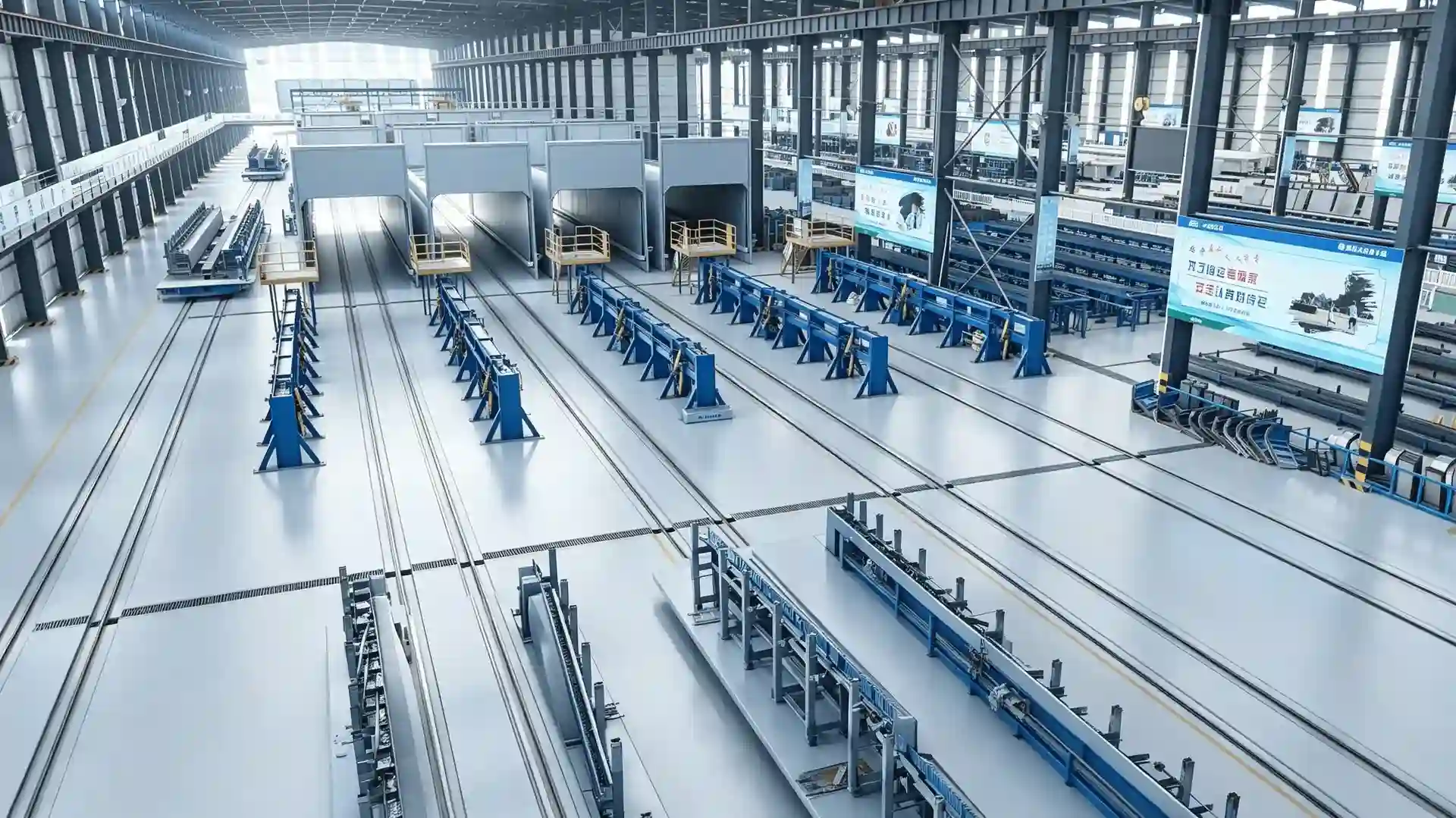
Mould quantity is a capacity decision
Buyers often ask a supplier how many moulds a precast beam factory needs. A number based only on daily output is not enough. One mould may remain occupied during preparation, reinforcement, concrete placement, curing, prestress release and demoulding. Product changes, inspection holds and shared handling equipment can extend that time.
The purchasing question is therefore: how many mould positions are needed to release the required number of accepted beams on the planned working calendar? That question should be answered before the buyer fixes the precast beam production line configuration, building footprint and equipment budget.
Treat the calculation as a planning model, not a supplier guarantee. The final quantity depends on approved product drawings, concrete and prestressing requirements, operating methods, site conditions and the buyer's production risk allowance.
Convert the delivery programme into casting starts
Start with accepted beams required by dispatch date. Divide the programme into representative periods rather than using one project average. A bridge project may need a steady baseline, a peak period and a tail period with lower volume but more product variation.
For each period, record:
- beam family and drawing reference;
- quantity required for dispatch;
- planned production days and shifts;
- expected rejection, repair and hold policy;
- storage and erection constraints; and
- whether moulds are dedicated or shared between beam types.
Convert the accepted-output target into required casting starts using the buyer's approved planning allowance. Do not hide that allowance inside the supplier's advertised capacity. If the buyer has no reliable basis for rejects or holds, show the assumption separately and test more than one case.
Calculate occupied time for each mould family
Mould occupied time begins when the mould is unavailable for another casting and ends when it can start the next preparation cycle. It may include cleaning, setup, reinforcement loading, embedded items, prestressing work, concrete placement, curing, release approval, demoulding and any inspection that blocks reuse.
A simple first-pass relationship is:
mould positions = required casting starts per production day × occupied time in production days
Round up to a whole position, then test the result against shifts, product mix, shared equipment and recovery needs. For example, an occupied time of more than one working day means a single mould cannot support one casting start every day. The equation does not prove capacity on its own. It makes the assumptions visible for supplier comparison.
Use separate occupied times for different products. A short non-prestressed beam and a long prestressed girder should not share one generic cycle. If adjustable moulds cover several lengths, include the changeover time and identify which parts remain common.
Do not assume the earliest release time
Curing and release decisions often control when a mould becomes available. The current ACI PRC-308-26 curing guide covers curing procedures, monitoring and accelerated curing, but the project specification must still define the method and acceptance basis used for the beams.
For prestressed girders, the buyer's engineer and quality plan must define the concrete strength and authority required before prestress release. An FHWA precast prestress plant review checklist asks for the required release strength, curing method, temperature records and specimens used for release decisions. This is a useful reminder that mould availability depends on verified release conditions, not a fixed number of clock hours selected by the equipment supplier.
Build at least three curing cases into the purchase model: expected conditions, a slower credible release case and the project peak period. If the planned output works only at the earliest assumed release, the mould count has no visible margin.
Add shared-resource constraints
More moulds do not increase output when another resource controls the line. Check each proposed mould quantity against:
- reinforcement and embedded-item preparation;
- concrete supply and placement window;
- vibration equipment and operator access;
- prestressing equipment and safety zones;
- curing enclosures, heat supply and controls;
- cranes, transfer carts and lifting beams; and
- inspection, repair and finished-beam storage.
Plot the daily sequence for the peak case. If two moulds require the same crane, concrete distributor or stressing equipment at the same time, either change the schedule or add resource capacity. Ask suppliers to show the operating sequence behind their proposed quantity rather than listing mould sets as a standalone line item.
Choose a recovery strategy before adding spare moulds
A buyer can create recovery capacity in several ways. Extra mould positions are one option, but longer shifts, planned overtime, a second shared resource, faster product changeover or schedule resequencing may be more effective for a particular constraint.
Define the events the line should absorb. These might include delayed release-strength results, one mould held for dimensional review, an unavailable transfer cart or a product change that takes longer than planned. Then ask each bidder to show how output recovers and which cost is included.
Avoid adding a percentage contingency without explaining what it covers. One extra mould may provide useful resilience on a small line but little benefit where curing capacity or crane access is already saturated. Recovery should be tested in the same time-based model as normal production.
Request one capacity sheet from every bidder
The RFQ should require a mould and capacity schedule for each product family. It should state the number of mould sets, usable length range, occupied-time assumptions, changeover method, curing positions, shared resources, staffing and expected accepted output by shift or day.
Ask bidders to identify the bottleneck in the normal case and the peak case. Require exclusions to be visible, including buyer-supplied cranes, concrete systems, utilities, buildings and storage equipment. This prevents one supplier from quoting a complete operating concept while another prices only mould steel.
Realjet develops project-specific production-line solutions from the component range, output target, site and delivery boundary. Sending the beam schedule, required dispatch programme, shift calendar, curing basis and factory information allows the first proposal to explain its mould quantity rather than present an unsupported capacity figure.