
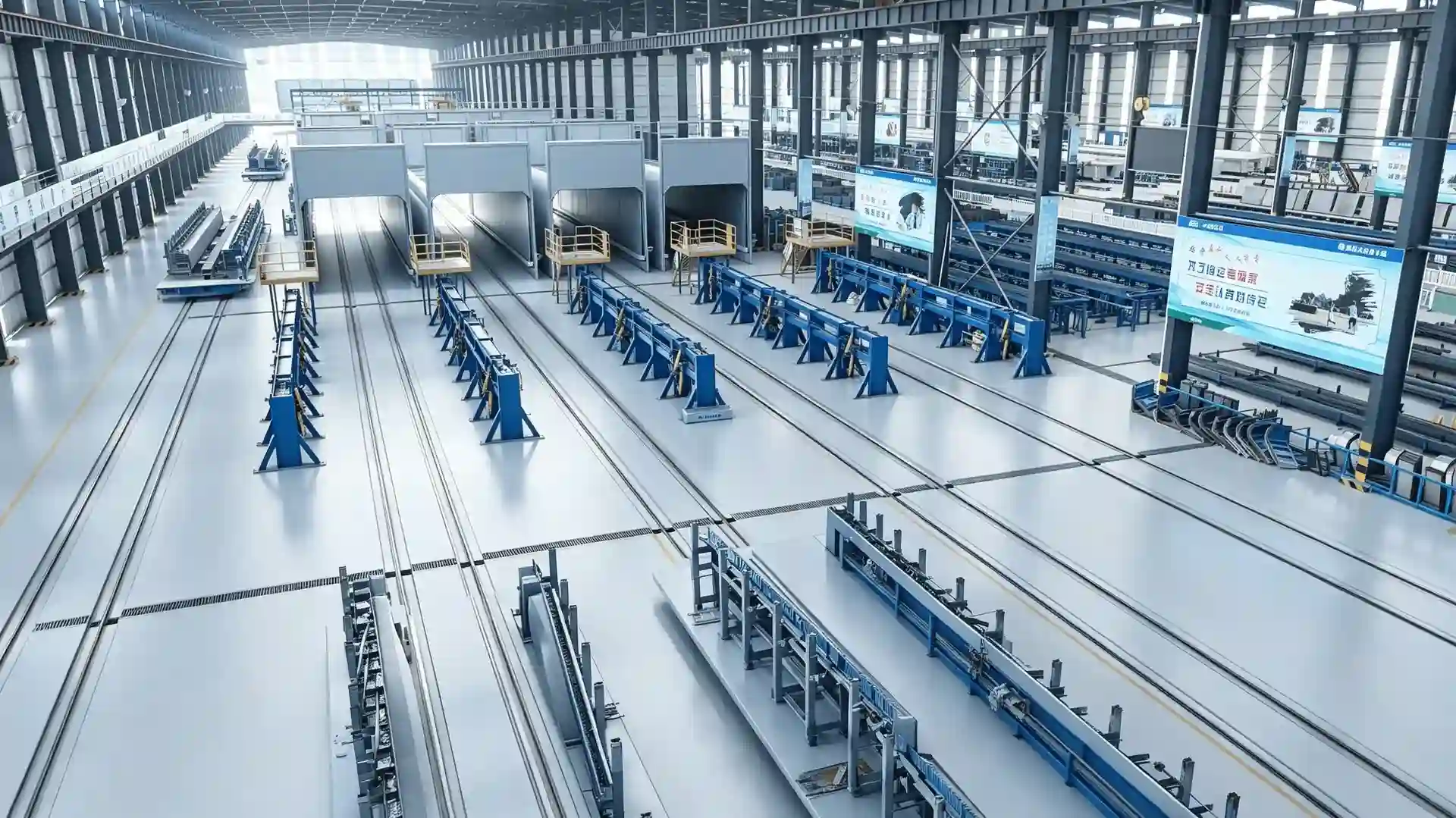
A precast beam production line is only as fast as the slowest link between the casting bed and the delivery truck. Casting may finish on schedule, but if finished components have nowhere to go, the beds stay occupied and the whole line stalls. Storage and handling are not an afterthought to the equipment package. They decide whether daily output actually leaves the factory.
This guide helps buyers plan stockyard capacity, stacking and handling for a production line that makes precast concrete beams and similar structural components. It covers the decisions that affect layout, equipment and interface scope before the line is ordered.
Why storage sits between casting and delivery
Freshly cast beams cannot always be delivered the same day. They need time to reach the concrete strength required for lifting, they wait for transport windows, and project sites often want deliveries matched to their own installation sequence rather than the factory's casting sequence. The stockyard absorbs that mismatch.
Without enough buffer space, one of two things happens. Either finished beams block the beds and the line slows, or they are moved before they are ready and risk damage. Both outcomes cost more than a properly planned yard.
What drives stockyard capacity
Stockyard size is not a fixed rule. It follows from a few project variables:
- Daily output. A line designed for two to four girders per day, using the common daily output range for beam lines, needs space for several days of production at any moment.
- Curing and move time. Components stay in the yard until they reach the specified transfer strength. In cold weather this window stretches, so the yard must hold more.
- Delivery cadence. If trucks arrive in batches matched to site progress, the yard holds a larger average inventory than if deliveries are steady.
- Component length and weight. Long span beams need long, clear bays and careful stacking, which uses more ground per unit than short elements.
A practical starting point is to size the yard for a defined number of days of output, then stress test it against the slowest delivery month. The floor space planning guide for beam lines covers the building footprint; the yard is the outdoor or covered extension of that footprint.
Stacking and support that protect the component
How a beam is supported in storage matters as much as where it sits. Poor support introduces bending, cracking at the ends, or long term camber that complicates later installation. General precast plant practice, reflected in PCI quality manuals such as MNL-116 and MNL-117, treats handling and storage as part of the product quality system rather than a separate logistics step.
Points buyers should specify:
- Bear on designed lift points or approved bearing zones, never on arbitrary faces.
- Use dunnage that is aligned across the stack so load passes straight through the component.
- Limit stack height to what the component and the ground can take, and separate different lengths so nothing overhangs into an aisle.
- Keep stored components clear of traffic and clear of areas where casting or stressing happens.
These are plant process controls. The exact values come from the component design, the concrete strength at move, and the site handling method, all of which belong in the project documents.
Handling equipment and lifting interfaces
Moving a finished beam from bed to yard to truck needs defined equipment and defined lifting points. The choice affects both the line scope and the yard layout:
- Gantry or overhead cranes suit fixed production buildings with aligned bays.
- Straddle carriers or specialised transporters suit open yards and long components.
- A rail mounted transfer cart, used on confirmed movable configurations, moves components between stations and toward storage without repeated crane lifts.
Lifting inserts, lifting sockets or cast in attachments must be designed for the loaded weight with a defined safety factor, and they must be shown on the component drawings. A mismatch between the lift point on the drawing and the equipment on site is a common cause of handling delays.
When a beam can be moved
The move timing is a concrete property question, not a scheduling preference. Components are moved only after they reach the transfer strength written in the project specification. That strength depends on the mix, the curing method and the temperature. Steam or controlled curing can shorten the window; ambient curing in cool weather lengthens it.
Buyers should confirm the expected curing method and the specified move strength during line planning, because both change how much yard space is needed and how fast the line can cycle. The civil foundation and utilities scope discussion ties into the same layout decisions.
Yard layout, ground and responsibility boundaries
The yard needs ground with enough bearing capacity for stacked loads and moving equipment, clear aisles for the handling method, and drainage so components are not sitting in water. These are site conditions that the buyer or project owner usually controls, while the equipment supplier provides the line and the handling machines sized to the agreed workflow.
The boundary is worth stating before order:
- The supplier scopes the production line, moulds, curing system and handling equipment per the agreed output and component range.
- The buyer or project owner usually provides the yard ground, foundations where required, utilities and the site handling plan.
- The handling procedure, lift points and storage rules are agreed jointly and recorded in the project documents.
Realjet supplies production lines for precast concrete components, including the equipment, moulds and handling systems sized to the project. Final yard layout, ground works and delivery sequencing are confirmed through technical review against the site and the component schedule.
Plan the yard with the same care as the line. Decide the buffer days, agree the handling method, and confirm the move strength early. A line that casts on time but cannot ship on time has not solved the real bottleneck.