
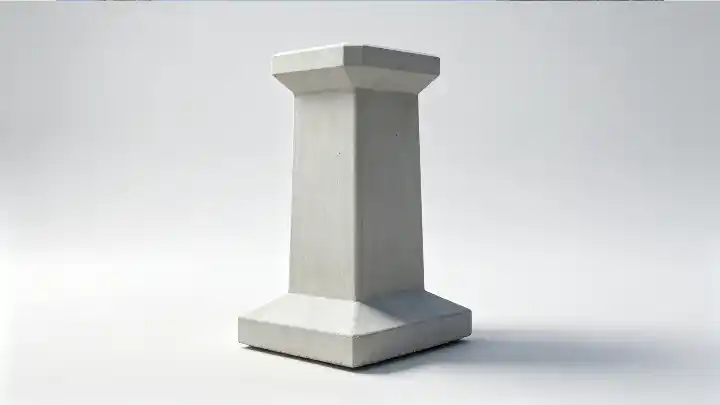
What such a line actually produces
A precast pier and pier cap production line casts the vertical and transverse substructure elements of a bridge: pier columns, single or multi column bents, pier caps, and in some projects the footings. The elements are cast in steel moulds at a precast plant, cured, stripped, stored and shipped to the bridge site.
The line does not produce the bearings, the deck, the piles or the finished bridge. It also does not decide the connection design, which belongs to the project's design authority. Realjet plans and supplies production lines for precast concrete components around the element, the output target and the site, and does not sell the piers or the cap beams themselves.
Some buyers arrive expecting a circulating line with a takt time, as in a girder or slab factory. Substructure work usually looks different, because the elements are heavy and the geometry varies from pier to pier. That difference drives the whole enquiry.
Why owners move piers off site
The case for precasting substructure elements is an argument about schedule and site access, not one about cost per cubic metre. In conventional construction the sequence is fixed: foundations first, then pier columns and caps, then beams and decks. Off site fabrication breaks that chain, so elements can be produced concurrently and delivered when the site can receive them.
The Federal Highway Administration overview of prefabricated bridge elements and systems sets out the practical effects: fabrication moves into a controlled environment where weather affects only the site work, formwork stripping and curing happen away from the work zone, and the time spent working over water or alongside live traffic falls. For a river or interchange pier, that last point is often the deciding one.
The same logic explains why pier caps are increasingly precast. Cast in place, a cap needs an extensive soffit and side formwork and a curing period in a location that is expensive to occupy. Cast in a plant, the curing period stops being a site constraint.
Element types and what they change
Column cross sections are usually rectangular or circular, and the PCI Northeast guidelines for precast substructures in accelerated bridge construction note that octagonal sections can be preferred because they are easier to fabricate. That is a mould decision as much as a structural one: every flat face and every corner radius has to be formed, sealed and stripped without spalling.
Columns can be solid, hollow, reinforced or post-tensioned. Hollow sections save material and reduce the weight that has to be lifted and supported, but they introduce internal formwork, a core to withdraw, and extra care during concreting. Where a pier is tall, the column may be cast as a stack of segments stressed together on site, which is normal practice on projects that need the substructure built quickly with minimal falsework.
Pier caps differ from columns in proportions. A cap is a wide, shallow, heavily reinforced element with bearing seats, corbels, blockouts and, often, a sloped soffit. The PCI Northeast guidance prefers a level cap where the project allows it, because sloped caps add fabrication cost without adding much value. That preference is worth carrying into the enquiry: it is one of the few decisions in this product family that changes the mould price materially.
Casting method: fixed positions rather than a cycle
A pier line is usually a set of fixed casting positions served by one crane, not a pallet circulation system. The reason is weight and geometry. A segmental or single column pier for a highway bridge can weigh more than any element in a beam factory, and the mould cannot be lifted and cycled in the same way as a beam bed.
Vertical casting is the standard approach for columns, because it keeps the element's own weight working with the formwork rather than across it, and it holds verticality without the element having to be rotated. A mould with an adjustable top or a variable head section lets one tool produce several column heights.
Pier caps are cast in the position that puts the corbels and bearing seats in the most accessible place for forming and stripping, which is normally upright or on their side. The choice is made once, at drawing stage, because it decides the mould's opening direction, the core arrangement and the lifting points.
The line therefore consists of moulds, casting positions, concrete supply and vibration, a curing arrangement, and the yard equipment that moves elements of tens of tonnes. Output is set by the number of casting positions and the curing period that the mix and section allow, not by a machine cycle time. Our note on how mould count relates to output describes the same arithmetic for a beam plant, and it transfers directly.
Connections decide the tolerances
Substructure precasting lives or dies on joints. Reinforcement is usually connected through grouted splice couplers, with closure pours for the remaining bars. The requirement normally stated in project specifications is that couplers are the only permitted connector between a column and the adjacent element, and that their positions are dimensioned from a common working point so that every element is measured the same way.
This is where a small casting error becomes an expensive one. A coupler that is 15 mm out of position may still be repairable on a 2 m specimen and fatal on a 3 m wide cap with 20 couplers in a row. The practical answer is jigged fixing of couplers and inserts inside the mould, and a dimensional check before the pour instead of after it.
Tolerances that accumulate matter as much as individual tolerances. A column cast within tolerance, sitting on a footing placed within tolerance, under a cap cast within tolerance, can still put its bearing seats outside tolerance. Fabrication tolerances are set by the supplier and the owner's specification, while the NCHRP guidance for prefabricated bridge element and system tolerances covers footing, column and cap element fabrication tolerances and is written to supplement the AASHTO bridge construction specifications. Erection tolerances are tighter in absolute terms; the PCI Northeast drawings give values of about 6 mm on the top of element elevation and on the beam seat elevation, and they note that small erection tolerances force the contractor to set and reset elements.
Lifting, storage and handling
Lifting points are designed, not improvised. Lifting anchors are cast into the element, set at a depth that allows the clutch or shackle to engage, and positioned so the sling angle stays within the range the anchor was rated for. Inserts that sit proud of a formed face are a finishing defect, and inserts set too deep cannot be picked up.
Storage is the part buyers underestimate. A pier cap supported at the wrong points will deflect and may creep if it stays in the yard for months. Storage positions should be shown on the drawing, close to the support conditions assumed in the design, and long storage should be accompanied by periodic checks of the element's shape.
Transport is the second constraint. Columns and caps are indivisible loads, so permitted axle loads, vehicle envelope and the route from plant to site set a hard limit on element dimensions. That limit belongs in the enquiry next to the production quantity, because it can decide whether a pier is cast as one piece or as segments.
Plant layout and utility inputs
A substructure line needs a covered casting hall with crane capacity matched to the heaviest element, a curing provision that can be controlled instead of assumed, water and drainage for mixing and washdown, three phase power for the crane and the curing controls, and a heavy yard with a route out for loaded trailers.
Concrete supply deserves its own line in the plan. Precast substructure specifications commonly call for a nominal 28 day strength in the region of 35 MPa, above what a typical cast in place substructure mix requires, because the element has to be lifted, transported and erected without cracking. That strength requirement interacts with the cement content, the curing regime and, for post-tensioned piers, the transfer strength.
What the buyer must settle before an enquiry
The design authority owns the structural design: the concrete class, the reinforcement, the coupler system, the connection design, the bearing seats and corbels, the post-tensioning, and the standard the element is designed to, which is normally the AASHTO LRFD bridge design specifications in the United States and the corresponding national code elsewhere. The mould and the line have to follow that design, not the other way round.
Inputs that help a supplier answer quickly include the element schedule with dimensions and weights, the number of piers and the required delivery sequence, the connection details, the finish and the tolerances to be held, the transport envelope, and the site date the first element has to arrive.
Where the line scope ends
A production line enquiry should state the boundary. Line scope normally covers the steel moulds, the casting positions, concrete distribution and vibration equipment, the curing arrangement and its controls, handling and transfer equipment, and the project support that goes with them. Foundations, the building, the incoming electrical supply, the storage yard, the bearings, site erection and the grouting of connections usually sit outside it, along with the structural design itself.
Our explainer on what a precast column and beam production line produces covers the building element version of the same question, and the production line type comparison sets out how the fixed and circulation approaches differ.
Next step
Start from the element schedule rather than a machine list: the pier and cap types, their weights, the connections, the tolerances to be held and the delivery sequence. With those inputs a supplier can propose mould configurations, casting positions, a curing regime and a handling plan that fit the project, and can state clearly which items remain in the buyer's scope.