
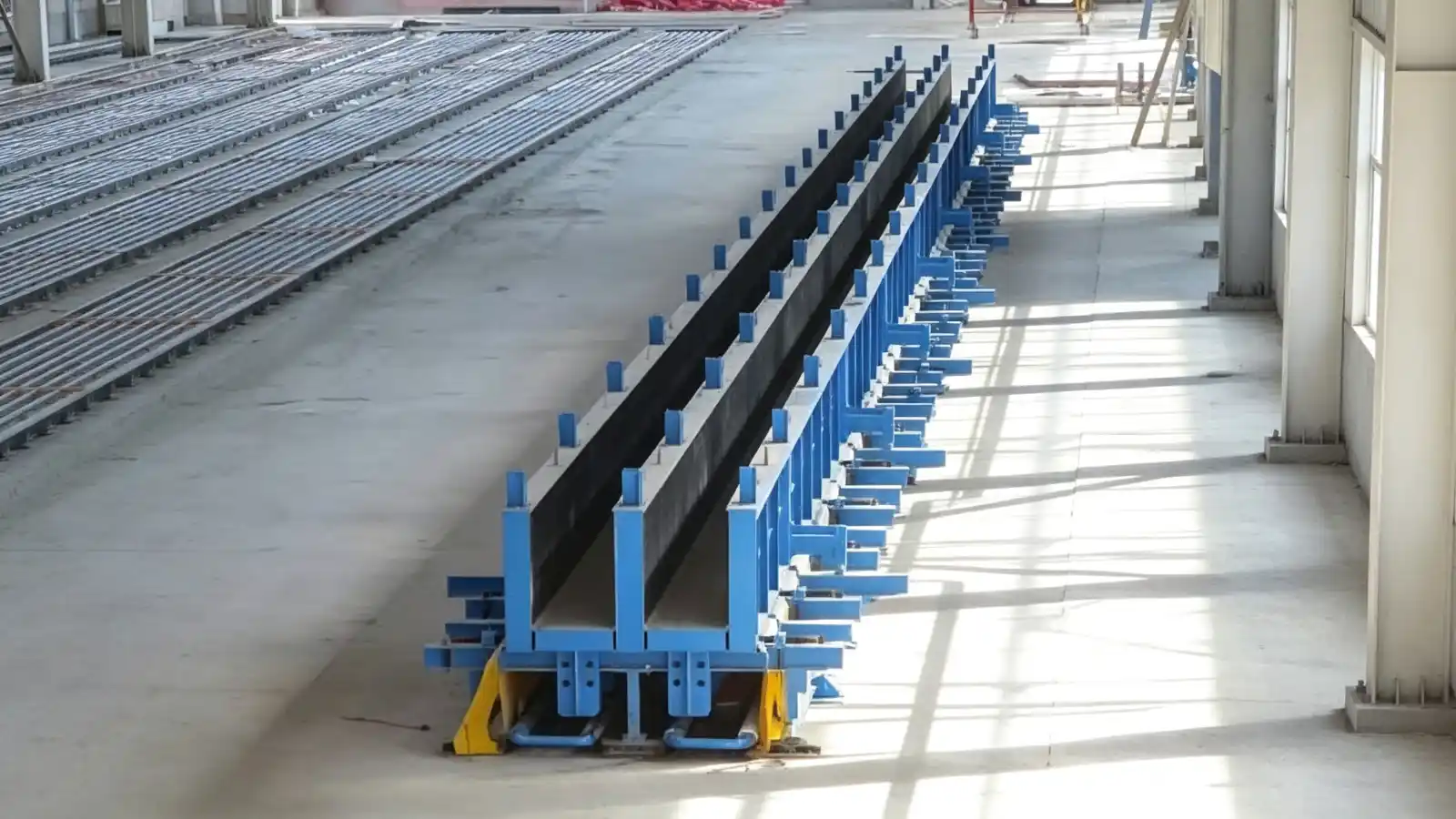
What the line produces
A precast column and beam production line is a project-specific plant that casts reinforced or prestressed concrete columns and beams as repeatable structural elements. These members form the frames of industrial buildings, parking structures, stations and similar load-bearing structures. The line makes the components in a controlled environment, then the elements are transported to site for erection. Realjet provides engineering and equipment for production lines that make precast concrete components. Realjet does not sell the columns and beams themselves.
The output is a family of linear structural members with defined cross sections, lengths and connection details. Because the geometry repeats, the line earns its value through consistent casting, curing and demoulding rather than through one-off formwork.
How it differs from panel and girder lines
A panel line (for wall or slab elements) usually works on flat beds or pallets where the product is wide and thin. A girder line focuses on long, deep sections such as bridge beams. A column and beam line sits between these in character: the members are three-dimensional and often need careful reinforcement placement, prestressing where specified, and moulds that open to release a shaped cross section rather than a flat plate.
The distinction matters for buyers because the mould system, the handling equipment and the yard space all change with the member shape. A line sized for flat slabs will not suit deep columns without different moulds and lifting provisions.
The production process steps
A typical column and beam line runs through a repeatable sequence. Concrete is batched and mixed, then transported to the casting area. The mould is prepared and released with form oil. Reinforcement and embedded items are placed, and prestressing is applied where the design calls for it. Concrete is cast and compacted, then cured until it reaches the stripping strength. The member is demoulded, the mould is cleaned and oiled, and the finished element moves to storage.
Curing is usually accelerated with heating on the casting bed or in a chamber to keep the cycle time predictable. The exact steps and their timing depend on the concrete mix, the member size and the local climate, all of which belong in the project definition rather than in a generic specification.
Layout choices: long-line bed versus station layout
Two layout concepts appear most often. A long-line bed holds the member along its full length, with reinforcement and prestressing strung between end anchors. This suits long, repeated members and gives a simple material flow. A station or carousel layout moves the work through defined stations for mould preparation, casting, curing and demoulding, which can improve labour use when several member types share the plant.
Neither layout is universally better. The right choice depends on member length, the number of parallel moulds, the available building footprint, the utilities and the handling equipment. Buyers should describe the site constraints early so the supplier can propose a layout that fits the plot instead of a standard template.
Output, space and utilities
Output is not a single number. It depends on the number of parallel moulds, the casting and curing cycle, the member length and how fast demoulding and handling can run. A buyer should ask for output as a range tied to a defined member mix rather than a peak figure, because the real constraint is often the yard space for curing and storage, not the casting rate.
The plant also needs power for mixing and machinery, water for concrete and curing, and a heat source where accelerated curing is used. Confirm these utilities early, because extending power or steam capacity after the building exists is far more costly than planning for it. Realjet sizes the equipment package to the output target and the site utilities you define.
Tolerances and acceptance
Dimensional acceptance of precast members follows published industry tolerances. In North America the PCI manuals, including the PCI tolerance specification, set product, erection and interfacing tolerances for precast and prestressed concrete. For infrastructure programmes, the FHWA Prefabricated Bridge Elements and Systems guidance shows why off-site fabrication is used to cut on-site time. These references describe general practice and are not a statement of any supplier's specific capability.
The buyer should state which tolerance class the project requires and confirm that the production controls and inspection plan can demonstrate it. Tighter tolerances are achievable but cost more in mould accuracy, handling and measurement, so the tolerance basis should match the structural and connection needs rather than a default tight value.
What to prepare before requesting a quotation
Before contacting a supplier, gather the member schedule with cross sections and lengths, the concrete strength and any prestressing requirement, the reinforcement and embedded-item details, the target daily or monthly output, the building footprint and utilities, the handling and storage plan, and the applicable standards. A clear brief lets the supplier size the mould set, the curing system and the handling equipment consistently.
When your project reaches the equipment stage, the next step is to share these inputs with a supplier who engineers production lines for precast concrete components. Realjet's precast beam factory solutions cover the equipment and project scope needed to plan a column and beam line around your specific members.