
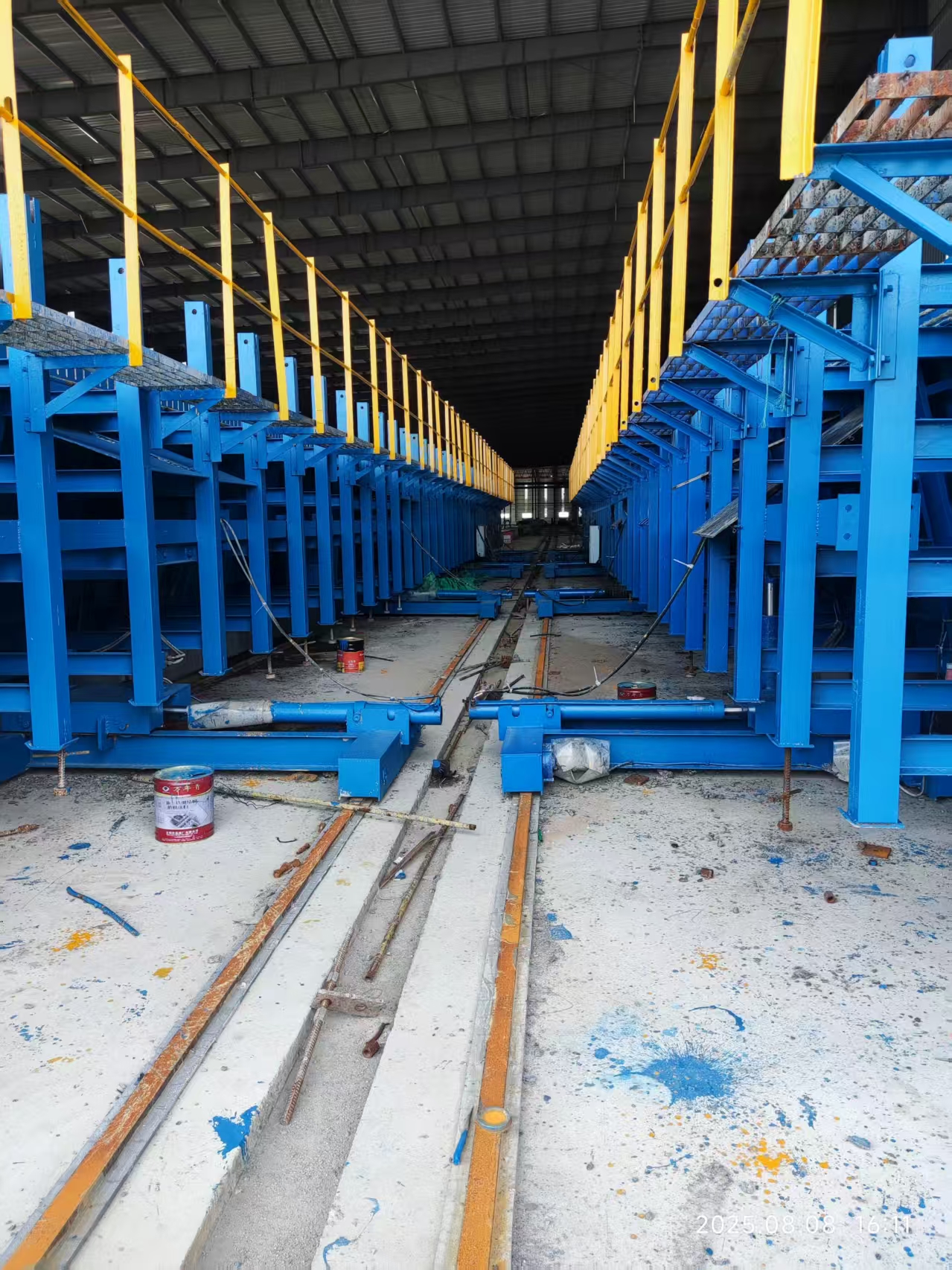
Plan the formwork with the factory, not after it
U-girder formwork affects more than the casting station. Mould length and spacing influence building width, crane coverage, reinforcement access, concrete distribution, curing occupancy and finished-beam handling. Integrating the formwork during factory planning helps the project team identify these interfaces before foundations and utilities are fixed.
Realjet starts with the component family, production target and cycle assumptions. The number of moulds is then coordinated with preparation time, casting duration, curing method, release sequence and buffer requirements.
Integrated planning considerations
- mould dimensions and operating envelopes;
- access platforms and safe working routes;
- reinforcement cage delivery and embedded-item installation;
- concrete conveying, placement and cleaning access;
- vibration equipment and control interfaces;
- curing chambers, covers or steam distribution requirements;
- crane coverage and component lifting routes;
- mould movement, rail foundations and maintenance space.
The objective is a verifiable production concept rather than an isolated equipment arrangement. Each station should have a defined task, required occupancy time and clear interface with the next process.
Applications
Integrated U-girder formwork is applicable to new precast beam factories, temporary project yards and capacity-expansion projects for highways, viaducts and urban transport structures. It can support fixed-mould, movable-mould or mixed production concepts depending on output and site conditions.
The buyer should provide component drawings, the production schedule, shift assumptions, plot or building dimensions, crane data and available utilities. Realjet uses this information to develop a layout basis and identify equipment boundaries.
From mould engineering to project delivery
Realjet designs and manufactures project-specific formwork and production equipment. For buyers planning a complete facility, our precast concrete beam factory service can connect process layout, equipment manufacturing, installation and commissioning.
Supporting steel structures, transfer frames and machinery components can also be produced through our contract manufacturing capability. The final supply scope is defined around project responsibilities, interfaces and acceptance requirements.