
Cold weather usually arrives after the mould order
A plant built for a temperate climate and operated through a real winter finds the problems in the first cold month: concrete gains strength slowly, the surface comes out patchy, stripping takes longer than the cycle allows, and someone asks whether the moulds should have been insulated.
By then the moulds are on site. Insulating a finished steel mould is a retrofit that changes weight and how the side forms open, and it often blocks access to the clamps and ties. Heating is worse: the circuit has to sit at a controlled distance from the casting face, with a panel, sensors and a route for the services.
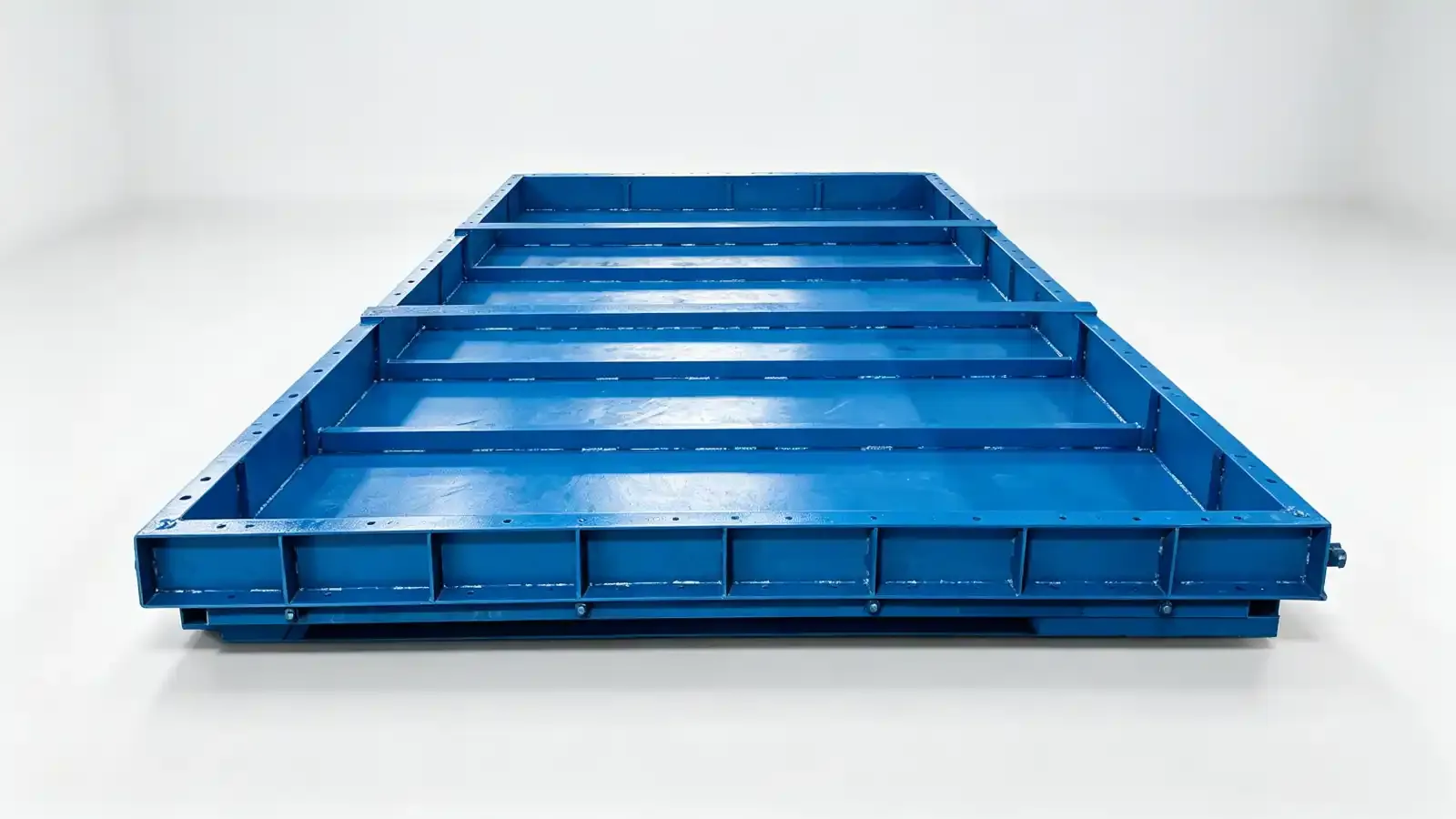
This article covers what a cold weather requirement asks of a mould, and how to put it in the order while the design is open. The arithmetic is clearest on large flat elements such as precast floor and roof slab moulds, where the casting face is wide and the heat loss path is short.
What counts as cold weather
The threshold is not "below freezing". ACI 306R treats cold weather as a period when the average daily ambient temperature stays below 5 °C for more than three consecutive days, or when the temperature falls below 0 °C during any part of a day. A plant in a mild region can cross that line for two weeks in a bad January and find the cycle time gone.
Two numbers travel with the definition and matter to the mould. Concrete should be placed at a temperature of at least 10 °C, and it has to be protected from freezing until it has gained enough strength to resist the expansion of ice in its pores. In ACI's own answer on cold weather protection, forms are assumed to be suitably insulated, with exposed surfaces, corners and edges doubly insulated, and external heat required if the placed temperature is below 10 °C.
Where the heat leaves a mould
Steel is a good conductor, which is why a steel mould is an efficient heat exchanger in the wrong direction. The paths that matter:
- Through the soffit or base plate into the pallet, the bed or the floor.
- Through the side forms into the surrounding air.
- At corners and edges, where two surfaces meet and the mass to volume ratio is lowest.
- Through any part of the mould that sits in a draught, which in a portal frame building is most of it.
A massive part of the mould holds heat for a while. A 6 mm side plate on an open frame does not. That is why the same mix at the same ambient temperature gives a sound element in one mould position and a cold, slow one two metres away.
Three ways to keep a mould warm
Insulation on the mould is a layer behind the casting face, or an insulated box section, that slows heat loss through the steel. It works with the heat of hydration and needs no services. It adds thickness and weight, and it changes the temperature gradient through the structure, which is a stiffness question as much as a thermal one.
Active heating means electric resistance mats, hot water or oil coils, or a steam jacket bonded to the back of the casting face. Heating gives control and can hold a surface temperature through a cold night, but it needs a circuit layout, a panel, sensors, and a decision about how close the element may sit to the face without curing the surface faster than the core.
An enclosure, whether a tent or a heated hall with warm air, is the curing system's job rather than the mould's. Separating the two responsibilities in the contract avoids paying twice or discovering a gap.
The three are rarely alternatives in practice. Most cold weather plants use an enclosure plus some mould insulation, and add active heating only where the cycle time demands it.
Thermal movement and dimensional control
A steel mould changes size with temperature. The coefficient for steel is about 12 × 10⁻⁶ per °C, which gives roughly 0.6 mm of growth per metre for a 50 °C rise. On a 6 m long slab mould that is 3.6 mm between a cold morning and a heated pour.
That number sits inside the tolerance band of many precast elements, which is the point. If the mould is measured cold and the element is cast warm, the dimensional record and the component do not describe the same geometry. If the heating is uneven, one end of the mould is longer than the other and the diagonals no longer match.
The practical answer is to fix the reference temperature in the order: at what mould temperature the dimensions are guaranteed, and at what temperature the mould is measured. A supplier who guarantees dimensions without naming a temperature has guaranteed less than the buyer assumes.
There is a second effect. If the mould is constrained at the base while the side forms expand, the restraint introduces stress in the frame and can bow a long side form. Slotted fixings and a defined free end exist for this reason, and they belong in the drawing rather than in a site modification.
Condensation on the form face
A cold steel face in a warm, humid building collects water. In a plant where the concrete is mixed warm and the hall is heated but the mould has been standing in a cold bay overnight, the face can be wet before the first bucket arrives.
The result is not cosmetic. Water on the face dilutes the paste at the surface, which shows as a colour difference, a weak skin or pinholes, and it interferes with the release agent film.
Two measures work: bring the mould above the dew point of the hall before placing, and apply the release agent to a dry face at the temperature it was designed for. Both are operating disciplines, but the mould order decides whether they are possible. A heated mould can be brought up to temperature on its own; an unheated one depends on the hall.
Stripping temperature and surface damage
Stripping a cold element into a cold draught is a thermal shock. The face cools faster than the core, the surface layer goes into tension, and fine cracks appear at the edges and around inserts. The MDPI review of formwork engineering for concrete construction names thermal shocking and early freezing as the two cold weather risks at stripping, and notes that a compressive strength of around 5 MPa is usually recommended before a form is struck to avoid severe damage.
Strength at stripping is a mix and curing question first, a mould question second. The mould decides the force needed to break suction between a green element and a wide smooth face, and whether the opening sequence can do that without levering against the concrete. A large flat face with a good finish and no draft is the hardest case, and cold weather slows strength gain most in exactly that case.
Ask for the stripping method to be described in the mould documentation, and for the strength the supplier assumes at stripping. If that number is above what the plant reaches in a winter cycle, the cycle time is wrong, not the mould.
Who controls the temperature
Cold weather protection has at least four parties: the mould supplier, the curing or heating system supplier, the batching plant, and the producer running the shift. Temperature control fails when the responsibility is split without an owner.
The mould supplier owns the thermal design of the mould: insulation, heating circuit layout, the guaranteed reference temperature for dimensions, and the surface temperature the mould can hold. The heating or curing supplier owns the heat source, the control loop and the sensors. The producer owns the record: what the mould temperature was at placing, what the hall temperature was, and when the element was stripped.
Put the sensor positions in the contract. A thermocouple in the hall and one in the concrete do not tell you the temperature of the casting face, which is the number that decides whether the surface cures or freezes.
What to add to the mould enquiry
| Item | What to state | Why it changes the mould |
|---|---|---|
| Climate data | Design minimum ambient temperature and the number of cold months | Sizes the insulation and decides whether active heating is needed |
| Production temperature target | Mould face temperature to be held, and for how long | Drives the heating circuit capacity or the insulation thickness |
| Heating medium | Electric, hot water, oil or steam, and who supplies it | Fixes the circuit layout, the connections and the panel interface |
| Reference temperature for dimensions | The temperature at which the guaranteed dimensions apply | Prevents a cold measurement being compared with a warm casting |
| Insulation position | Behind the casting face, on the frame, or as a separate blanket | Changes weight, thickness and stiffness of the mould |
| Stripping method and strength | Method, and the concrete strength assumed at stripping | Matches the mould to the winter cycle time |
| Sensor provision | Positions, type and who reads the record | Makes the temperature claim checkable |
| Free end and fixings | Where thermal movement is allowed | Avoids restraint stress bowing long side forms |
Who owns which decision
| Decision | Owner | Why it sits there |
|---|---|---|
| Design minimum temperature and cold months | Buyer, from site climate data | It is a plant location fact, not a mould property |
| Insulation or active heating | Buyer decides, mould supplier advises | Cost and cycle time both move with the choice |
| Thermal design of the mould | Mould supplier | Insulation, circuit layout and reference temperature are mould design |
| Heat source, control loop and sensors | Heating or curing supplier, unless the mould package includes it | Clear split prevents an unowned interface |
| Temperature record during production | Producer | It is a production record, not a delivery document |
| Concrete strength at stripping | Producer, agreed with the designer | Mix, curing and cycle time all contribute |
Where to take the question
A cold weather requirement is cheap to answer at the mould design stage and expensive afterwards. The buyer who states the design minimum temperature, the target face temperature and the stripping strength gets a mould that fits the winter cycle, and a clear boundary between what the mould does and what the curing system does.
Realjet designs project specific steel moulds around component geometry, casting method and plant layout, with dimensional records agreed against the component drawing. The precast concrete moulds section covers the families, the building component moulds category covers slabs, walls, columns and stairs, and the precast beam factory line page shows how moulds sit inside a full production line package.