
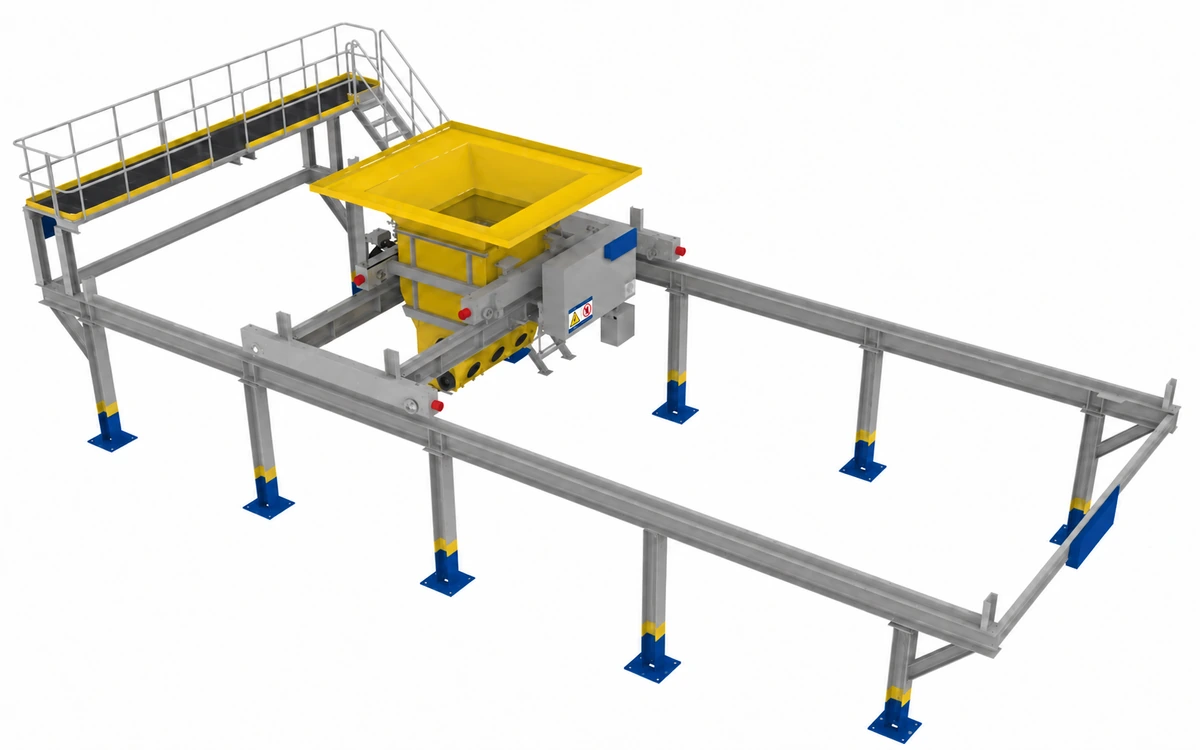
Equipment Overview
A concrete spreader receives fresh concrete and places it across a precast production pallet. The reference configuration offered through REALJET combines weighing, controlled discharge and gantry travel for wall and slab production. Spreading and screw discharge options allow the equipment concept to be reviewed against the concrete mix, element geometry and casting process.
Where the spreader fits in your plant
The spreader works at the casting stage, after shuttering and reinforcement preparation. Concrete arrives at its hopper, the machine moves into position, and discharge is coordinated with the casting area. The pallet then proceeds to the compaction and finishing operations required by the production process.
For a carousel plant producing solid walls, sandwich walls or lattice girder slabs, the review starts with pallet size and the space available above the casting station. Sandwich wall production also needs a defined sequence for the insulation and second concrete layer. These product requirements determine the configuration; the spreader alone does not define the capability of the complete line.
Controlled loading, weighing and discharge
- One-touch loading and return: return-to-loading operation supports repeated concrete receiving cycles.
- Intelligent weighing: the weighing function supports control of the concrete quantity handled at the station.
- Spreading or screw discharge: select the discharge arrangement around the product and concrete placing requirements.
- Concrete setting alarm and fault self-diagnosis: operators can respond to the equipment's reported condition during production.
- Remote and control-panel operation: the reference design includes both operating interfaces and automatic lubrication.
The quoted equipment scope should identify which functions are included and how signals are exchanged with the concrete supply and vibration station.
How a casting cycle is organized
- Receive concrete at the loading position and review the required quantity.
- Move the gantry and trolley to the casting area.
- Discharge through the selected spreading or screw arrangement.
- Coordinate the completed placing operation with the next production step.
- Return for the next load and carry out the cleaning required by the operating procedure.
The final sequence and operator responsibilities are defined for the selected plant layout.
Reference Specifications
| Item | Reference specification |
|---|---|
| Reference overall dimensions | 13,220 × 5,700 × 3,680 mm |
| Discharge arrangement | Spreading / screw |
| Maximum hopper volume | 3 m³ |
| Reference casting widths | 1.6 m / 2.7 m |
| Discharge gates | 8–12 |
| Maximum distribution rate | 1.5 m³/min |
| Gantry / trolley travel speed | 0–25 m/min |
These figures describe the reference configuration. Final dimensions, equipment scope and operating conditions are confirmed in the project specification.
Select the spreader around the casting station
Send REALJET the pallet dimensions, element drawings, concrete supply method and required casting sequence. The plant span, track position and available headroom help define the travelling structure. The casting width must also suit the usable mould area and the reinforcement arrangement.
A maximum discharge rate is an equipment reference, rather than a finished-element output guarantee. Concrete delivery, movement between positions, placing requirements and cleaning all belong in the cycle review. For an existing plant, include photographs and drawings of the receiving hopper, track supports and vibration station.
Frequently Asked Questions
What is the difference between a concrete spreader and a concrete transport bucket?
A transport bucket moves fresh concrete between supply and receiving points. A spreader places concrete over the casting pallet. Their capacities, receiving positions and operating signals need to be coordinated.
Is spreading or screw discharge better for my precast product?
The choice depends on the concrete mix, the required placing pattern and access around the mould and reinforcement. Share the product and casting requirements so the discharge arrangement can be reviewed.
Does a 3 m³ hopper mean every load contains 3 m³ of concrete?
No. The figure is the reference maximum hopper volume. The usable working quantity depends on the selected equipment and operating conditions.
Can the spreader be added to an existing line?
An upgrade can be assessed from the pallet layout, track supports, headroom, concrete supply and control interfaces. Compatibility is confirmed through that review.