
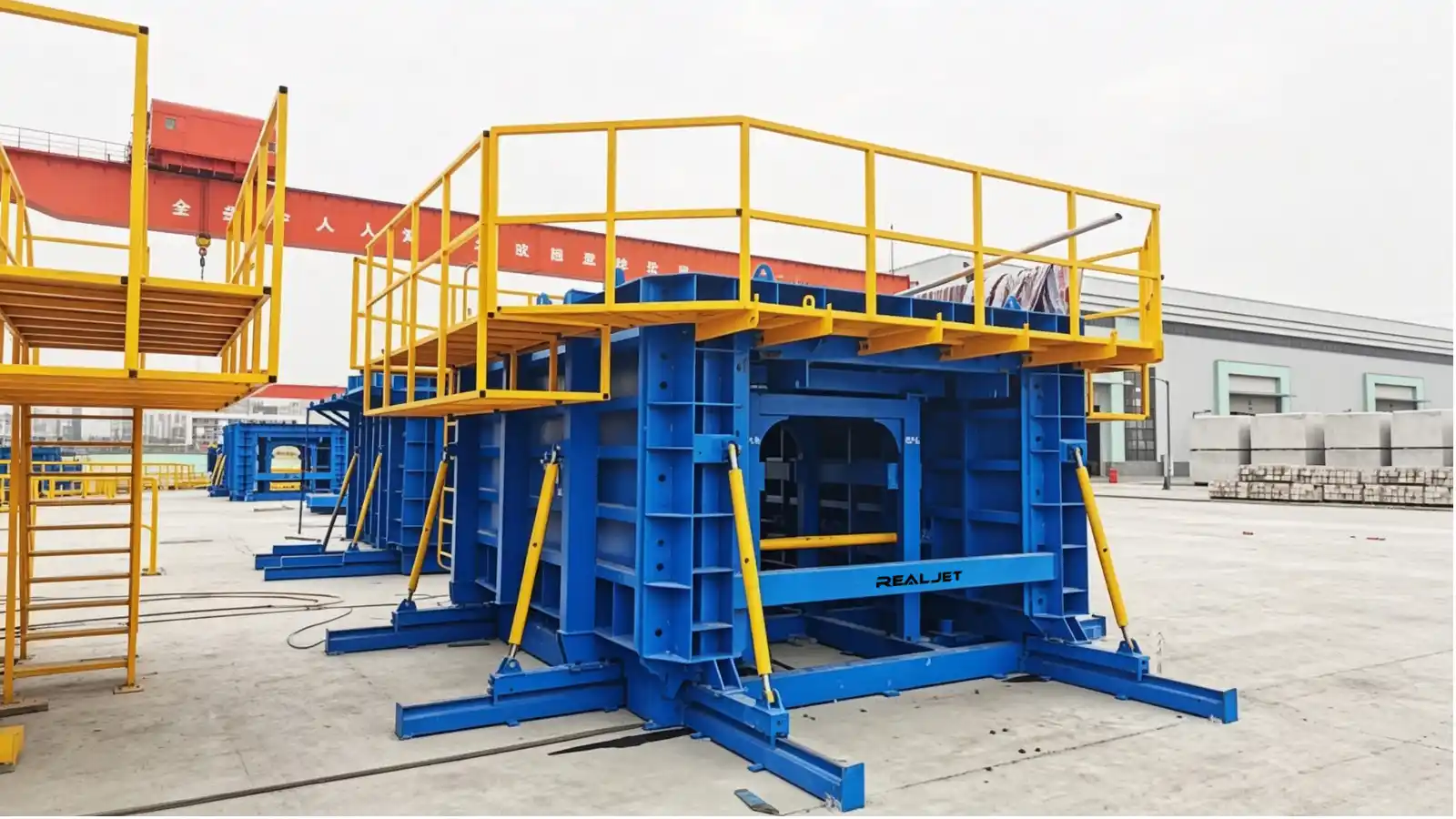
What a box culvert mould produces
A box culvert mould forms buried precast concrete structures used for drainage, storm sewers, road or railway crossings and utility routes. The mould is the tooling; the precast plant casts units to the approved structural drawings and the standards selected by the project. ASTM lists C1433-25 for monolithic single-cell precast reinforced concrete box sections, with a separate metric companion standard. That scope does not automatically cover every culvert geometry, country or project. The buyer's designer must identify the applicable specification and edition. Realjet supplies the mould system, not the culverts.
This guide covers the inputs a buyer should gather before requesting a quotation for a box culvert mould, so the supplier can configure the tooling to the actual geometry and output.
Geometry and dimensional inputs
The mould is driven entirely by the component geometry, which comes from the buyer's structural design. Specify:
- Clear span and rise, the opening dimensions, since these set the mould size.
- Total element length and whether units are cast in one piece or in shorter segments.
- Number of cells: single, double or triple cells change the internal wall layout.
- Wall, floor and roof thicknesses, and any haunches, chamfers or slope in the invert.
- Minimum cover and any step or skew at the ends.
These values are defined by the design standard and the site, not by the mould supplier. Where the alignment turns or steps, the mould may need skew ends or adjustable fillers, so state these early because they change the side-form and end-form design. The supplier's job is to build a mould that produces the agreed geometry repeatably.
Joint type, reinforcement and embedded items
Box culverts mate through prescribed joints, so the mould must form the joint profile. Tell the supplier the joint type, whether it is gasketed, keyed or plain, and the groove geometry for any rubber gasket. Also provide the reinforcement cage layout, lifting inserts, and any embedded items or block-outs, because the mould needs matching recesses and fixing points.
The reinforcement itself is designed by the buyer or the project designer. The mould supplier forms the space the cage occupies and the surfaces the concrete must meet.
Demoulding method and production rate
Box culvert moulds are built with different opening and closing systems. Hydraulic operation reduces manual effort and shortens the cycle for high output, while mechanical or conventional systems suit lower volumes. The choice affects both the mould price and how it fits the production line. State your preferred demoulding method and the daily or annual output, because the number of moulds and their cycle time together set the plant capacity.
Review the wider precast concrete mould range, the tunnel and underground mould category, and the specific box culvert mould product when defining requirements.
Mould count, transport and site limits
The number of moulds you order sets how many units you can cast in parallel, and therefore your line output. A single geometry may need several identical moulds to hit a daily target. At the same time, mould size is limited by your factory door, crane capacity and the road or container dimensions for delivery, so very large culverts may need the mould supplied in sections for on-site assembly. Confirm these site constraints in the RFQ so the supplier sizes the mould for both production and handling.
Tolerances, surface and acceptance evidence
Product tolerances and surface requirements come from the approved project documents and applicable product standard. Surface finish may matter for visible faces, joints or hydraulic flow, so identify the controlled faces and the acceptance basis. Ask the supplier to explain how the mould will be inspected against its approved drawings and which records are included. If the purchase contract requires a trial assembly, dimensional witness or trial cast, define the location, measurement points, materials, responsibilities and acceptance route before comparing prices.
PCI states that its plant certification program evaluates plants against published quality manuals, including MNL-116 for structural precast production. That is relevant when PCI certification is a project requirement, but it does not set the contract geometry or prove that a particular mould supplier or plant is certified. Verify any certification claim and its category directly.
The design authority stays with the buyer or the designated designer. The mould supplier is responsible for tooling accuracy against the agreed drawing, not for the structural design of the culvert.
What to include in the box culvert mould RFQ
Before you request a quote, prepare:
- Component drawings: section, joint profile, reinforcement cage and lifting details.
- Clear span, rise, length, cell count and wall thicknesses.
- Joint type and gasket specification.
- Required output and preferred demoulding method.
- Applicable tolerances, finish class and acceptance evidence.
- Delivery scope: supply only, or supply with installation support.
Realjet develops project-specific box culvert mould systems from approved component inputs. Start with the box culvert mould product page and the precast concrete moulds overview so the RFQ addresses the correct tooling type and delivery boundary.