
Why the RFQ defines the manufactured result
A concrete pump chassis is a large welded assembly that carries structural, hydraulic and operating systems. The mounting references it provides decide whether the pump, boom and outriggers line up in service. When buyers issue a contract-manufacturing RFQ with only a general arrangement drawing, suppliers fill the gaps with their own assumptions. Those assumptions change welding method, machining allowance, inspection scope and price. A useful enquiry starts from the finished assembly and states what the chassis must support before any part drawing is priced.
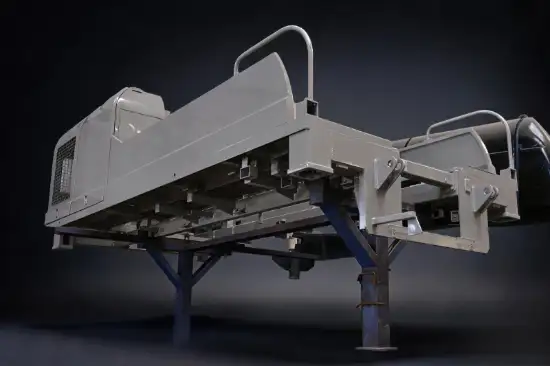
Realjet manufactures concrete pump chassis to customer drawings, combining heavy steel fabrication with machining of critical interfaces and final assembly checks. The construction machinery contract manufacturing service links cutting, forming, welding, contract machining, coating and inspection within one project-controlled workflow. The chassis shown on the concrete pump chassis product page illustrates this made-to-drawing scope, not a standard product.
Build the drawing hierarchy first
The RFQ should state which document controls when the 2D drawing, 3D model and bill of materials disagree. Mark released files, reference-only files and provisional information separately. Without that hierarchy, one bidder prices the current revision while another adds contingency for likely changes, and the comparison becomes meaningless.
For each drawing define:
- drawing number, title and revision;
- material grade and applicable material specification;
- dimensions and tolerances that control fit or function;
- weld symbols, weld size and inspection requirement;
- machined surfaces, datum scheme and surface finish;
- coating system and areas that must remain uncoated;
- purchased components and whether the buyer or supplier provides them;
- identification and traceability marks.
ISO 2553:2019 sets rules for representing welded joints on technical drawings, covering geometry, manufacture, quality and testing. ISO 1101:2017 defines the symbolic language for geometrical tolerancing. These standards give a common language once the project has chosen its specification basis. They do not select tolerances or weld requirements for the designer.
Set a quotable welding quality basis
Requesting "high-quality welding" without a defined basis produces quotations that cannot be compared. State the governing welding standard, material group, required procedure qualifications, welder qualifications, acceptance level and non-destructive testing scope. Identify critical joints and any restriction on repair.
For structural steel fabrication placed on the European market, EN 1090-1 requires a Declaration of Performance and CE marking for load-bearing components, with execution classes from EXC1 to EXC4. Bridge and crane structures commonly fall at EXC3. EN 1090-2 anchors its welding requirements to ISO 3834, the series that defines quality requirements for fusion welding. ISO 3834-2:2021 sets the comprehensive level for workshops and field installation sites. Citing it does not by itself define the complete job; the RFQ still has to state project standards, inspection responsibilities and records.
A useful bid describes the planned route at quotation stage. It identifies main subassemblies, fit-up method, welding sequence, distortion-control approach, hold points and the stage at which critical interfaces are machined. The aim is to expose assumptions that affect cost and delivery, not to approve a full manufacturing procedure before award.
Separate fabrication tolerances from machined interfaces
Applying one tight tolerance to the whole chassis usually raises price without improving function. Large welded structures move during fit-up, welding and thermal processing. Machined mounting faces, bores and alignment features may need close control, while non-functional plate edges and access openings can accept a wider range.
Mark the functional datums first. Then identify relationships that must be achieved after welding, such as bore-to-bore position, mounting-face flatness, shaft alignment or the location of a pivot interface. Tell bidders whether those features are machined in one setup, measured after fabrication or controlled by a trial assembly. If a dimension can only be achieved by machining after welding, say so, and identify any machining allowance included in the drawing. This lets the supplier plan material preparation, weld sequence, fixturing and final machining around the same acceptance condition.
Specify the inspection evidence before comparing price
List the evidence that must accompany delivery. Depending on the project this may include material certificates, weld procedure and personnel qualification records, dimensional reports, non-destructive testing reports, coating records, purchased-component certificates and final release documentation. Welder qualification under schemes such as ISO 9606 and procedure qualification to ISO 15614 are common references; non-destructive testing personnel are often qualified to ISO 9712. The RFQ should state which of these apply and to what level.
Tie each record to an inspection point and responsible party. A machined bore may require a dimensional result against a drawing characteristic, while a coating requirement may need surface-preparation and dry-film-thickness records. Avoid a generic "quality dossier" because bidders interpret that phrase differently. Define access for buyer or third-party inspection and state which points require notification, witness or approval before work continues. Late inspection requirements interrupt production and add costs that the original quotation did not include.
Put quantity, packaging and delivery into the same scope
A prototype, a first production batch and repeat annual orders create different manufacturing plans. Give bidders the expected quantity, likely release pattern and whether tooling or fixtures should support future batches. Ask them to separate one-time engineering or tooling charges from recurring unit prices.
Packaging should protect the finished interfaces. Machined faces, ports, threads and coating need suitable protection. State lifting points, centre-of-gravity information, transport constraints and any preservation period. If delivery is phased, define which documents and loose components travel with each assembly.
Before issuing the RFQ, confirm that every bidder receives the same revision set, quantity basis, inspection scope and delivery boundary. A controlled enquiry gives both sides a clearer basis for technical review and price comparison, and it lets the contract manufacturer plan welding, machining and inspection around the buyer's actual acceptance condition rather than a guessed one.