
Why testing sits inside the line order
A precast line is bought to produce units that can be stripped, stressed and shipped on a schedule. Whether a unit may be stripped or stressed is decided by concrete strength, and strength is decided by specimens. If the plant cannot make and test specimens at the rate the line casts, the cycle time on paper is not the cycle time in the hall.
That is why the testing scope belongs in the same enquiry as the casting equipment, even though none of it is equipment the line supplier normally builds. The line package usually stops at the casting machine, the beds and the handling. The laboratory that decides when a unit leaves the bed is a separate purchase, and the split is rarely written down.
Two curing regimes, two different questions
Standard cured specimens sit in a controlled environment and answer one question: did the mix reach the specified strength. Field cured specimens sit beside the unit, under the same cover or in the same chamber, and answer a different question: is this unit strong enough to strip or stress now.
State highway specifications separate the two in as many words. Maine requires the cylinders used to decide strand release to be field cured, and the 28 day cylinders to be standard cured, both in the same section of Section 535 of the Maine DOT standard specifications. New York requires cylinders used to determine detensioning strength to be cured as shown on the working drawings, which ties the specimen to the curing regime the unit actually received (NYSDOT Section 718).
A plant with one curing tank has answered the first question and guessed at the second. The curing system order and the specimen store are the same decision seen from two sides.
How many specimens, and counted against what
Frequency is where two quotations for the same line stop being comparable, because the counting unit changes the labour bill.
Maine works per day and per bed: cylinders are made for each day's cast and each form bed used, with additional cylinders at least once a week for the owner. Indiana works per member: a minimum of two 6 in by 12 in cylinders per member cast, with the option of testing earlier than 28 days (Indiana 707-B-180). New York works per unit: two cylinders for transfer strength, then two more at 28 days, with each transfer cylinder at no less than 95 per cent of the required transfer strength and the average at or above it.
On a long line casting several units in one pour, "per unit" and "per bed" are different numbers. A line casting four beams per bed needs either eight cylinders per pour or two, depending on which rule the order quotes, and the difference is technician time, mould time and storage.
The rule also decides who owns a failure. If specimens represent the bed, one weak result questions every unit on it. If they represent a single unit, the question stays with that unit.
Who performs the test, and who watches
Maine requires the strength tests to be made in the presence of the quality assurance inspector and states that tests not witnessed are not acceptable. New York requires cylinders to be made and tested in the presence of the inspector, with the inspector as sole judge of which specimens are damaged. Indiana requires the fabricator to supply all specimens at no cost to the department and to give notice before manufacture begins.
Those clauses describe a control system, not a lab bench. The buyer has to decide which side of it they want: results produced and signed by the plant, or results produced in front of a representative who signs as well. Both exist in commercial plants. The order should name the model rather than leave it to habit.
Maturity readings as a second opinion
Temperature based maturity methods, standardised as ASTM C1074, estimate strength from the temperature history of the concrete rather than from a break. The reading is continuous, which suits a plant that wants to strip as soon as possible, and it costs one sensor per unit instead of a set of cylinders.
The method needs a curve built for the actual mix and validated against real breaks. It also does not replace the acceptance specimens unless the specification says it does. Written into an order as the release authority, an unvalidated curve is a guess with a sensor attached.
What the line package usually leaves out
Compression machine, curing tank, slump cone, air meter, balance, cube moulds and a bench to work on are plant infrastructure. They are rarely inside a casting equipment package, and they are often not in the civils either. Between the two they can be bought late, which is how plants end up casting for a month with specimens curing in a bucket.
The questions worth settling in the enquiry are short. Is testing equipment in the supplier scope, in the civils contract or bought by the plant. Who commissions and calibrates it. Who staffs it on the shift that casts. The staffing article treats the technician as a line role rather than an office one, which is the right way round.
Where the samples live
Distance between the bed and the curing tank matters more than it looks. Specimens need to be moved without disturbance while they are still soft, and the first hours decide whether the specimen represents the unit or a badly compacted copy of it.
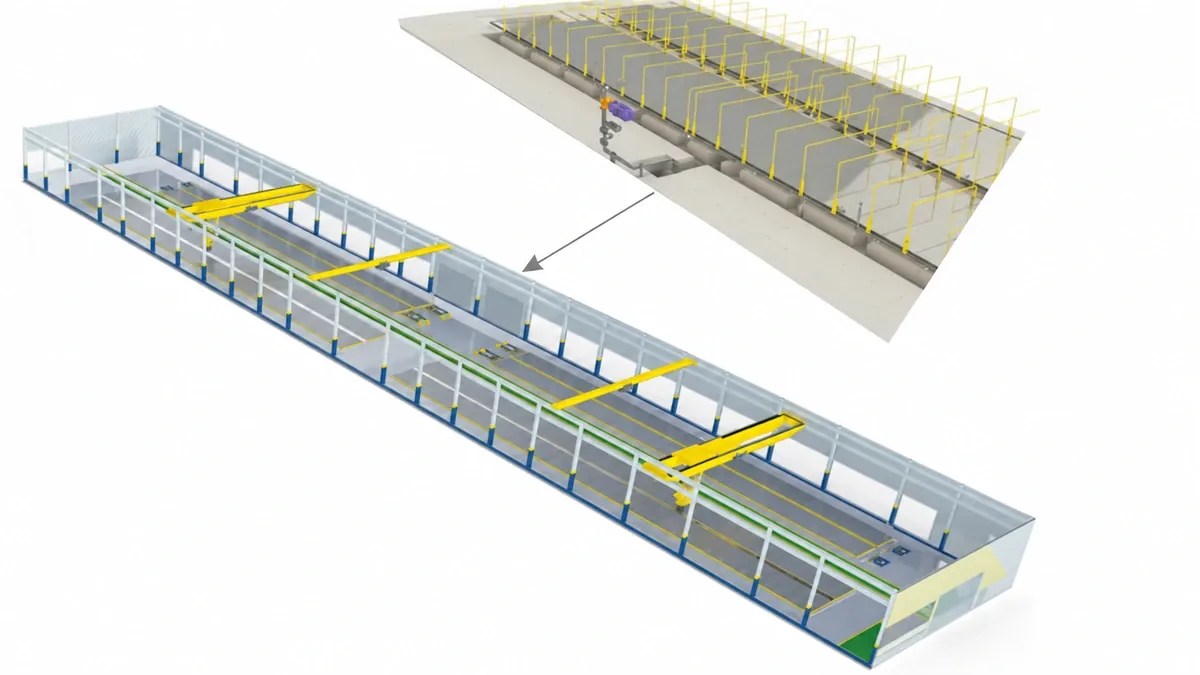
In a hall two hundred metres long, a tank at one end means a walk of several minutes each way, several times a shift. That walk is one reason sampling frequency slips in the second month of production. A specimen store and a small wet room near the middle of the casting area costs little at the design stage and is difficult to add later.
Records that tie a result to a unit
A strength result without identification is a number. Maine requires the unit identification, air content, water to cementitious ratio, slump flow and concrete temperature to be recorded when the specimen is cast. New York goes further and requires automatic temperature recorders at intervals along the casting bed, with each chart marked with the bed, the date, the casting time and the units it represents.
For a producer shipping to a client who asks for evidence, that record is the product. The commissioning checklist is the point where the recording routine is proved while the supplier is still on site, which is a better moment to find a gap than during the first audit.
What to put in the enquiry
| Item | What to state | Where it lands |
|---|---|---|
| Test methods | The standards for sampling, specimen preparation and compression | Order specification |
| Frequency | The counting unit: per day, per bed, per unit or per mix | Technician hours and cylinder stock |
| Curing regime | Which tests are field cured and which are standard cured | Specimen store and curing tank |
| Witnessing | Who signs, and whether unwitnessed tests count | Buyer or plant quality plan |
| Equipment | Laboratory equipment supply and calibration | Package scope or civils |
| Records | Data fields and how results link to a unit | Shipping documentation |
| Release authority | Who may release a unit for stressing, stripping or dispatch | Quality plan |
Where to take the question
The testing scope rarely appears on a line layout drawing, which is why it gets missed. It belongs with the line scope as a written list, next to the curing regime and the release rule it serves. Once those three items are in the enquiry, quotations for the rest of the package can be compared on equal terms.
Plants that settle it before the order is placed spend the first month casting. Plants that settle it afterwards spend the first month explaining why the specimens do not match the units.