
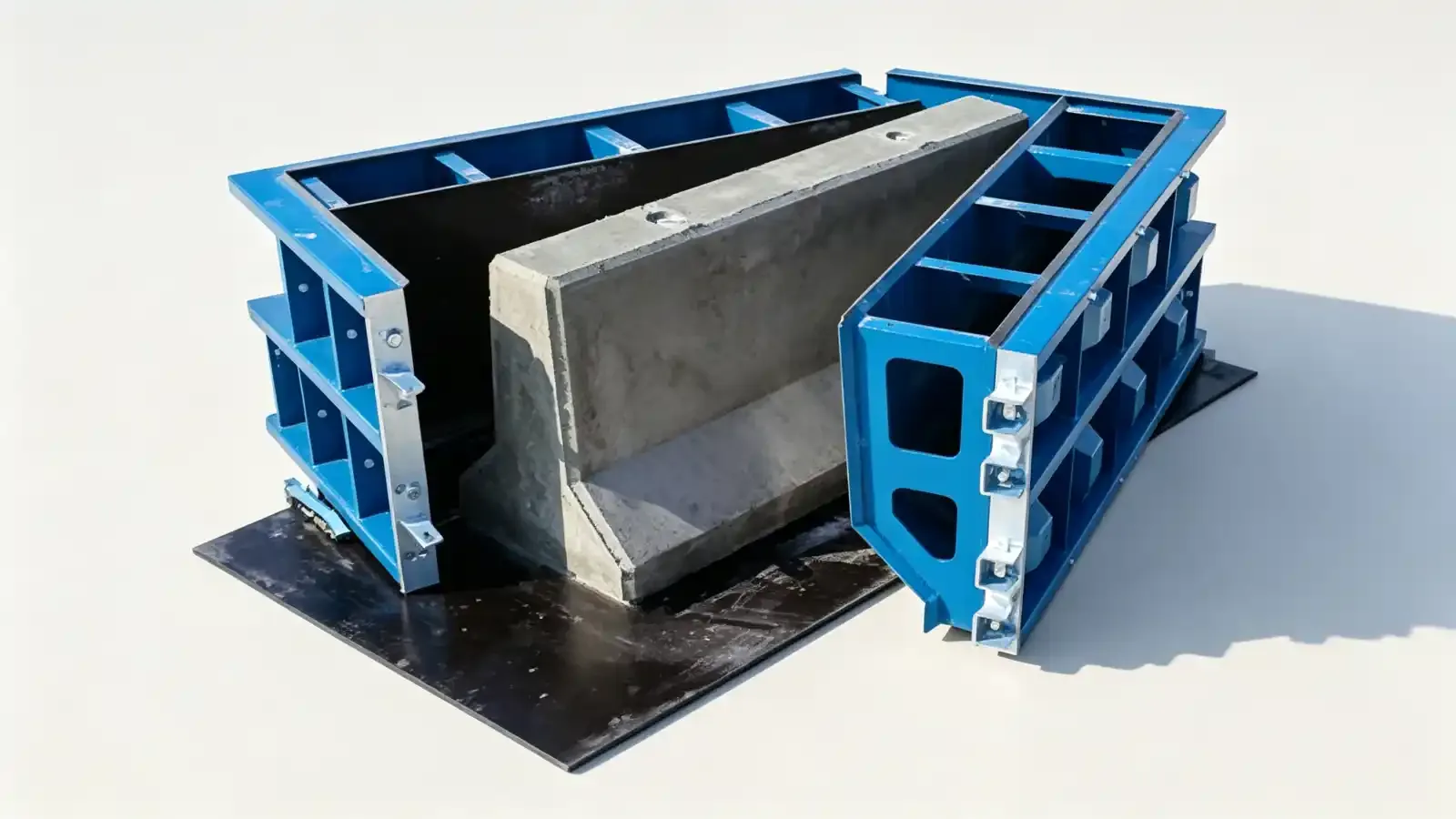
A barrier or kerb mould is a welded steel structure with a casting face. Buyers often specify the component geometry and the finish but leave the mould's weld quality to the supplier's standard practice. Two quotes then describe very different products: one may come from a shop with a documented welding quality system and recorded inspection, the other from a shop that only promises the mould will work. Weld quality can be written into the order for a precast line without asking the buyer to take over the mould designer's job.
Why the weld is part of the buying decision
The casting face of a barrier mould is assembled from plate and rolled or folded sections. Weld seams on and behind that face carry the repeated load of concrete placement, vibration, stripping and panel opening. A weld that is sound on the day of dispatch can open or distort after hundreds of cycles, and the first visible sign is often a line on the concrete face rather than a failure in the steelwork.
Weld quality belongs in the enquiry as a way of asking the supplier to show that the joining process is controlled and that the resulting structure will hold its geometry. It says nothing about how the mould looks. The mould tolerances guide explains the separate question of what tolerance the finished cavity must hold.
Start with the quality system, not a weld name
The first item to ask about is the supplier's welding quality system. ISO 3834-2:2021 defines comprehensive quality requirements for fusion welding of metallic materials, in workshops and at field installation sites, and was confirmed in 2026. It covers the elements that make a repeated weld consistent: personnel, equipment, materials, procedures, inspection and traceability. Realjet's verified capability includes welding to ISO 3834-2 and robotic arc and GMAW welding with post-weld cleaning.
A buyer should ask which part of ISO 3834-2 the supplier actually applies to the mould order and what records will be issued. A quality system on paper is not the same as a procedure for this mould. The scope statement in the quotation should name the workshop, the process and the inspection route, so it can be checked later.
Quality levels for imperfections
The second item is the acceptance level for weld imperfections. ISO 5817:2023 specifies quality levels for fusion-welded joints in steel and applies to material thickness from 0.5 mm. It gives three levels, designated B, C and D, with B the highest requirement on the finished weld. It covers fully penetrated butt welds and all fillet welds, and its principles can be applied to partial penetration butt welds.
The standard also states that the quality levels refer to production and good workmanship, and that metallurgical aspects such as hardness are outside its scope. A buyer can nominate a level for visible imperfection on the mould without claiming the standard also proves fatigue life or hardness. The right level depends on where the weld sits. A seam on the exposed casting face deserves a tighter callout than a stiffener weld on the back of the panel.
The standard does not set the level for a particular product. That remains a designer or buyer decision. Asking the supplier to propose a level for each weld class, with a short reason, produces a more useful response than naming the highest level everywhere.
General tolerances are a different document
Weld quality does not control the shape of the assembled mould. For that, the order needs a dimensional tolerance basis. ISO 13920:2023 specifies general tolerances for linear and angular dimensions and for shape and position of welded structures in four classes based on workshop accuracy. It states that the applicable tolerances are those shown on the drawing, and that manufacturing documentation with dimensions but no adequate reference to general tolerances is incomplete.
A barrier mould order should therefore carry two distinct statements: a weld imperfection level under ISO 5817 and a dimensional tolerance class under ISO 13920. Conflating them is a common source of dispute. A weld can meet its quality level while the assembled cavity is out of shape, and a mould can measure correctly while one seam is unacceptable. The approval drawings guide sets out what the buyer should approve before steel is cut.
Functional faces need a datum scheme
General tolerances still leave the buyer's real concern unanswered: where the casting face sits relative to the mounting points and the mould's opening sequence. ISO 1101:2017 defines the symbol language for geometrical specification of workpieces and the rules for interpreting it. A datum scheme that identifies the casting face, the pallet interface and the hinge or clamp references gives both parties a common way to measure the mould after fabrication.
For a barrier mould, the datum scheme should follow the way the mould will be used. If the unit is cast face down on a pallet, the pallet contact is a natural primary reference. If the side panels open on a fixed hinge line, that line belongs in the measurement record. The slab mould base and pallet interface guide shows how a similar interface is handled for a different product family.
Inspection evidence to request
A short evidence list works better than specifying every inspection method. Ask for the welding procedure records relevant to the mould, the qualification of the welders or operators, and the inspection report that identifies which welds were checked and by what method. Ask whether visual inspection was carried out on the casting face seams and whether any repair was made before dispatch.
The ACI PRC-347-14(21) Guide to Formwork for Concrete gives priority to safety, quality and economy, and treats contract documents as the place where the engineer or architect states the guidance the formwork designer needs. The same logic applies to a steel mould. The owner defines the required outcome, the mould supplier designs the structure and the evidence should show that the design was followed. A dimensional record against the approved drawing, agreed at enquiry, closes the loop.
Repair scope before and after trial
Repair is where an unclear order becomes expensive. A buyer should know whether a weld repair before first cast is included in the quoted price and who approves it. A repair on a casting face seam may change the local geometry, so it should be recorded and rechecked. A repair on a stiffener behind the face is a different case.
The refurbish or replace guide deals with the later decision on a worn mould. At the order stage, the useful question is simpler: what counts as a defect, who pays to put it right, and what happens if a first cast reveals a seam line that inspection did not catch. The mould trial assembly guide shows how a witnessed workshop trial can settle those points before shipment.
Who decides what
The buyer or designer owns the component geometry, the finish class and the acceptance criteria for the concrete unit. The mould supplier owns the steel design, the weld procedure, the stiffener layout and the method of holding the casting face in position. Both parties share the dimension record, because the buyer needs evidence that the mould reproduces the approved geometry and the supplier needs to know which measurements matter.
Realjet engineers project-specific steel moulds around component geometry, casting method and plant layout, with dimensional records agreed against the component drawing. Welding to ISO 3834-2 and post-weld cleaning are verified capabilities. A generic order does not verify the specific acceptance level, inspection extent or repair scope for a given barrier mould. Those stay open until the parties write them down. The barrier and kerb mould RFQ guide covers the geometry inputs that sit alongside these quality questions, and the concrete barrier mould profile guide covers the profile decision itself.
Writing the enquiry
A compact enquiry asks for four things: the welding quality system and its scope, the proposed ISO 5817 level by weld class, the ISO 13920 tolerance class for the assembled structure, and the inspection and dimensional records to be issued. It attaches the approved component drawing and the datum scheme, and it names the owner's finish and tolerance requirements. Suppliers can then respond on the same basis.
Buyers planning a wider casting operation should also review the precast beam factory page, which describes how moulds fit into a production line package. For the mould itself, start from the mould catalogue, then the municipal and infrastructure mould range and the road barrier and kerb mould page before requesting a quotation. That sequence keeps the quality conversation tied to a real product and a real component geometry.