
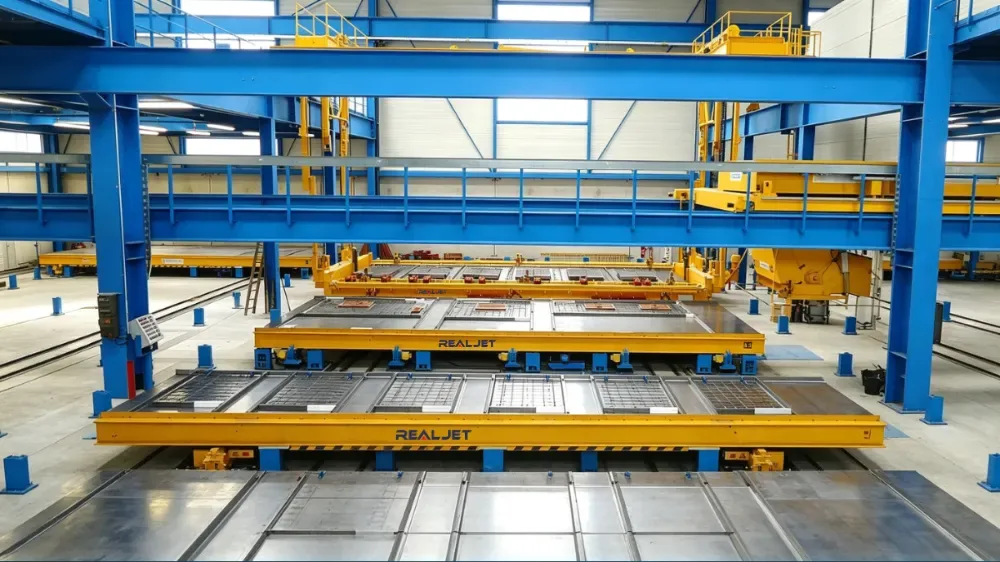
A slab mould is often judged by its casting face. The buyer looks at panel thickness, edge profiles and surface finish. The part that decides whether the mould works on a given line is underneath: the base frame and the way it meets the pallet or casting car. A stiff mould on a twisted pallet will not hold geometry, and a well-made pallet with a flexible mould base will lose it under vibration. This guide covers the interface as a purchase item, so a buyer can describe it in an enquiry instead of discovering it during installation.
Why the base belongs in the enquiry
The mould and the pallet are two separate purchases in many projects. The mould may come from a steel fabricator, the pallet from the line supplier, and the plant may already own cars from an earlier investment. Each party can produce a drawing that is correct on its own and wrong at the joint. The interface needs a shared set of dimensions, agreed before either item is released for fabrication.
Start with the production route. A fixed casting table asks a different question from a circulating pallet: the mould stays in one position and levelling can be done once, while a moving pallet must stay aligned through transfer, vibration and curing. Realjet supplies project-specific steel moulds for precast floor and roof slabs around component geometry and plant layout, so the production route is part of the technical brief rather than a later detail.
Define the datum before the plate thickness
The first line to agree is which surface of the mould is the reference. ISO 1101:2017 defines the symbol language for geometrical specification, including form, orientation and location. On a slab mould, the useful datum is usually the casting face or a machined pad related to it, not the outside of the base frame. Naming the datum on both the mould drawing and the pallet drawing prevents two suppliers from measuring from different edges.
General welded tolerances need a stated class as well. ISO 13920:2023 gives four classes for length, angle, shape and position of welded structures, and says that documentation without an adequate reference to general tolerances is incomplete. A drawing that shows a flat base and a tight casting face but omits the class leaves the fabricator to choose. Choose it in the order, and identify which features are exceptions.
Flatness is a shared result
A slab mould needs the casting surface to sit flat through the pour. Flatness at the works is not the same as flatness on the line. The pallet may have its own crown, the support rollers may be worn, and the vibration table may deflect under load. Ask for the flatness of the mould alone, the pallet alone and the assembled combination, with the measurement conditions written down.
The combined measurement is the one that matters. A buyer who measures the mould on trestles and the pallet on the workshop floor has no evidence about the pair. Ask the supplier to state how the combined assembly will be checked, at what load and at which support points. For a wider view of the product family, the precast mould range explains how moulds are grouped by the component they produce.
Clamping defines who can change the mould
A base frame can be welded to a pallet, bolted through slotted holes, or located on pads with clamps. Each choice has a consequence. A welded base is cheap and permanent, and it commits the pallet to one mould. Bolted and clamped arrangements allow a pallet to carry several moulds in sequence, at the cost of a locating feature that must be protected from concrete spill.
State the changeover expectation in the enquiry. If the buyer plans to run two slab sizes on one car, the number of changeovers per week and the time allowed for each belong in the brief. That number drives the clamp design and the tolerance on the locating pads. It also decides whether the buyer needs spare locating parts. The building component mould category groups the mould families where this kind of shared pallet is common.
A clamped joint also needs a rule for concrete that enters the interface. Specify whether the base is sealed, whether there is a drain path, and how the pads are cleaned. A detail that is easy to wipe at the end of a shift is worth more than a tighter nominal tolerance that cannot be reached after the first pour.
Vibration must pass through the joint
Slab production often uses vibration to consolidate the mix. The energy has to travel from the table through the pallet and into the mould without loosening the fixings. A rigid clamping pattern at the perimeter can isolate the centre of a large mould; a base with too few stiffeners can flex and open the joint under repeated vibration. Ask the supplier to state the assumed excitation and how the base was checked for it.
Keep this separate from prestressing. A prestressing bed carries force along the component and its anchorage belongs to the bed design. A pallet-mounted slab mould generally carries vibration and handling loads rather than the full tensioning force. If the same line will do both, the interface needs to be reviewed for each condition. The vibration and compaction guide explains where those inputs enter a line specification.
Fitting the mould into a circulation line
On a circulation line, the pallet is moved by a ferry or transfer car, then parked for casting and curing. Every move applies a horizontal load to the mould base. Bolts and clamps should be checked for that load, and any protrusion below the pallet should be reviewed against the transfer equipment. Ask for the envelope of the loaded pallet, including the mould, and compare it with the line's transfer path.
The number of pallets in circulation sets how often the mould is handled, which is a separate question from its stiffness. The pallet fleet guide covers how fleet size is calculated. If the buyer is comparing fixed and moving production routes, the fixed and circulation line comparison sets out the wider trade-off.
Inspection evidence to request
Ask for a dimensional record of the assembled mould and pallet, with the datum scheme and the instrument used. ACI PRC-347-14(21) treats contract documents, tolerances, inspection and adjustment as part of formwork work, and includes a section on site precasting. It is a general formwork guide rather than a steel mould specification, so use it to frame the questions rather than as a acceptance limit for a particular slab.
A workshop trial is useful when the mould is new or the pallet is reused. Record the first cast, the joint line and any movement at the clamps. The approval drawings guide explains what the buyer should approve before steel is cut, and the mould weight and lifting points guide covers the handling loads that a heavy slab mould adds to the pallet. Structural repair welds on a base frame should be recorded against a welding quality basis such as ISO 3834-2.
Who decides what
The buyer owns the component geometry, the production route and the pallets already on site. The mould supplier owns the base design, the locating features and the dimensional record for the mould. The line supplier owns the pallet or car and the transfer interface. Where a mould is fitted to an existing pallet, someone must own the adaptation, and that name should appear in the order.
No mould purchase implies a complete production line. A mould order covers the steel form and the agreed interface; casting equipment, curing, handling and batching remain separate scope. To review the surrounding package, see the precast production line page.
Put the interface on one drawing
For the enquiry, send the slab drawing, the pallet drawing if one exists, the expected production route and the changeover plan. Ask for one interface drawing back, showing datum, flatness, clamp positions, loads and the accepted general tolerance class. Send the same brief to every bidder.
The base and pallet are not the visible part of a mould, but they decide whether the visible part stays accurate. Agreeing them before fabrication is cheaper than adjusting a loaded pallet on site. To discuss a slab mould against your pallet arrangement, start with the floor and roof slab mould page and include the interface brief with your enquiry.