
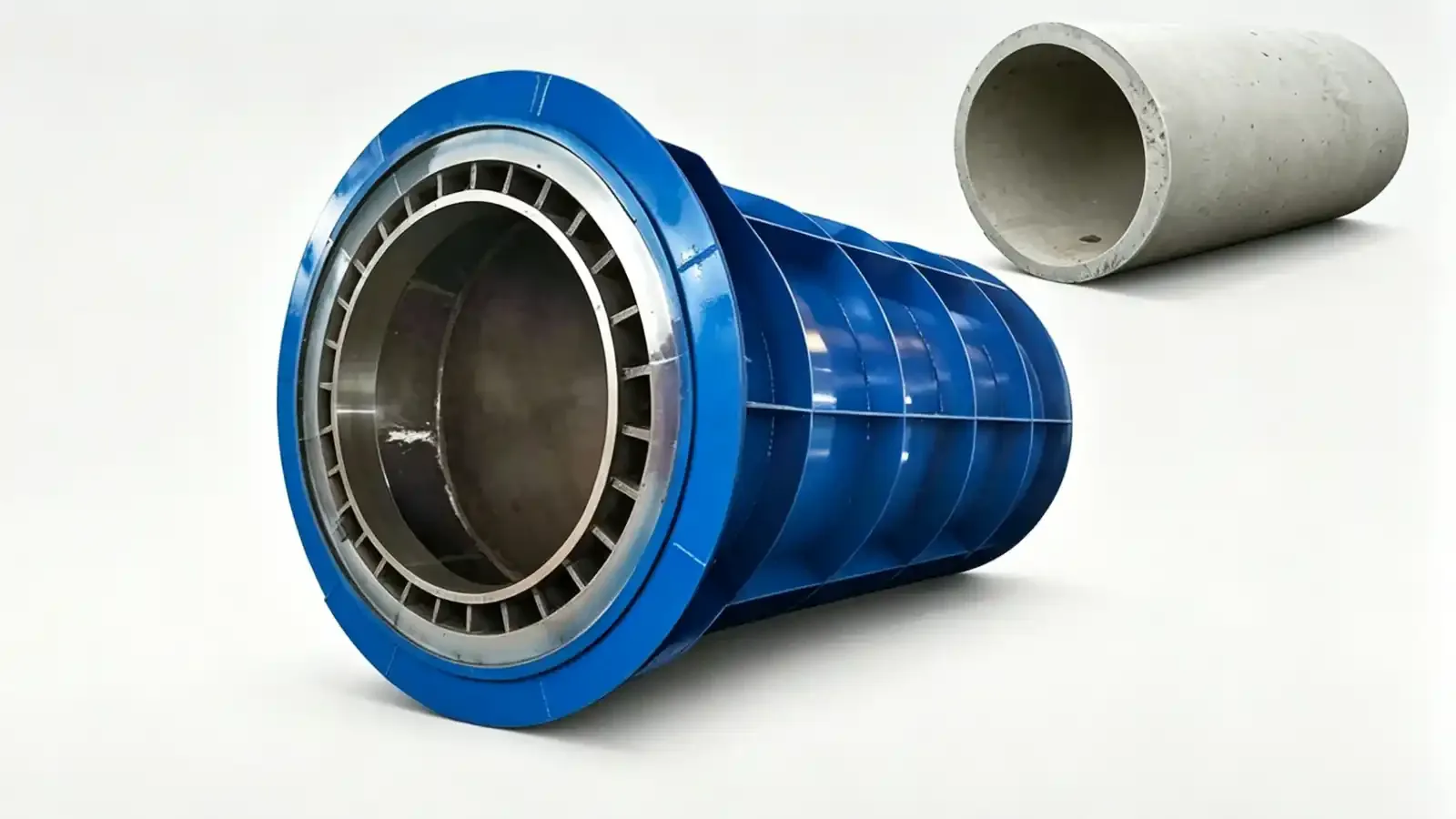
The question a cast count cannot answer
Buyers asking how many casts a pipe mould will deliver are asking for a number that does not exist in the standards. A steel mould used on a precast line may run for years on one section and fail early on another. The difference comes from the mix, the release practice, the stripping method, the reinforcement configuration and how the mould was handled between casts. A supplier who quotes a universal life is stating an assumption about casting practice. It is not a property of the steel.
The useful question is narrower. Ask what condition will make a mould stop producing acceptable pipe, who measures that condition, and what evidence will be handed over when the mould is new. Seen that way, mould life is a contract question about acceptance limits and records. The producer owns the casting practice. The designer owns the pipe class and joint geometry. The mould supplier owns the steelwork and the dimensional records against the approved component drawing. A buyer who separates those three roles can compare offers on a common basis.
What actually ends a pipe mould's useful life
A pipe mould rarely fails all at once; it drifts out of tolerance. The inside diameter moves as the shell wears or deforms. The joint face loses its true plane, so a gasket joint no longer seals consistently. The bell or spigot profile rounds at the contact edge. The exterior surface picks up weld repair marks or corrosion pits that print onto the concrete. Any one of these can turn a mould that still looks sound into a source of rejected units.
Handling damage is the other route. A mould dropped from a crane, struck by a cage or forced open after a sticky cast will carry a local deformation that no amount of release agent fixes. That is why the lifting arrangement and the stripping sequence belong in the purchase discussion, not just in the operating manual. The mould weight and lifting points in a precast line order covers the equipment side of that question.
The product standard sets the acceptance
A mould is judged by the pipe it makes. For reinforced concrete culvert, storm drain and sewer pipe in North American practice, ASTM C76-25 is the current purchase and manufacturing specification. It covers five strength classes, materials, reinforcement arrangements and the physical tests used to judge the product. The standard is explicitly a manufacturing and purchase specification, not an installation guide. The owner must relate field requirements to the chosen class.
That distinction matters when a buyer asks a mould supplier to guarantee pipe performance. The supplier can guarantee the mould geometry and the dimensional records taken against the approved drawing. It cannot guarantee a class that depends on reinforcement, mix and testing controlled elsewhere. Put the pipe standard and the class in the buyer's specification, then ask the mould supplier to state which mould features are held to that geometry and how they will be measured.
Surface finish and the first accepted cast
A new mould is judged by its first accepted cast as well as by its dimensions. ACI PRC-347-14(21) deals with the contract documents, design, construction and materials of formwork, and includes sections on form coatings, release agents, inspection and surface irregularities. It gives a framework for deciding what a formed surface should look like before production begins.
Agree the reference area and the acceptance rule for that first cast. Which face counts, how many bugholes are tolerated, and whether a repair is allowed before acceptance are all questions for the project team. The mould supplier should be present when the decision is made, because the answer can require a change to the casting face or the joint finish. A first cast accepted without a written record becomes a memory, and memories change when a new quality manager arrives.
A datum scheme makes wear measurable
Wear only becomes a purchasing fact when it is measured against a stable reference. ISO 1101 provides the language for geometric specification, so the mould drawing should name the datums from which diameter, joint flatness and profile are checked. Without that scheme, two inspectors can measure the same mould and reach different conclusions.
General tolerances for the welded structure are a separate layer. ISO 13920:2023 states that documentation with linear, angular, shape or position indications is incomplete without a reference to general tolerances, and that the chosen class follows the functional requirement. Name the class for the mould frame, then specify individual tolerances on the casting face and joint interfaces. The approach mirrors the tolerances specified for a production line mould order, but the acceptance limit here is the pipe the mould produces.
Ask for the measurement record to include the instrument, the datum, the date and the cast count at the time of measurement. A set of numbers without a cast count cannot show a wear trend. A trend with a cast count can tell the buyer when to schedule a refurbishment before rejection starts.
Wear parts and repair scope
Some mould components are intended to be replaced. Joint strips, clamps, pivots, release fittings and local liner plates wear faster than the shell. Decide which of these are supply items in the first order and which are consumables the producer buys locally. The wear parts to include in a precast production line order sets out how to make that list before the line starts.
Repair scope is a harder conversation. A welded repair to a shell or a flange is structural work, and it should be described with the same care as the original fabrication. ISO 3834-2:2021 applies to fusion welding quality requirements and was confirmed in 2026. Say who authorises a repair, which standard governs it, and whether the repaired zone is re-measured against the original drawing. A mould repaired without a record loses the traceability that made its life predictable.
Refurbishment or a new mould
At some point the cost of returning a mould to tolerance approaches the cost of a replacement. There is no universal cast count at which that happens, because shell thickness, joint design and the number of previous repairs vary. The decision should follow the measurement trend and the current rejection rate.
Put the criteria into the order. Define the dimensional limit at which a mould is withdrawn from production, the condition in which it can be repaired, and who reviews the decision. The same logic is used in refurbish or replace drainage channel moulds. A buyer with a clear rule can plan replacement castings into an annual budget instead of discovering them in a rejected batch.
Where to buy the mould
The three levels of the catalogue matter here because they separate application from product. The general mould range shows the steel formwork and the quality checks described across the catalogue. The municipal family groups the pipe, manhole and drainage products that share the same casting constraints. The concrete pipe item then fixes the geometry and the enquiry route.
Keeping those levels distinct avoids a common mistake. A buyer who orders from a general catalogue heading may receive a mould suited to a different joint system. Confirm the product slug against the approved section drawing before the order is placed.
What the order should state
A short life-related brief can be added to a normal mould enquiry without turning it into a maintenance contract. It should name the section and class, the drawing revision, the datum scheme, the first cast acceptance rule, the measurement records and the repair authorisation. The details of the casting process remain with the producer.
| Item | Buyer or designer | Mould supplier |
|---|---|---|
| Pipe class and joint | Selected and frozen | Mould geometry to match |
| First cast acceptance | Witnessed and signed | Casting face and joint finish |
| Wear limits | Set from product tolerance | Measurement records and datum scheme |
For the equipment context around the mould, the precast production line page describes the casting, curing and handling package. A mould ordered for a line should be checked against the same output assumptions used to size that line.
Where the responsibility sits
A service life can only be predicted when the boundaries are clear. The designer fixes the pipe class and joint geometry. The buyer controls the mix, the release practice, the stripping method and the production records. The supplier delivers the steel mould, the dimensional records and the agreed repair scope. Realjet designs project specific steel moulds around component geometry, casting method and plant layout, with dimensional records agreed against the component drawing.
Buyers comparing offers should ask each supplier to state what it will measure, when it will measure it, and what happens when a mould drifts outside the agreed limit. An answer written into the order is worth more than a promised number of casts.
Where to take the question
Bring the approved pipe section, the joint detail, the product class and the expected annual quantity to the enquiry. Ask for the datum scheme, the first cast procedure and the dimensional record as part of the offer, not as documents to be produced later. Those three items turn a vague life question into a set of conditions both parties can check.
Start with the concrete pipe mould product page for the section geometry, then follow the municipal infrastructure moulds category and the precast concrete moulds catalogue to see where the product sits in the wider range.