
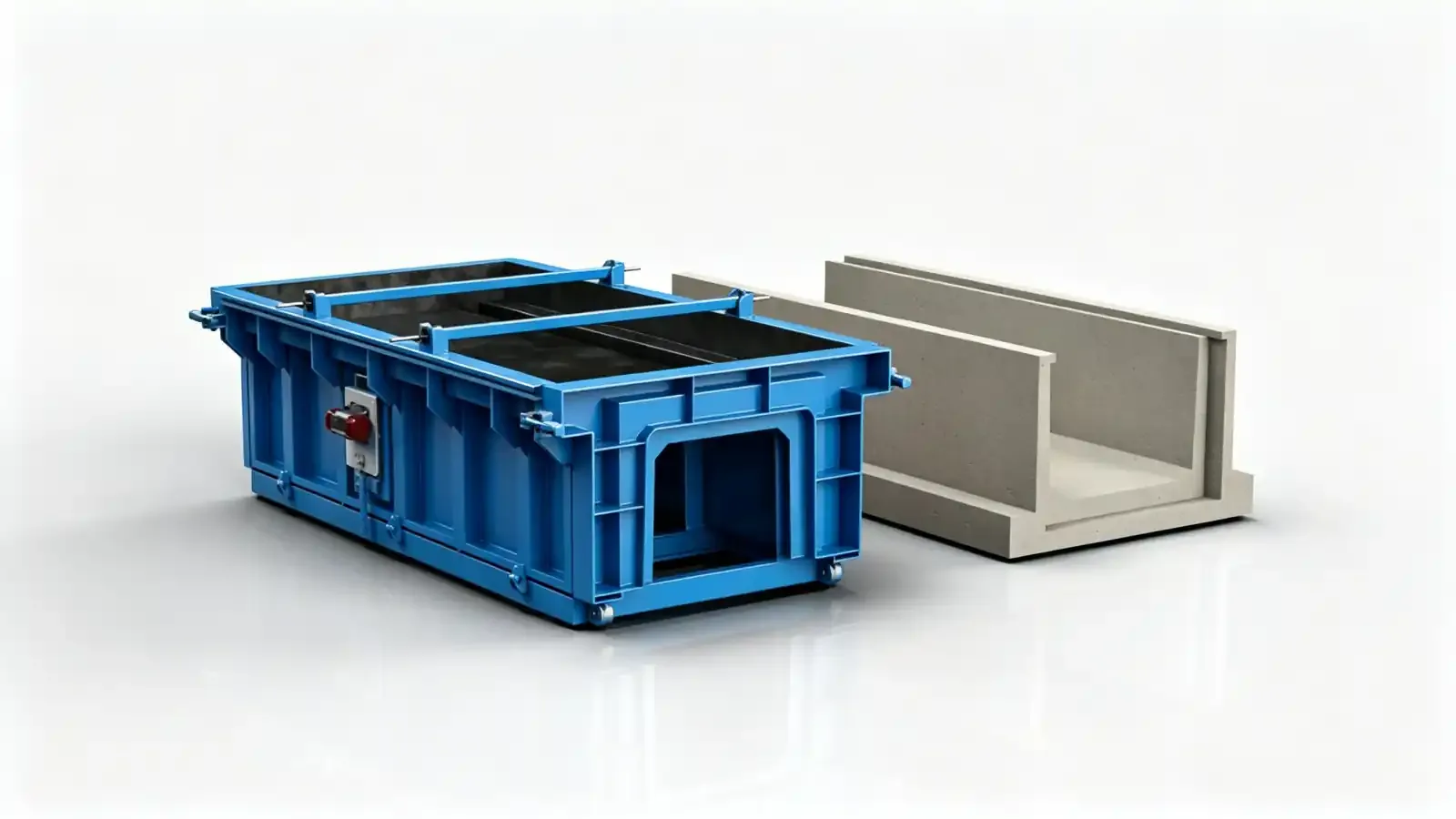
The decision arrives before the next casting run
A drainage channel mould does not fail all at once. The casting face loses its edge definition, the joints open a little, a corner starts to catch on stripping, and the finish needs more hand work each week. At some point the plant has to decide whether to repair the mould or order a new one.
That decision belongs in purchasing. It decides what goes into the next enquiry, what evidence the supplier must provide, and who takes responsibility for the dimensional result afterwards. A buyer who treats it as a workshop question usually ends up with a refurbished mould that nobody will stand behind.
The logic differs from the modification or new build decision, which starts with a change in the component geometry. Here the product is unchanged. What has changed is the condition of the tool that makes it.
Three levels of link, three different questions
Drainage channel moulds sit in the municipal infrastructure mould family, alongside products for roads, water and drainage networks. The precast concrete mould catalogue places that family next to the bridge, building and tunnel ranges.
Each level answers a different question. The catalogue answers what kind of mould is being discussed. The category page answers which products share the same production and handling constraints. The product page answers what a drainage channel mould actually has to form: the channel section, the joint geometry and the load-class-related dimensions that the finished unit must meet.
A refurbishment quote that does not reference the same geometry as the original order is not comparable to a new mould quote. Use the product page as the reference point in the enquiry so both bidders work from the same section.
Why channels wear in a particular pattern
Drainage channels are long, repetitive units cast in high numbers. The mould sees many stripping cycles, and the wear concentrates in predictable places: the top edges of the casting face, the joint lines between side sections, and the internal corners where the concrete abrades during demoulding.
Load class is part of the picture. The drainage channel load class guide explains how the class and joint arrangement shape the mould. A heavier class with a thicker section does not automatically make a longer-lasting mould, but it changes where stress sits at the joints and how much force the stripping operation needs.
A buyer should not accept a blanket statement that a mould "lasts a certain number of casts." There is no universal figure, and the number depends on the mix, the release practice, the stripping method and the finish class. ACI 347 treats formwork economy and the condition of formed surfaces as design and construction questions, not as a single life figure. Its chapters on tolerances, irregularities in formed surfaces and inspection are the right references for deciding whether a mould is still capable of producing the specified unit.
Measure the mould before asking for a price
The first step is a measured condition report, not a refurbishment quote. Without it, a buyer is asking a supplier to price an unknown object.
The report should record the internal section at several stations along the mould, the flatness of the casting face, the condition of the joints and the width of any gaps, and the thickness of the plate at the areas that wear first. Photographs tied to measured locations make the report usable by someone who has not seen the mould.
Dimensions should be stated against a datum scheme, with tolerances written to ISO 1101, rather than as a list of unrelated measurements. A note that the channel width is out by a few millimetres is not actionable. A note that says where it was measured, against which datum, with which instrument and against which tolerance, is.
The same applies to surface condition. ACI 347.3 defines four quality levels for formed concrete surfaces and describes how to evaluate deviations against them. If the buyer's finish requirement is stated in those terms, the mould condition can be compared with the finish it is expected to produce, instead of being described as "tired" or "still good."
What refurbishment can honestly restore
Refurbishment is a set of operations, and each one has a limit. Re-facing a worn casting face can restore edge definition and surface finish. Rebuilding a joint face can close a gap that is printing onto every unit. Replacing hinge pins, wedges and bolts can restore the opening sequence. Local weld repair can deal with a cracked rib or a damaged corner.
What refurbishment cannot do is restore material that is no longer there, or correct a structure that has moved. If the plate has thinned across a wide area, the stiffness has gone with it. If the mould has been dropped or badly stored, the geometry may be out beyond what a face rebuild can fix. Those are new-build conditions even if the mould still looks serviceable.
Any repair welding also needs a quality basis. ISO 3834-2:2021 sets comprehensive quality requirements for fusion welding and is the reference to name when a repair is structural rather than cosmetic. Ask the bidder which welding procedure applies to the repair and how the result will be inspected.
Corrosion belongs in the same assessment. The corrosivity categories of ISO 12944-2 give a way to describe the environment the mould has been stored in and the coating condition it now has. Surface preparation before any re-coating should be stated as a grade, not left as "clean and paint."
When replacement is the better purchase
Replacement becomes the better option in four situations. The component drawing has changed and the mould cannot absorb the change without a rebuild. The structure has lost section or moved out of geometry. The mould has already been refurbished more than once and the drawings no longer match the object. Or the finish class has moved up, and the existing casting face cannot deliver it at any reasonable repair cost.
There is also a commercial test. A refurbishment quote that approaches the cost of a new mould should be compared against the value of keeping the old one, including the downtime while it is out of production and the risk that the repair does not hold. The cost-per-cast approach sets out how to spread a mould purchase over accepted units; the same arithmetic works for a refurbishment, with a shorter remaining horizon.
The mould wear parts guide is worth reading alongside this. Some of what looks like a refurbishment is simply a set of replaceable items that should have been in the original order, and ordering those separately may be cheaper than a full repair.
Comparing the two offers on one page
A refurbishment quote and a new mould quote are only comparable if they promise the same output. Ask both bidders to state:
- The internal section and tolerance the finished mould will hold, against the component drawing
- The finish class the casting face will produce, with the reference used to define it
- The scope of work in enough detail to see which parts are repaired and which are replaced
- The inspection and dimensional record that will be handed over
- What happens if the first cast does not meet the agreed geometry or finish
The last item carries more weight than the price. A supplier who will accept a first-cast test and rework the face until it passes is offering something different from one who guarantees only the repair operation.
The mould joints and grout loss guide explains why joint condition matters to the finished unit. In a refurbishment, the joint is usually the part most likely to be overlooked in the quote and most likely to be noticed on the first cast.
Who owns which decision
The product geometry and the finish class belong to the designer of the precast element, or to the buyer acting on the designer's instructions. The mould supplier, whether repairing or building new, is responsible for the steel: its stiffness, its joints, its stripping behaviour and its dimensional record. The plant operator owns the casting practice that determines how quickly the next mould will wear.
Realjet engineers project-specific steel moulds around component geometry, casting method and plant layout, with dimensional records agreed against the component drawing. Refurbishment is assessed on the same basis: the condition survey and the repair together have to return a mould that can produce the drawn component. The company does not set the product geometry, and a repair order does not transfer that responsibility.
Where a mould is being replaced rather than repaired, the enquiry should state the casting method and the curing arrangement the new tool must work with. The floor and roof slab mould RFQ guide gives an example of the inputs a mould supplier needs, and the same list applies to a drainage channel replacement.
What to send with the enquiry
A buyer who wants a firm comparison sends the condition report, the current component drawing with its revision, the original mould drawings if they survive, the finish class, the casting and stripping method, and the number of units the mould must still produce. A supplier who receives all of those can price a refurbishment against a new build on equal terms. One who receives a photograph and a question about price will return a number that changes later.
Where to go next
Start from the drainage channel mould page to confirm the section and joint geometry being ordered, then use the municipal mould family to see the related products and the full catalogue for the other families. For buyers who are also reviewing the line the mould will run on, the precast beam production line page covers the equipment and handling context.