
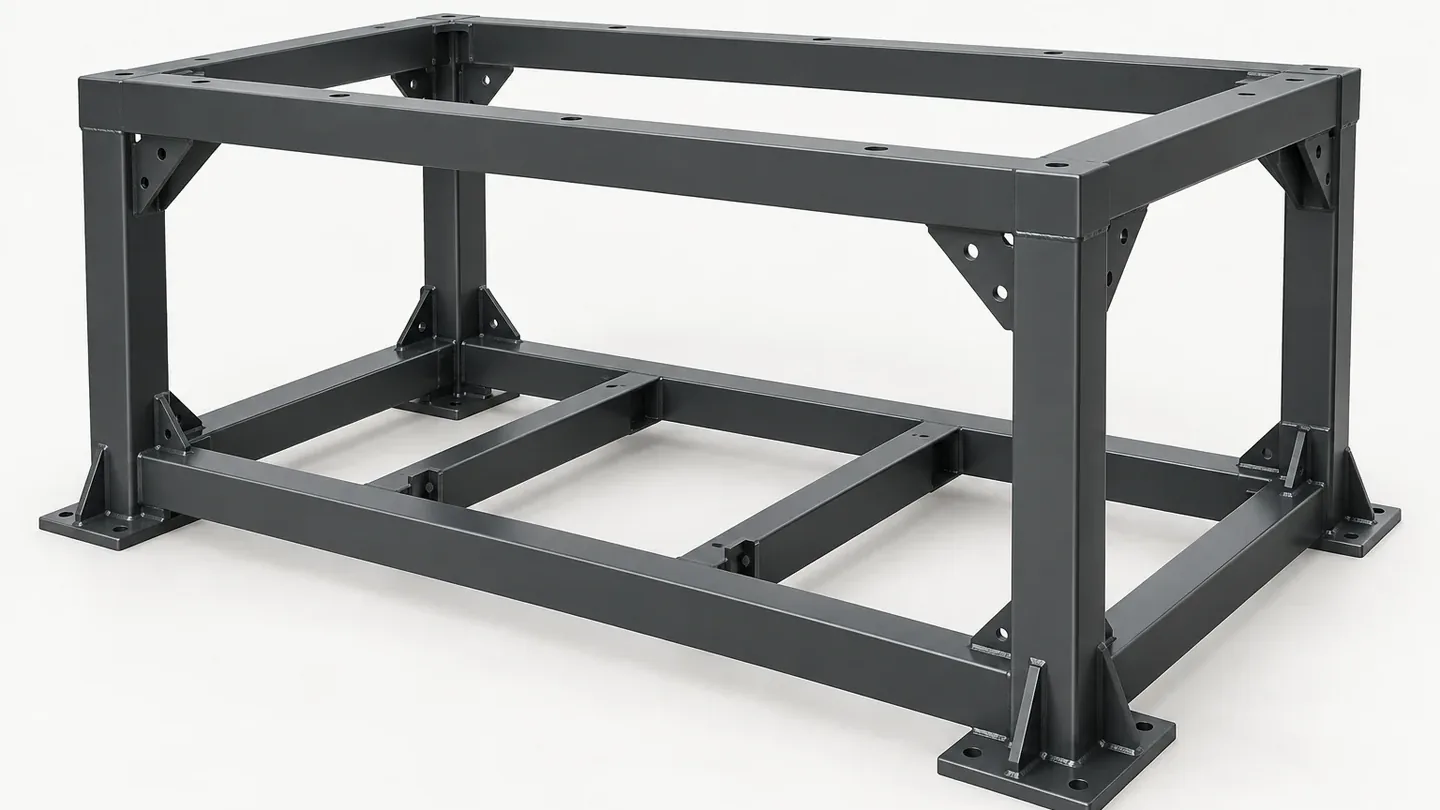
A stillage is a manufactured part
Buyers often file transport frames under packing and send them to a supplier late in the order. That classification hides the engineering. A steel stillage is a welded structure with a load path, contact surfaces, lifting features and dimensional interfaces. It is made from the same plate, section and welding processes as the machinery frame it carries, and it needs the same drawing discipline. Treating it as an afterthought leaves machined faces scored, stacks leaning and returnable frames written off after one trip.
Realjet makes welded machine frames, structures and equipment supports to customer drawings and machines interfaces after fabrication. A transport frame ordered under the same made-to-drawing contract manufacturing service sits inside that capability. It does not extend to product design: the buyer or the designer supplies the load cases, the part envelope and the handling concept.
Start with the part, not the frame
The useful input is the part, not a picture of a similar stillage. Give the supplier the overall envelope of the item being carried, its mass, the location of its centre of gravity, and how many parts ride in one frame. Mark the faces that must stay untouched. A housing with a ground sealing face and a welded bracket with a painted finish need different contact arrangements, even when both weigh the same.
Orientation matters as much as mass. A long beam lying flat distributes load along its length; stood on end, it concentrates load at one foot and changes the tipping behaviour during a fork lift. State the intended orientation in the frame and show it on the drawing. If the part is delivered in more than one orientation through the chain, say so, because a frame designed for one posture can be unsafe in another.
Define the load path before the shape
A frame has to survive four different conditions: static stacking, fork or pallet handling, crane lifts, and the accelerations of road or sea transport. A section that passes a static stack check can still crack at a lift lug when the load swings. Ask the buyer's handling engineer to state which of these conditions applies and at what load, then let the fabricator size members and welds against that brief.
For sea shipments, the IMO cargo stowage and securing code is the reference that ship planners work to. It does not certify a stillage. It explains why tie-down points, stacking locks and clear marking of lifting positions belong on the drawing rather than on a packing note written after manufacture.
Stacking and nesting change the geometry
Returnable frames earn their cost through repeated trips, and stacking is what makes the return trip economic. A stackable frame needs locating features that work without visual alignment from above: tapered feet, corner sockets or positive stops. The design must also say what happens when a stack is misaligned, because forcing a stubborn frame into place damages the coating and the locators together.
Nesting is the opposite requirement. Frames that collapse into one another save space on the return leg but need a clean release after a loaded trip. Dirt, paint build-up and bent members are the usual causes of a nested stack that will not separate. Write the empty-frame height, the loaded stack height and the maximum stack count into the specification so that warehouse and shipping can plan the same geometry.
Protect the machined interfaces
The frame's job is to keep the part's datum surfaces away from steel. Specify the contact points, the material at those points and how it is fixed. Hard wooden blocks, bolted polymer pads or shaped cradles all work, but each has a replacement cycle and a contamination risk. A pad that can slide under load will polish a machined face even when no impact occurs.
Where a part leaves the shop with a protective coating or a masked bore, state whether the frame contact is allowed on that surface. Coating damage at a contact point is often discovered only at the customer's goods-in, when the supplier and the carrier each assume the other checked. A short contact diagram, with the allowed and forbidden zones drawn on the part, removes that argument.
Datums and tolerances belong on the frame drawing
A stillage that locates a part for machining or inspection is more than packaging. If the part is clamped in the frame for a measuring operation, the frame's repeatability becomes part of the measurement. ISO 1101 gives the geometric specification language for those interfaces, and it should be applied to the locating features, not to the whole structure.
General welded construction tolerances have their own reference. ISO 13920:2023 states that manufacturing documentation with linear, angular, shape or position indications is incomplete without a reference to general tolerances. Name the class on the stillage drawing, then add individual tolerances only where a locator has to repeat. The same distinction drives tolerance stack-up in a welded frame: tightening everything raises cost without improving the one interface that matters.
Welding quality is a specified property
A frame that carries a load is welded work, so the order should name the quality basis. ISO 3834-2:2021 sets comprehensive quality requirements for fusion welding and was confirmed again in 2026. ISO 5817:2023 defines quality levels B, C and D for imperfections in fusion welded joints, with B the highest requirement. Neither document picks a level for the buyer.
Name the level for each weld group, along with the inspection method and extent. A lift lug weld and a cosmetic stiffener do not need the same treatment. Ask for the dimensional report taken after welding and before painting, referenced to the same datums used on the part. A trial assembly and dimensional inspection of a first frame catches a locator error while correction is still cheap.
Material certificates, records and identity
Traceability on a transport frame is usually lighter than on the part, but it should be explicit. State whether the steel grade needs a certificate, whether heat numbers must be transferred to the finished frame, and whether welders and filler metals need to be recorded. The same principles that apply to material certificates and traceability in contract manufacturing apply here, scaled to the consequence of failure.
Give each frame a permanent identity marking that survives washing and outdoor storage. A serial number tied to a drawing revision lets an owner withdraw a batch when a locator is found to be wrong. Without it, a frame fleet becomes indistinguishable and a single defective group stays in circulation until something is damaged.
Export packing and the handover point
The frame often sits at the boundary between two contracts. One party supplies the frame, another loads the part, a third arranges shipping and a fourth receives it. Write down who fits the pads, who tightens the restraints, who seals the frame and who owns the packing list. The packaging and export scope in a manufacturing enquiry covers the paperwork side of that boundary.
State the delivery term and the unloading responsibility. A frame delivered on a truck without a fork pocket on the correct face can trap a consignment at site, especially when the receiver has only a forklift. The same question arises when the frame is returnable: who pays for the return leg, who inspects it on arrival, and what condition counts as fair wear.
Who owns the frame
Ownership changes the commercial answer. A frame included in the part price is usually written off into that order. A returnable fleet is an asset with a tracking system, a repair budget and a deposit or loan arrangement. Buyers who expect repeated orders should raise ownership early, for the reasons set out in fixture ownership in a contract manufacturing order.
The design authority is a separate question. A frame designed by the supplier for the buyer's stated loads carries supplier responsibility for the structure. A frame designed by the buyer and sent out for fabrication carries buyer responsibility for the load cases, with the supplier responsible for making it as drawn. Mixing the two produces a frame nobody owns. Put the name of the responsible designer on the drawing title block.
What to put in the enquiry
A short, specific brief gives bidders a comparable basis. The table below is the minimum set for a returnable frame that will be used more than once.
| Item | What to state | Why it matters |
|---|---|---|
| Part data | Envelope, mass, centre of gravity, orientation | Fixes the load path and contact points |
| Handling | Fork, crane, stack count, transport mode | Decides lifting and tie-down features |
| Interfaces | Contact zones, forbidden zones, locator datums | Protects machined faces and repeatability |
| Quality basis | Weld quality level, inspection extent, records | Makes inspection comparable between bidders |
Ask for a drawing with the brief, not a price alone. The drawing should show the frame loaded and empty, with the stack arrangement and the lifting positions marked. If a supplier proposes a change to the structure, require it in writing against the drawing revision.
Where to take the question
A transport frame is worth specifying when the part is heavy, the machined faces are exposed, or the same journey happens many times. It is less useful for a one-off small part that can travel in a standard crate. Decide that first, then put the handling and interface requirements into the enquiry rather than leaving them to the packer.
For a made-to-drawing welded structure with machined or inspected interfaces, start with the steel frame fabrication product page. Describe the part and the journey, and ask the supplier to confirm which parts of the frame design belong to the buyer and which belong to the fabricator.