
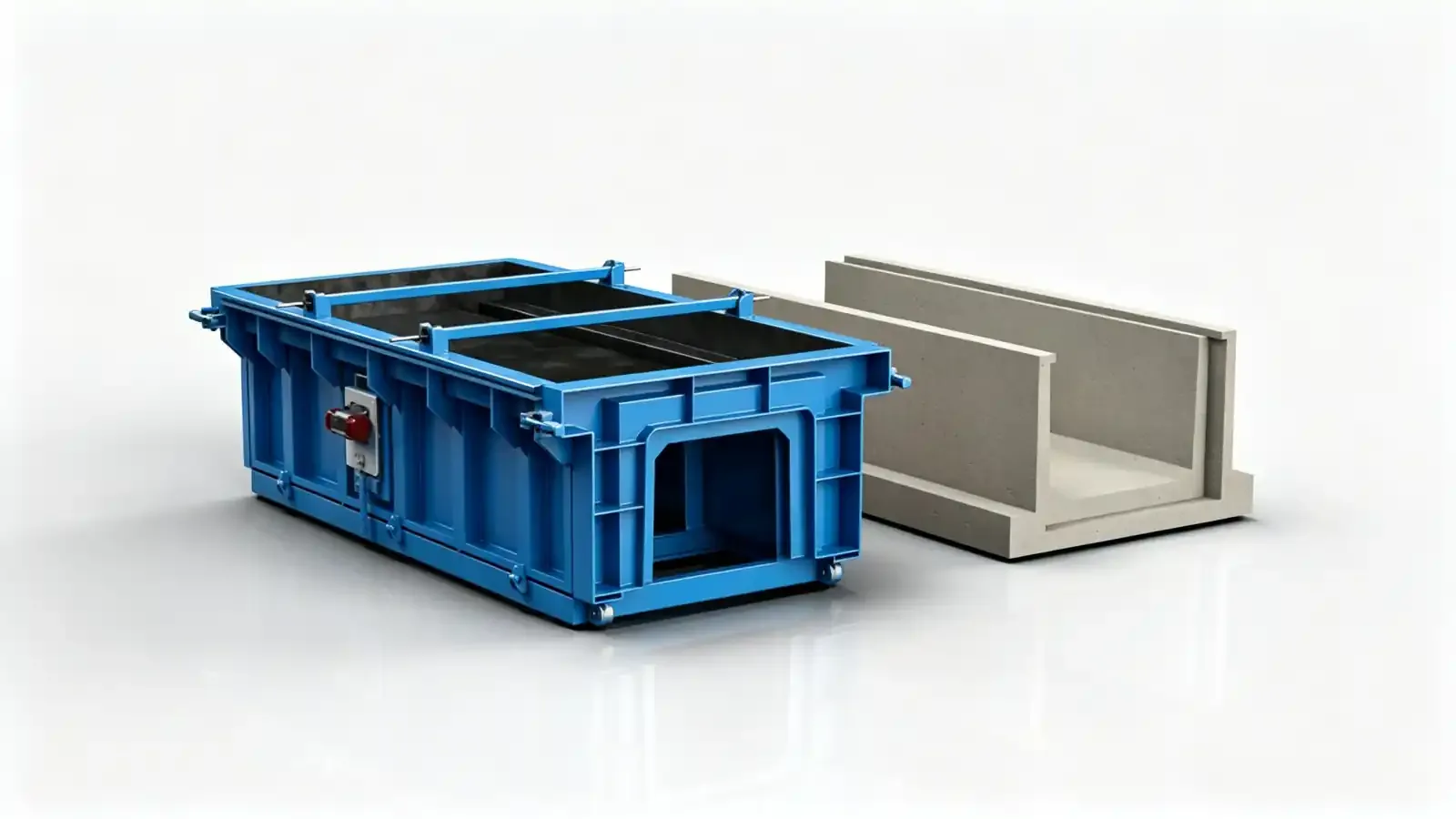
What the line actually produces
A precast drainage channel production line makes the concrete channels that collect surface water along roads, paved areas, ports and yards. The common shapes are U channels and slot or kerb drainage units, cast in steel moulds and supplied in lengths that a crew can handle. The line does not make the drainage system by itself. It produces the channel sections and, where the mould allows, the matching covers or inverts that the project specification calls for.
Buyers new to the product often compare it with concrete pipe. Both are municipal precast items, both use steel moulds, and both are judged on how well a buried or trafficked unit keeps its shape. The differences matter at the line level. A channel is usually short, open at the top and cast with a defined slope or outlet. That makes mould turnover and demoulding access more important than the pipe making question of how a long cylinder leaves its form. The precast concrete pipe production line is a useful contrast, as is the kerb and barrier production line when the unit sits at the road edge.
The product standard sets the buying brief
Before choosing equipment, establish what a compliant channel is in the market where it will be used. In Europe, BS EN 1433:2002 covers drainage channels for vehicular and pedestrian areas. Its title describes the full scope: classification, design, testing requirements, marking and evaluation of conformity. BSI records the standard as current. The buyer's designer selects the class and the installation condition. A line supplier cannot choose it on the buyer's behalf.
That split is worth writing into the enquiry. The project team owns the channel class, the joint detail and the surface water calculation. The line supplier owns the equipment that reproduces those features consistently. If the class is still under design when equipment is ordered, the order should say which mould and test interfaces will be kept adjustable and which will be fixed. Pretending the choice can be deferred until after installation is how a line ends up unable to make the unit the project actually needs.
Wet cast, dry cast and the mould family
Most U channels are wet cast: a flowing mix goes into a steel mould, compaction removes entrapped air, and the unit stays in the mould until it can be stripped. Dry cast is used where a low slump mix and immediate demoulding suit the product, commonly for smaller blocks and some kerb units. The choice follows from the section geometry, the specified surface, the reinforcement or fibres, and the output the plant must sustain. The comparison in wet cast or dry cast production lines applies here as well.
The mould family follows the process. A two-part steel mould with a removable core gives an open channel with accurate internal faces. A stackable mould lets several sections cure in one footprint, but it needs a stripping sequence that does not drag the green unit. Side outlets, step irons and cover bearers all add inserts to the mould. Each insert is a changeover item, and each one affects how many casts a crew can complete in a shift.
The process chain, station by station
A line is a chain of stations with a rhythm. It starts at the mould preparation area, where forms are cleaned, released and checked. It moves to casting, where concrete is placed and compacted. It continues through curing, then stripping, then finishing and stacking. Transport between stations may be by pallet transfer, roller track or overhead crane, depending on unit mass and plant layout.
The useful question at each station is what can stop the rhythm. A mould that takes longer to clean than to fill will set the cycle. A curing area that holds one shift of output will stop casting at the end of that shift whether or not the mixer is ready. ACI PRC-347-14(21) treats formwork as a system of design, construction and materials with inspection and removal built into the sequence. That is the right level of detail for a buyer comparing line offers, even though the guide addresses formwork generally rather than a proprietary channel line.
Mould count sets the rhythm
For most channel plants, output is set by the mould fleet: how many moulds are circulating and how long each one occupies a station. If a unit needs eight hours before it can be stripped and a shift produces one cast per mould, the number of moulds sets the practical daily output. Adding a second shift without adding moulds usually adds curing pressure rather than finished units. The same arithmetic is explained in how many moulds a precast beam production line needs, although the channel section changes the numbers.
Ask bidders to state their assumed cycle time, mould count and number of casts per mould per day as separate figures. A single output figure hides the assumption. Two suppliers can quote the same daily capacity with very different mould fleets, and only one may fit the buyer's storage area and capital plan.
Batching and concrete supply
A channel line needs a batching plant that can deliver a consistent, workable mix at the moment the casting station calls for it. The interface is physical as well as procedural: discharge height, transport route, queue space and washdown all affect the layout. The batching plant interface in a precast line order sets out how to describe that boundary without selecting the supplier's plant design.
State who owns the mix design and who releases a batch. If the buyer already operates a batching plant, the line supplier needs its hourly output, discharge arrangement and quality records. If the plant is part of the package, the buyer needs the mix envelope, the consistence range and the trial batch evidence. The line supplier should not be asked to guarantee a channel class that depends on a mix controlled by someone else.
Curing space and release
Curing drives the footprint of a channel plant more than the casting station does. Units may be covered and left in the mould, stripped early and moved to a curing area, or heated to shorten the cycle. Each route needs a different amount of floor area and a different control system. The curing system RFQ for a precast line shows how to state a release criterion and then let bidders propose the equipment.
The release decision belongs to the producer, under the project specification. A line supplier can provide temperature control and records, but cannot set the strength at which a channel may be stripped unless the buyer's engineer has defined it. Write down who signs off the first cast, what measurements are taken, and whether the result becomes a standing instruction for later casts.
Handling, stacking and packing
A finished channel is stacked, strapped and moved to storage before it goes to a site. Short open sections can be nested, but nesting is limited by the internal taper and by the cover units that may sit inside. Ask for the stack height, the nest count and the lifting arrangement in writing. A crane or a fork attachment that works for a single section may damage a nested stack at the support points.
Storage planning is often the constraint that appears too late. A line that produces well but has nowhere to put three days of output will stop. Include the buffer area, the access route and the loading point in the same layout review as the casting hall. The line supplier can propose equipment for transfer, but the buyer owns the site boundary and the outbound logistics.
Utilities and plant envelope
The line's utility demand follows the process choices. Wet cast needs water and washdown drainage. Accelerated curing needs steam or electricity and insulated enclosures. Handling needs compressed air or hydraulic power, and the crane needs a defined hook height and runway. State what is already on site and what the package must provide, because a buyer who assumes an existing boiler can deliver steam at the required pressure will find the assumption priced as a variation later.
For buyers planning the plant as a whole, the precast concrete plant solutions page gives the wider context of batching, curing and handling packages. Keep the line enquiry at the same level of definition: inputs, interfaces and responsibilities, rather than a list of brand preferences.
Buyer, designer and supplier responsibilities
A clean division of scope prevents most disputes on these projects. The project designer owns the channel class, joint geometry and surface requirement. The buyer owns the site, utilities, product programme and the production records policy. The line supplier owns the machines, moulds and the interfaces it proposes between them. Realjet supplies production lines and equipment as project packages covering casting equipment, moulds and the interfaces to batching, curing and handling. It does not sell the concrete channels the line produces.
Quality evidence should follow the same split. Ask for equipment records, mould drawings, control descriptions and trial production results. Do not ask the equipment supplier to certify a product whose mix and reinforcement it does not control. ISO 9001:2026 is the current edition of the management system standard and a reasonable baseline for a supplier's quality system, but it is not a product performance specification.
Where to take the question
Start with the channel section and the standard it must meet, then work backwards to mould count, curing space and utilities. A line that is sized from a generic output figure will be wrong in one of those three places. Buyers who can send a section drawing, a daily or annual quantity, the site envelope and the utilities already available will get a comparable proposal much faster.
For the equipment side of that decision, the precast production line page sets out the production line scope. Send the channel geometry and the required class, and ask the supplier to state which parts of the layout are fixed and which remain open until the section is approved.