
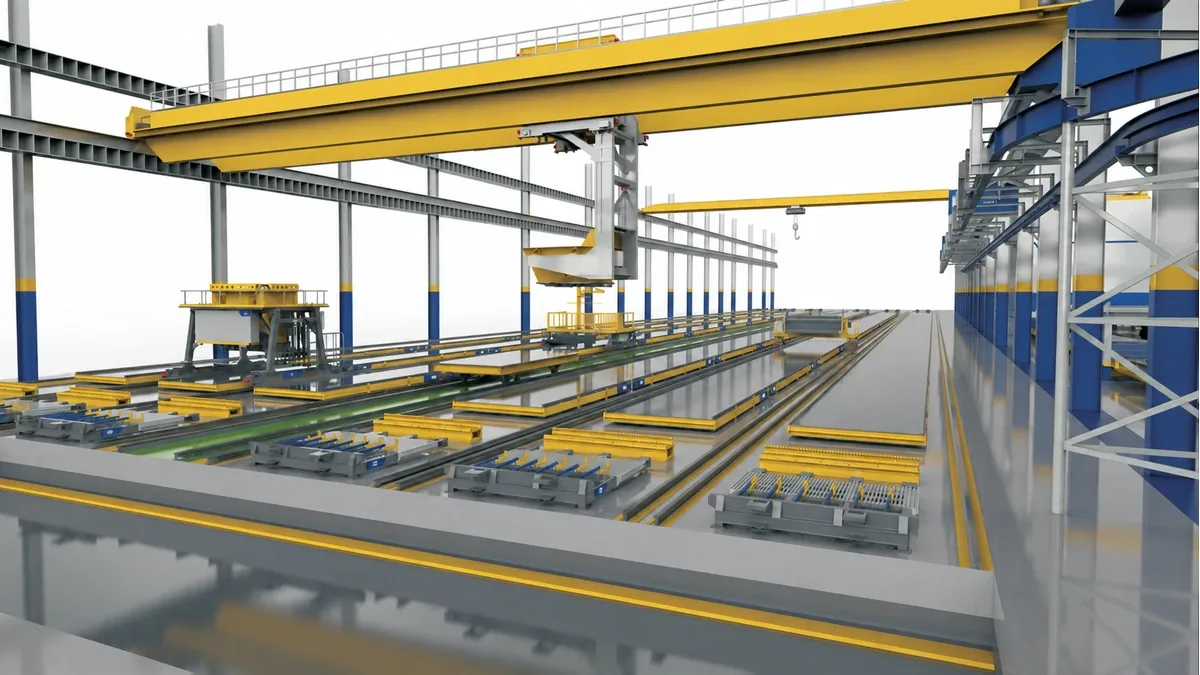
A precast retaining wall block production line is the set of stations that turns approved wall unit geometry into repeatable concrete units: moulds, batching and placing interfaces, compaction, curing, demoulding and handling. It is a group of stations rather than a single machine. The line supplier sells the means to make facing panels or retaining blocks, usually for a mechanically stabilised earth wall or a gravity wall, not the wall units themselves. The first step in specifying the line is to name the product family, because the casting route and the equipment package change with the unit.
What the wall units are
The Federal Highway Administration's 2024 manual on design and construction of mechanically stabilised earth walls notes that most permanent walls in the United States use segmental precast concrete facings with galvanised steel reinforcement. It records that a common precast segmental facing unit is about 25 square feet, roughly 2.25 square metres, and generally square, while larger units up to about 50 square feet, or 4.6 square metres, have become more common. The same source notes that dry-cast masonry blocks and wet-cast units are also used as facing, often with geogrid reinforcement.
Those families do not share one production line. A square facing panel is usually a flat, face-down wet cast with reinforcement, connection hardware and a formed texture. A dry-cast masonry block is made at much higher count on a small-block machine with a different mould and curing logic. A buyer who asks for a "retaining wall line" without naming the unit has not given the supplier enough information to quote an equipment package. The wet cast versus dry cast guide sets out the process choice in more detail.
What the designer fixes before the line is designed
The wall designer determines the facing geometry, the connection device location, the reinforcement arrangement, the concrete class and the tolerances. A South Carolina specification for mechanically stabilised earth walls requires facing panels to be cast on a flat surface with the front face down, the concrete placed without interruption and consolidated by an approved vibrator. It also requires the panel connection devices to be positioned within 1 inch of the specified dimension, other dimensions within 3/16 inch, and the difference between diagonals no more than 1/2 inch.
Those numbers belong to the product, not to the line supplier. The supplier's job is to design moulds and stations that can hold them over a defined number of cycles. If the designer allows a 3/16 inch dimensional tolerance but the mould plan cannot hold it after demoulding and thermal movement, the line will produce rejects. The enquiry should therefore carry the facing drawing and the owner's acceptance criteria, not just an output target. The mould tolerance guide explains how product tolerances translate into mould checks.
Stations in a typical facing panel line
A wet-cast facing line often begins with a mould preparation station, where the casting face is cleaned and release agent applied, followed by placement of reinforcement and connection hardware. Concrete is then distributed from the batching plant, placed into the mould and consolidated. The panel cures until it can be lifted without damage, the mould is opened, and the unit moves to a storage or finishing station.
The same South Carolina specification gives a useful picture of the controls a buyer should expect. It requires the back face to be screeded to remove open pockets of aggregate and surface distortion beyond 1/4 inch, panels to be supported until concrete reaches 1,000 psi, and curing by burlap for 36 hours or by steam. It defines an acceptance lot as 40 panels or a single day's production, whichever is less, and requires the date, lot number and panel identification to be marked on each unit. A line that cannot support those steps and records will not satisfy the specification, whatever its nominal output.
Curing and release strength decide the cycle
The casting cycle, not the number of moulds alone, sets output. A panel can leave its mould only when the concrete has enough strength for stripping and handling. If the owner's specification ties shipping or lifting to a compressive strength, the curing system has to reach that strength within the planned cycle. Steam curing, enclosure design and temperature records then become part of the equipment package rather than an afterthought.
The FHWA manual on mechanically stabilised earth walls includes a casting yard for precast facing elements in its construction chapter, alongside inspection of reinforcement, leveling pads, alignment checks and connection examples. That sequence shows why a line must be planned with the yard. A supplier can offer a fast casting table, but if the cured panels have nowhere to stand within crane reach, the table will wait. The curing system guide and the cycle time guide cover the two calculations that should sit behind the equipment schedule.
Mould count and geometry changes
Facing panels are often repeated many times, so mould reuse matters more than in a bespoke bridge beam shop. The number of mould sets follows the daily target, the cure time and the time each mould is occupied for preparation and stripping. A buyer who doubles the target without changing cure time is really buying another set of moulds and more handling, not just a faster table.
Texture and geometry also affect the mould order. The surface finish on the exposed face is formed by the mould face, so a change from a smooth face to a patterned one changes the tooling and the release regime. Where a project uses several facing shapes, the enquiry should state how many distinct geometries exist and whether they can share a pallet base. The guide to mould quantity gives the method for translating output into sets, and the line equipment package guide shows where moulds stop and the rest of the package begins.
Handling and the yard interface
A facing panel or large block is awkward to turn and stack. The line supplier and the buyer should agree who provides the lifting beam, where the crane runs and how units are supported during storage. The South Carolina specification requires handling and storage that protect the connection devices and the exposed finish, and prohibits attaching galvanized connection hardware to the face panel reinforcement. A lifting point that damages the formed face creates a rejection that no casting station can fix.
The yard also sets the storage footprint. If panels are shipped at three days after casting and at the required strength, the storage area must hold at least three days of output plus a margin for testing. That requirement is a layout input with a direct effect on the purchase. Buyers planning a new plant can start from the line layout checklist and the storage and handling guide.
What belongs in the equipment package
The practical package covers the moulds, the casting and compaction interfaces, the curing arrangement and the handling equipment needed to move a unit from the mould to the yard. It normally stops at the battery limits of batching, civil works and utilities, which may be supplied by another party. The exact boundary belongs in the order. A buyer who assumes the line supplier also provides the concrete batching plant or the building steelwork will find a gap when the site is ready.
The FHWA manual describes an approved product list process for wall systems and notes that system suppliers may engage in evaluation programmes. The facing system itself may therefore be proprietary or approved, while the equipment that makes it sits outside that approval. Realjet supplies project-specific production lines, moulds and equipment for making precast components. It does not supply the retaining wall units or certify a wall system. The precast beam factory page describes the line planning scope, and the wall panel line article covers a related family.
Questions to put in the RFQ
An enquiry that can be compared between suppliers states the unit geometry and weight, the finished face requirement, the concrete class and placement method, the cure and release criterion, the daily and annual output, the number of distinct shapes and the site constraints. It also states which standards the owner will apply. A specification that requires particular tolerances or markings changes both the mould design and the records the line must support.
Two government sources are useful starting points for the product requirements: the FHWA 2024 MSE wall manual for facing types and current practice, and the FHWA construction manual for casting and erection sequence. The South Carolina supplemental specification shows how an owner turns those requirements into measurable panel criteria. Buyers who bring that level of detail to the first enquiry get a line proposal that can be evaluated against a real production duty, and Realjet can then confirm which stations and moulds belong in the scope.