
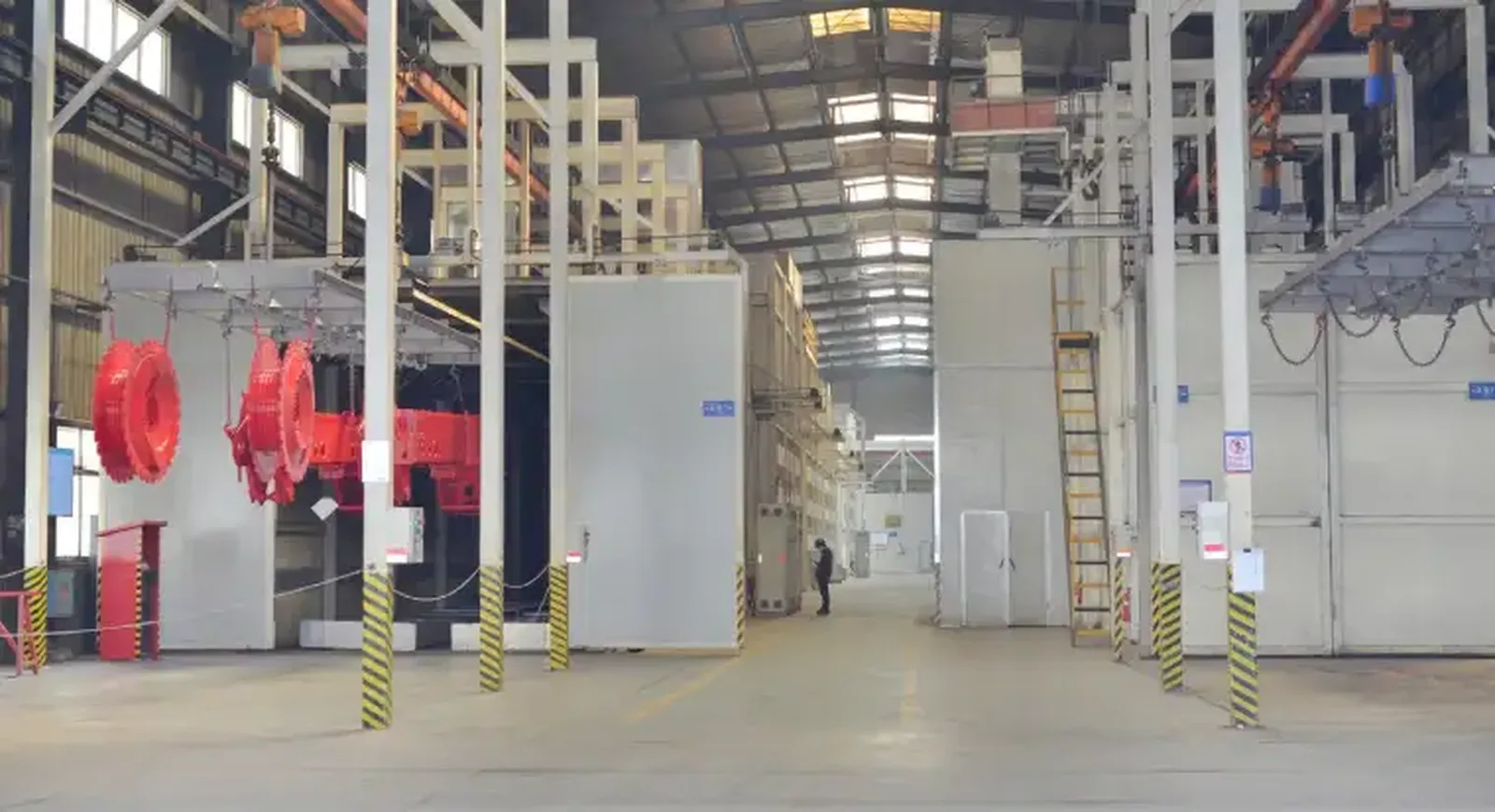
Why coating belongs in the contract manufacturing RFQ
When you send a fabricated steel part to a contract manufacturing supplier, surface treatment is not an afterthought. Most premature corrosion on fabricated frames, chassis and machined assemblies starts at weld toes and edges, where the coating film is thinnest. A clear coating specification in the RFQ keeps every quotation comparable and keeps responsibility clear. Realjet machines and welds parts to customer drawings. Surface treatment is delivered as part of the agreed scope, not as a separate product line, so the buyer has to state what protection the part needs for its service environment.
Choose the corrosivity class first
The environment decides the coating system. ISO 12944 classifies atmospheric corrosivity from C1 (very low, heated indoor) through C5 (very high, industrial or coastal with salt) to CX (extreme, offshore). Each class is defined by the mass loss of test coupons, and the standard links it to minimum system requirements. A buyer who writes only "epoxy paint" lets every supplier quote a different system, so the prices are not comparable. State the corrosivity class from ISO 12944-2 and the target durability, usually Low (up to 7 years), Medium (7 to 15 years) or High (more than 15 years) per ISO 12944-5. The ISO 12944 series is maintained by ISO and listed in the ISO committee catalogue at https://www.iso.org/committee/48070/x/catalogue/p/0/u/1/w/0/d/0.
Specify surface preparation, not just the topcoat
No coating performs better than the surface beneath it. ISO 8501-1 defines preparation grades for uncoated steel. For high performance systems the common minimum is Sa 2.5 (near white blast cleaning), equivalent to SSPC-SP10. Below that grade, residual mill scale and rust interrupt the bond, and zinc rich primers lose their cathodic protection. The standard is published as ISO 8501-1:2007 at https://www.iso.org/standard/43426.html. State the required grade, the surface profile (often 40 to 70 micrometres Rz) and the soluble salt limit before painting. These values belong in the RFQ, not in a later conversation.
Define the coating system and film thickness
A protective system is a primer, one or more build coats and a topcoat, selected together for the environment. For aggressive service a zinc rich primer over Sa 2.5 steel, followed by epoxy build coats and a polyurethane topcoat, is a typical build. Hot dip galvanizing to ISO 1461 is an alternative for some parts. The buyer should state the total dry film thickness (DFT) and, where it matters, the per coat DFT. Edge protection is the detail most often missed: edges, weld toes, bolt heads and connections need stripe coating by brush before full spray, because spray thins at sharp geometry and those points fail first.
Internal faces and site touch up
Internal bores and enclosed cavities are often left uncoated, because a coating in the flow or access path can be damaged or can contaminate the process. For parts that are welded on site after delivery, the field weld and the adjacent heat affected zone need touch up with a material compatible with the shop system. Write this into the RFQ so the supplier knows whether to supply touch up kits, and so the buyer knows which surfaces were never meant to be coated.
Protect the finish through packaging and transport
A coating that passes inspection can still be damaged before it reaches site. The RFQ should state how the part is packed: isolating coated surfaces from direct contact, blocking moisture in marine transit, and protecting edges from impact. Realjet can apply the agreed packing scope, but the buyer sets the transit condition (indoor, outdoor, sea freight) that drives the protection level. This step connects surface treatment to the wider export packing discussion without moving responsibility for the coating system itself.
Put inspection evidence in the contract
Steel structure coating is covered by execution standards such as EN 1090-2, which sets requirements for the protective coating of load bearing steelwork and feeds into CE marking. For the RFQ, ask for measurable evidence: DFT readings with calibrated gauges per coat, adhesion by pull off (ISO 4624) or crosscut (ISO 2409), holiday detection on immersed or buried surfaces, and surface profile checks before application. Material certificates for the base steel under EN 10204 (3.1 or 3.2) close the traceability loop. These records let the buyer verify the work instead of trusting the invoice.
Where responsibility sits
The buyer or the design institute defines the corrosivity class and durability target from the real service environment. The supplier proposes a coating system that meets those targets and executes it to the agreed standard, with inspection records. Realjet delivers the fabricated and coated part to the drawing, but it does not set the environmental class for a plant it has not visited. Write the class, the preparation grade, the DFT and the inspection list into the RFQ, and the quotation becomes a like for like comparison rather than a guess.
A complete coating specification turns a vague "painted finish" line into a checkable requirement. Review the contract manufacturing page, then package the corrosivity class, preparation grade, DFT and inspection points into one RFQ before you ask suppliers to quote.