
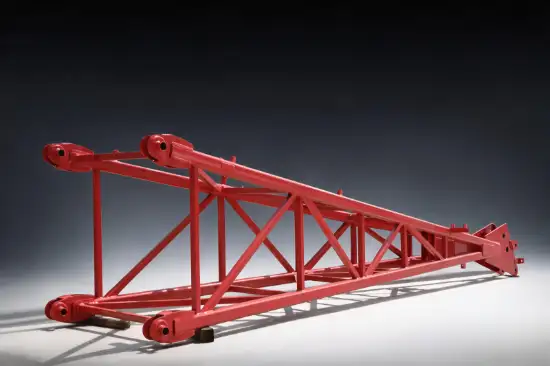
What a crane boom head does
The boom head is the terminal section of a crane boom or jib. It carries the sheave assembly, load hook attachment or auxiliary fittings and transfers the lifted load into the main boom chords. Depending on the crane type, the head may be a welded box section with a head plate, a lattice frame with pinned nodes, or a fabricated bracket on a telescopic section. What all variants share is that the load path is concentrated at a small number of connections, so the welds, pin bores and alignment must be right.
For a procurement team, this means a boom head is not a generic welded frame. The RFQ must identify the design owner, the load cases the head must meet, the steel grades, the welded joint details and the dimensional checks that prove the part is fit for assembly. Realjet provides contract manufacturing for crane and construction machinery structures to customer-approved drawings, including boom head fabrications with welded joints and machined interfaces. The scope is drawing-led; we do not offer an off-the-shelf replacement boom head.
Drawing and BOM inputs the supplier needs
Start the RFQ with the drawing package. The supplier needs geometry, not only pictures. Useful documents include the general arrangement, detail drawings for the head plate and cheek plates, weld symbols and sizes, the bill of materials with steel grades, and any standards the drawing invokes such as AWS D1.1 or EN 1090. If the boom head is part of a family of lengths, say which dimensions are fixed and which change with boom configuration.
Material certificates are part of the same package. High-strength quenched and tempered steels are common in boom structures because they keep weight down while carrying high cyclic loads. The buyer should state the grade, the required impact toughness at the design temperature and whether mill certificates must show chemical analysis and mechanical properties. Without this information the supplier cannot confirm weldability or choose the right welding procedure.
State the design ownership clearly. Unless the contract explicitly includes design engineering, the buyer remains responsible for the structural design and for confirming that the drawings are suitable for the intended crane class and duty cycle. Realjet reviews the drawing package for manufacturability and may ask for clarification on fit-up, access for welding or machining sequences, but the approved design belongs to the buyer.
Welding and machining scope to define
Boom heads combine heavy welded assemblies with precision interfaces. The head plate, cheek plates, pin bosses and sheave mounts must be located accurately after welding distortion has occurred. For this reason the RFQ should separate as-welded tolerances from post-weld machined tolerances. General fabrication tolerances for welded steel structures are often covered by ISO 2768 or AWS D1.1, while pin bore diameters and position tolerances may need tighter control.
The welding procedure specification is normally the supplier's responsibility to develop, but the buyer should state the required qualification standard and acceptance class. AWS D1.1 is widely used for structural welding of cranes in North America, while EN ISO 3834 and EN 1090 are common references in Europe and many international projects. For high-strength steels, specify preheat and interpass temperature limits and whether post-weld heat treatment is required. The supplier must qualify the procedure with the actual material thicknesses and joint details used in the boom head.
Machining of pin bores and mounting faces is usually done after welding. The RFQ should say whether the supplier machines from the welded assembly or whether the buyer supplies separate machined parts for assembly. If the supplier machines, include the required bore diameter, tolerance, surface finish and any coaxiality or parallelism requirements between bores. The supplier will need a fixture that references the boom centreline so that the head aligns with the rest of the boom during field assembly.
Inspection evidence and trial assembly
Ask for inspection evidence that matches the risk of the part. A typical package for a boom head includes material certificates, weld procedure and welder qualification records, weld inspection reports by ultrasonic or magnetic particle testing, dimensional reports before and after machining, hardness or toughness test records when specified, and a surface treatment or coating report. Do not ask for more testing than the design requires, but do not omit the tests that prove the critical interfaces.
Trial assembly is valuable when the boom head must mate with other sections. The buyer can require the supplier to check pin fit, sheave alignment and bolt-hole patterns on a fixture that represents the adjacent boom section. This does not replace the final crane assembly at site, but it catches interface problems before the parts are shipped. The RFQ should say whether trial assembly is required, what fixture the supplier must use and what acceptance criteria apply.
Packaging and shipping should also be addressed. A boom head may be long, heavy or asymmetric. Lifting points may be needed for loading and unloading. The RFQ should state whether the supplier provides lifting lugs, whether the part ships loose or in a frame, and what corrosion protection is expected during sea freight. These details affect both price and delivery schedule.
From RFQ to supplier review
A well-prepared boom head RFQ lets suppliers quote on the same basis and reduces the risk of rework after delivery. Compare quotes on the actual scope, not only on price: one quote may include machining and NDT, while another may list them as options. Visit the supplier if the project size justifies it, or review photos and inspection records to confirm that the shop can handle the section size, welding requirements and machining tolerances you have specified.
If you are sourcing a crane boom head or similar welded machinery structure, Realjet's contract manufacturing team reviews customer drawings and defines the welding, machining and inspection scope before quoting. You can start from the contract manufacturing overview or the crane boom head product page to describe your component and request a project review.