
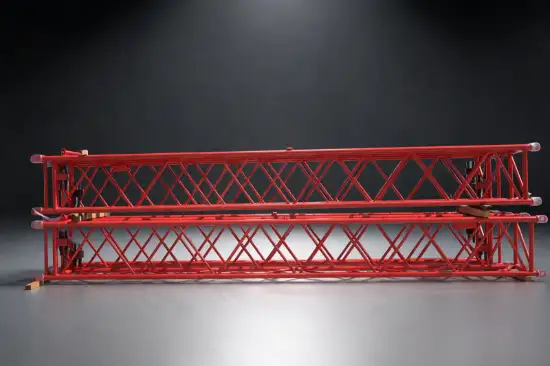
Why a crane jib arm needs its own RFQ
A crane jib arm is a long welded structure with connection points at each end. Lattice members transfer load through many joints. The end fittings control how the section connects to the rest of the machine. A supplier can fabricate something that looks correct in a photograph and still miss the centre line, pin spacing or end-interface relationship needed for assembly.
The equipment manufacturer owns the design. Material grades, tube sizes, member positions, weld details, load cases and acceptance criteria must come from approved project documents. The contract manufacturer's task is to turn those documents into a controlled fabrication, machining, inspection and delivery route.
Procurement teams need to compare that route before they compare price. A quotation based on overall length and estimated mass will not show whether the bidder has allowed for fixtures, staged inspection, machining, coating protection or transport supports.
Define the supplied assembly and drawing hierarchy
Start by marking the supply boundary on the general arrangement. State whether the order covers one complete jib section, several interchangeable lattice extensions, or subassemblies that the buyer will join later. Identify buyer-supplied pins, bushings, fasteners, hydraulic parts or other fitted items.
The enquiry package should include:
- the assembly drawing and part drawings, each with revision and approval status;
- the bill of materials and the material standard for every tube, plate and end fitting;
- weld symbols, joint details and any approved weld map;
- the main centre line, end datums and critical interface dimensions;
- tolerances for length, straightness, pin positions and coaxial features;
- machining and coating requirements;
- the planned quantity, batch pattern and delivery sequence;
- inspection records, marking and packaging requirements.
If the 3D model and 2D drawing disagree, the RFQ must say which document governs. It should also name the person or process that can approve a manufacturing clarification. Otherwise a bidder may fill gaps with assumptions that only become visible during final assembly.
Control lattice geometry through the welding sequence
Long lattice structures can move as welded joints cool. The RFQ should ask the supplier to explain how fixtures establish the centre line and end interfaces, how the welding sequence limits accumulated distortion, and which measurements are taken before the section leaves the fixture.
A generic statement about distortion control is not enough. The bidder should show the proposed datum plan for the actual section. If a jib consists of multiple extensions, the plan also needs to address interchangeability at matching end connections.
Ask where the supplier will place temporary supports during fit-up and welding. A poorly supported section can satisfy a free-state measurement in one position and change when lifted. The approved drawing or inspection plan should define the measuring condition where it affects acceptance.
Specify weld acceptance instead of requesting "good welding"
The buyer should state the governing welding standard, required procedure and personnel qualifications, inspection method and acceptance level. These are design and quality decisions, not values for a bidder to choose after pricing.
ISO 5817:2023 defines quality levels B, C and D for imperfections in fusion-welded joints. ISO describes those levels as production and workmanship requirements, not a fitness-for-purpose decision. The responsible designer or project specification must select the applicable basis. Citing ISO 5817 does not prove that a supplier is certified, and it does not replace the joint details or inspection scope.
For a quotable package, identify which welds receive visual examination and which require another specified examination method. State the sampling extent, reporting format and authority for repair approval. A commercial comparison is unreliable when every bidder prices a different inspection assumption.
Coordinate end fittings and pin interfaces
End fittings deserve separate review because they combine welded geometry with machined features. The buyer should define bore diameter, spacing, position, coaxiality, surface finish and any bushing or pin fit. State whether the supplier machines the interface before welding, after welding, or through an approved combined sequence.
Machining after structural welding can control the final relationship between bores, but it requires suitable equipment, access and a stable datum setup. Pre-machined fittings may simplify machining reach, yet their finished features need protection during welding and coating. The RFQ should ask the bidder to explain its selected route and the checks performed before and after machining.
Also identify surfaces that must remain free of paint. Finished bores, pin seats and electrical bonding points can require masking or temporary protection. Packaging should prevent those surfaces from carrying the weight of the section during transport.
Make inspection evidence part of the purchased scope
An inspection certificate without measured results gives the buyer little help during assembly. Match the requested evidence to the drawing features and manufacturing stages. Depending on the purchase specification, the final record package may include:
- material certificates and part identification;
- approved welding procedures and applicable personnel records;
- weld inspection reports against the stated acceptance basis;
- fixture or in-process dimensional checks;
- final straightness, length and end-interface measurements;
- bore and pin-interface reports where machining is included;
- coating records and protected-surface checks;
- final marking, packing and release documentation.
Specify when the buyer or its inspector may review records or witness a hold point. A hold point placed after coating cannot recover evidence that should have been collected before machining or surface treatment.
Include transport and repeat-order conditions
A long lattice section may need transport frames, lifting points and restraints that keep loads away from finished interfaces. Give bidders the delivery destination, route constraints known to the buyer, lifting restrictions and required packing condition. Ask who designs and supplies any reusable transport frame.
For repeat orders, define how the approved first article becomes the production baseline. The agreement should cover drawing revision control, fixture changes, material substitutions and the records required for later batches. Do not assume that approval of one section automatically approves a changed design or process.
The published crane jib arm manufacturing reference shows the type of tubular lattice structure and manufacturing route involved. It is not a standard crane accessory. Buyers ready for a supplier review can send controlled drawings, materials, welding requirements, critical dimensions, quantity and delivery conditions through Realjet's construction machinery contract manufacturing service. Final scope and acceptance remain subject to the approved project documents.