
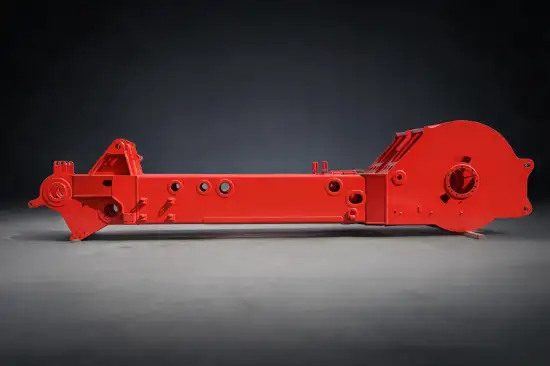
Why a crane mast RFQ needs more than a fabrication drawing
A crane mast or base structure carries loads between the lifting equipment, slewing system and supporting chassis. On a finished machine it may look like a straightforward welded box. Buying one is not so simple. Plate geometry, weld shrinkage and final machining all affect the position of bearing seats, pin bores and mounting faces. A quote based only on overall dimensions can miss the work that determines whether the assembly fits the buyer's machine.
This is also why a buyer should treat the mast as a made-to-drawing structural assembly, not a catalogue component. The machine designer remains responsible for the approved design, materials, load cases and acceptance criteria. The contract manufacturer needs a controlled package that turns those requirements into a repeatable fabrication, machining and inspection route.
The central buying question is whether the supplier can control the welded structure and the machined interfaces as one process. A low fabrication price does not answer it. A well-defined RFQ does.
Define the exact supply item before comparing prices
Start with an assembly boundary. State whether the order covers the welded mast only, a mast with machined bores and faces, or a larger assembly that includes brackets, pins, bush housings, hydraulic mounts, fasteners or trial-fitted parts. Identify any buyer-supplied items and any items that the manufacturer must procure.
The drawing package should then contain:
- an assembly drawing and part drawings with revision status;
- a bill of materials with material grades and applicable standards;
- weld symbols, joint details and any weld map required by the quality plan;
- defined datums and geometric tolerances for critical interfaces;
- machining allowances where welded parts are finish-machined after fabrication;
- coating requirements and clearly marked surfaces that must remain uncoated;
- quantity, batch pattern, packaging method and delivery destination;
- the required inspection records and document language.
Do not ask bidders to infer missing functional dimensions from a model image. If a dimension controls a slewing bearing, pin, cylinder mount or chassis connection, identify it as critical and state how it will be accepted.
Link welding and machining through one datum plan
The most important process decision is when the critical interfaces are created. A supplier may machine individual plates before welding, finish-machine the completed weldment, or use a combination of both. The right sequence depends on the approved design and available machining envelope, but the RFQ should make the intended outcome clear.
Suppose two pin bores need a controlled relationship to a mounting face. If the plates are machined independently and then welded without a robust fixture and verification plan, welding distortion can change that relationship. Finish-machining the assembled structure can reduce the risk, provided the supplier has equipment large enough to hold and reference the weldment. Ask each bidder to explain the proposed datum chain, welding sequence, distortion-control method and machining setup.
Geometric requirements should be stated on the drawing rather than described as "high precision." ISO 1101:2017 defines the symbol language and interpretation rules for form, orientation, location and run-out tolerances. The buyer should identify the governing drawing standard and put tolerances on the features that matter. The standard does not choose the values for the buyer.
Specify welding quality without assuming certification
Welding quality is more than the appearance of the final bead. It includes material identification, procedure qualification, welder qualification, consumable control, joint preparation, preheat where required, in-process checks, repair control and the inspection records defined by the contract.
ISO 3834-2:2021 sets comprehensive quality requirements for fusion welding in workshops and at field installation sites. A buyer may use it as part of a supplier-evaluation framework when it is applicable to the project. Do not, however, assume that citing the standard proves a supplier is certified or that it defines the weld acceptance level for a specific mast. Ask for the evidence required by the contract and verify its scope.
The RFQ should state the applicable welding code, weld acceptance criteria and nondestructive examination scope. It should also say who approves procedures and repairs. If these points remain open, bidders may price different levels of control while appearing to quote the same drawing.
Ask for evidence mapped to the critical interfaces
"Final inspection included" is weak evidence. Request an inspection and test plan that maps checks to drawing features and production stages. Depending on the approved requirements, the record set may include:
- material certificates tied to identifiable parts;
- welding procedure and personnel qualification records;
- joint-preparation and in-process welding checks;
- specified visual or nondestructive examination reports;
- dimensional results for the welded body before machining;
- final bore, face, position and alignment reports from the approved datums;
- coating preparation and dry-film records where required;
- photographs, marking records and packing documentation.
Ask how nonconformities will be reported and who can approve a concession. This matters when the part is project-specific and a late deviation could interrupt the buyer's machine assembly.
Compare supplier capability against the actual part
A capable supplier for one crane structure is not automatically capable of every mast. Compare the part's mass, envelope, plate thickness, weld access and machining reach with the bidder's proposed equipment. Useful questions include:
- Which fixture will hold the assembly, and how will the supplier verify it before welding?
- Can the proposed machine tool reach all critical interfaces in the planned setup?
- Which dimensions will be checked between welding and machining?
- How will the supplier protect finished bores and faces during blasting, painting and transport?
- Which operations are performed in-house, and how are outsourced processes controlled?
- What production evidence will be submitted before shipment?
The answer needs to describe the route for this part, not recite a general list of workshop machines. Buyers can use the published crane mast contract manufacturing reference to see the kind of welded and machined structure involved, while keeping project-specific dimensions and requirements under drawing control.
A practical RFQ package for supplier review
Before requesting a firm quotation, issue one controlled package to every bidder. Include the drawings, bill of materials, annual and batch quantities, required delivery condition, inspection plan, documentation list and commercial boundary. Mark assumptions that remain open and require bidders to list exclusions explicitly.
Price comparison becomes much more reliable when the scope is stable. It also gives procurement, engineering and quality teams a common basis for supplier clarification. If the drawings are still at an early stage, request a technical review first and identify which details must be frozen before pricing.
Realjet's made-to-drawing contract machinery manufacturing service covers project-specific welded structures and machined interfaces. To start an engineering review, send the controlled drawings, material list, critical datum and tolerance scheme, welding requirements, inspection evidence, coating specification, quantity and delivery boundary. Final materials, dimensions, standards and acceptance criteria remain subject to the buyer's approved project documents.