
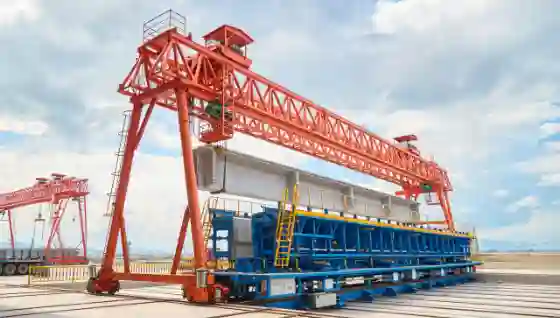
The production target is the starting point
An expressway precast yard is not defined by its equipment list. It is defined by the number and type of girders required, the delivery sequence to the erection front, the available site and the time allowed for each production cycle.
That is the useful lesson from the G15 Shenhai Expressway Ningbo South Section, Contract TJ05 project. Realjet participated in the project by supplying production-line solutions for 30 m T-girders. The confirmed configuration comprises two T-girder lines designed around a combined daily output of six girders.
Public project records identify the contract as the TJ-5 civil-works section of the G15 Shenhai Expressway Ningbo Xiwu–Ma'aoling Section reconstruction and expansion project. They also identify Zhejiang Jiaogong Jinzhu Transportation Construction Co., Ltd. as the contractor for this section. The formal contract identity and contractor are recorded in a Zhejiang Communications Investment Group procurement notice, while a Shenzhen Stock Exchange filing by Zhejiang Communications Technology reports the civil-works contract award.
For a contractor evaluating a similar yard, the important question is not whether one machine can run faster. It is whether mould preparation, reinforcement, concrete placement, vibration, curing, prestressing, demoulding and transfer can repeatedly support the required release rate.
What the TJ05 line configuration includes
The verified project configuration can be summarised without extending beyond Realjet's confirmed delivery record:
| Planning item | Confirmed project configuration |
|---|---|
| Precast product | 30 m T-girders |
| Production arrangement | Two T-girder lines |
| Combined daily output | 6 girders/day |
| Core process systems | Mould transfer, concrete placing, vibration, steam curing and prestressing |
These figures should be read as one integrated production brief. Six girders per day is the combined project output, not the nominal speed of an individual machine. Likewise, two lines do not automatically produce six girders every day unless the upstream supply, curing window, prestressing sequence and downstream handling are balanced around the same target.
This distinction matters during procurement. Comparing suppliers only by installed power, transfer speed or the number of automated functions can hide the real bottleneck. A production line should instead be evaluated by the slowest repeatable process that controls girder release.
Why mould movement changes the layout decision
In a conventional fixed-bed arrangement, labour, reinforcement, concrete and equipment move repeatedly to the product. A mould-transfer arrangement changes that logic: the mould and girder move through defined workstations, allowing each station to be organised around a specific operation.
For the TJ05 project, mould transfer is one of the confirmed core systems. Its value is not movement for its own sake. It creates the possibility of separating work zones, clarifying equipment interfaces and reducing conflicts between simultaneous activities on the two lines.
Before selecting this arrangement for another project, the project team should verify:
- the total transported mass of the mould, reinforcement and concrete product;
- the rail alignment, floor tolerances and available turning or return space;
- crane access and lifting boundaries at each workstation;
- safe separation between personnel routes and moving equipment;
- recovery procedures if a transfer operation is interrupted; and
- how the two lines share concrete supply, curing utilities and prestressing resources.
A layout drawing that shows only equipment footprints is therefore incomplete. It must also show movement envelopes, maintenance access, material routes, temporary storage and the interfaces between the two production lines.
Curing and prestressing govern the release rhythm
Steam curing and prestressing are also part of the confirmed TJ05 process scope. Together, they illustrate why daily output must be checked against engineering hold points rather than treated as a simple arithmetic target.
The curing cycle must follow the approved concrete mix and project quality plan. Prestress transfer can take place only after the specified concrete strength and other release conditions have been verified. Accelerating one stage without coordinating temperature control, strength testing, prestressing operations and inspection may simply move the queue to the next workstation.
For production planning, the contractor should map at least four times separately:
- hands-on operation time for each workstation;
- waiting time for curing, strength development and inspection;
- transfer time between workstations; and
- contingency time for cleaning, maintenance, product variation and quality holds.
This produces a more reliable cycle model than using a single average duration. It also reveals whether shared equipment can support both lines during peak periods.
Concrete placing and vibration must be planned as one operation
Concrete placing and vibration appear as separate systems in an equipment schedule, but they perform one quality-critical operation. The placing rate, layer thickness, access to the mould and vibration sequence must work together for the geometry and reinforcement density of the 30 m T-girder.
For a comparable line, buyers should ask suppliers to demonstrate how the proposed arrangement addresses the actual product drawings. Useful review points include concrete delivery continuity, access near congested reinforcement, external and internal vibration coverage, operator visibility, cleaning access and the recording of process parameters required by the project quality plan.
This is also where line balance becomes visible. If concrete supply is shared between two lines, the batching and transport plan must support the intended casting sequence without creating avoidable waiting time. If vibration equipment is dedicated by line, its maintenance and backup strategy should be defined before production starts.
What contractors can take from the G15 TJ05 project
The G15 Ningbo South TJ05 configuration offers five practical lessons for teams planning a precast concrete component production line:
- Begin with the required girder release schedule, not a catalogue of machines.
- Treat the two lines as one production system wherever they share people, utilities or handling equipment.
- Model curing and prestressing as controlled hold points in the cycle.
- Review mould transfer through layout, safety, recovery and maintenance requirements.
- Validate concrete placing and vibration against the actual girder geometry and reinforcement arrangement.
Realjet supplies project-specific production-line solutions rather than the precast girders themselves. For a new project, the TJ05 arrangement should be treated as a relevant reference, not a standard package to copy unchanged. Product drawings, quantity, construction programme, site geometry, climate, utilities, staffing and local acceptance requirements must be reviewed before the process and equipment configuration are fixed.
A useful first technical discussion should therefore start with the girder schedule, drawings, required daily output and site plan. Those inputs make it possible to test the production rhythm and identify the interfaces that need to be resolved before equipment manufacturing begins.