
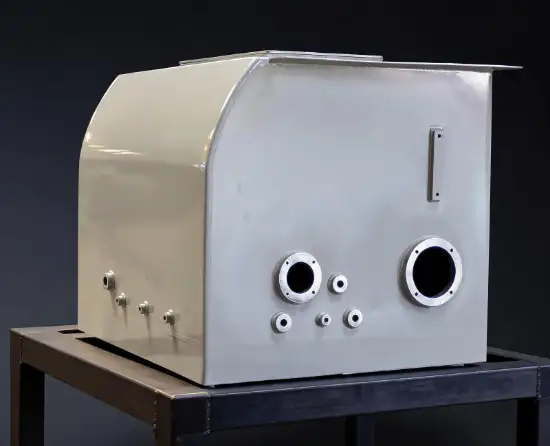
Why a tank drawing is not enough for a firm quotation
A buyer looking for hydraulic oil tank contract manufacturing usually has a drawing, a target quantity and a delivery date. That is enough to start a discussion, but not enough for suppliers to quote the same job. One supplier may include leak testing and internal cleaning. Another may price only fabrication and painting. Their totals cannot be compared until the technical and commercial boundaries match.
The RFQ should describe the tank as part of a hydraulic system, not simply as a welded box. Ports, baffles, mounting points, service openings and internal condition affect both manufacturing and acceptance. If the tank belongs to a new machine, include the assembly context so the supplier can see which interfaces matter.
Realjet provides made-to-drawing machinery contract manufacturing for fabricated and machined components. The final manufacturing route, inspection plan and supply boundary still depend on the approved customer documents.
Freeze the design inputs before suppliers price the work
Issue one controlled RFQ package to every bidder. It should contain the general arrangement, detail drawings, bill of materials, 3D model if available, drawing revision and quantity schedule. Mark which document governs if the model and drawing disagree.
For the tank itself, state:
- external envelope, usable capacity and any required free volume;
- material grades and thicknesses for the shell, baffles, bosses and brackets;
- port schedule with thread or flange standard, size, orientation and datum position;
- mounting datums, load interfaces and clearance around service items;
- working fluid and any material or coating compatibility requirements;
- weld standard, symbols and any restrictions on internal projections;
- surface preparation, external coating and areas that must remain uncoated;
- batch quantity, forecast demand and required delivery sequence.
Do not ask the contract manufacturer to choose system safety requirements silently. ISO 4413:2010 covers general rules and safety requirements for hydraulic systems and their components, including cleaning and reliable operation. The machine designer or buyer should identify the standards and system requirements that govern the tank, then place the applicable requirements in the RFQ.
Define leak testing as a method and a record
"Leak tested" is not a complete acceptance criterion. The RFQ should name the test medium, test pressure or vacuum, hold time, allowable indication, preparation condition and required record. Those values must come from the buyer's design basis or governing specification. They should not be guessed by the fabricator.
Ask bidders to explain when the test occurs. Testing before coating can make a leak easier to locate. A later final check may be needed if machining, fittings or handling could affect the sealed boundary. The agreed sequence belongs in the inspection plan.
Also define who supplies temporary plugs, test fixtures, gauges and adapters. If calibrated instruments are required, state the calibration evidence and validity expected with the shipment. This detail often explains a real price difference between quotations.
Specify internal cleanliness without vague wording
"Clean inside" gives neither the supplier nor the inspector a measurable result. The buyer should decide what must be removed, how the tank will be cleaned, how cleanliness will be checked and how the openings will be protected afterward.
Possible acceptance methods include a documented visual inspection, wipe test, flush procedure or fluid sample. The correct choice depends on the hydraulic system and the buyer's own cleanliness plan. ISO 4406:2021 defines a code for the quantity of solid particles in hydraulic fluid. It does not, by itself, tell a tank supplier what cleanliness level your machine needs. ISO 12669:2017 provides a method for determining a required system cleanliness level. The responsible system designer should convert that requirement into a practical manufacturing and acceptance instruction.
If the supplier must provide a particle count, specify the sampling fluid, sampling point, flushing condition, laboratory or instrument requirement and report format. If no particle count is required, say so and define the alternative check. Either choice is clearer than leaving bidders to make different assumptions.
Keep fabrication checks separate from system responsibility
The tank manufacturer can verify the characteristics included in its scope. Typical checks may cover materials, dimensions, port locations, mounting datums, weld condition, leak-test results, internal condition and coating. The buyer should mark critical characteristics on the drawings or inspection plan rather than expect every dimension to receive the same control.
System performance remains a separate question. Fluid aeration, heat rejection, return flow, suction conditions and machine vibration depend on the complete hydraulic design and operating environment. Unless the supplier has been contracted to design and validate that system, do not turn those outcomes into implied fabrication guarantees.
For a first trial unit, request a clear approval point before repeat production. The supplier can submit the inspection results, photographs or sample documents agreed in the RFQ. The buyer can then approve the manufacturing baseline or issue a controlled change.
Compare quotations with a scope table
A one-page comparison table prevents low initial prices from hiding missing work.
| Quotation item | What the buyer should compare |
|---|---|
| Engineering review | Drawing review only, manufacturability feedback, or supplier design responsibility |
| Material | Grade, certification, substitutions and traceability |
| Fabrication | Forming, fixtures, welding, distortion control and interface machining |
| Testing | Method, instruments, records, witness points and retest responsibility |
| Cleaning | Process, acceptance check, preservation and closure of ports |
| Finishing | Surface preparation, coating system, masking and repair criteria |
| Documentation | Inspection report, material records, test report and release documents |
| Packaging | Port protection, corrosion protection, lifting method and shipment supports |
| Commercial basis | Trial quantity, repeat quantity, tooling, lead-time basis and change control |
Ask each bidder to list exclusions and assumptions against the same headings. A supplier should also identify which requirements cannot be confirmed until it receives final drawings or fluid-system information.
Send an RFQ that can become a manufacturing baseline
Before requesting a final price, check that the package contains controlled drawings, the port and interface schedule, acceptance methods, required records, quantity and delivery boundary. Keep unresolved questions in an open-item list with an owner and due date.
Realjet's hydraulic oil tank contract manufacturing example is not a universal specification; each tank is reviewed against customer-authorised requirements. Send the correct tank drawings and acceptance basis through the contract manufacturing enquiry so the first response can address scope, evidence and quotation assumptions instead of filling gaps with guesses.