
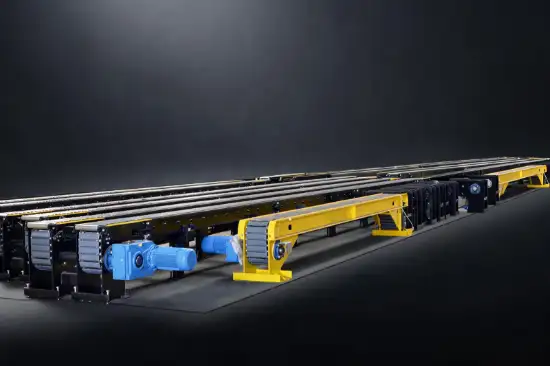
What is an industrial chain conveyor contract manufacturing project?
An industrial chain conveyor contract manufacturing project turns a buyer's material-handling requirement into fabricated frames, machined interfaces, chain and sprocket assemblies, drives, guards and controls. The supplier may manufacture to a completed drawing package. In other cases, the parties agree that the supplier will develop part of the mechanical design. The quotation basis should make that difference clear.
"How much is a chain conveyor?" is too broad for a useful first question. Buyers need to define what the conveyor must move, the route it follows and the engineering decisions they will retain. Quotations become comparable once every bidder receives the same operating case and delivery boundary.
Realjet's custom machinery component manufacturing service covers fabrication, machining, assembly and inspection for project-specific equipment. A buyer should still define the conveyor duty and approval responsibilities before asking any manufacturer to price the work.
Fix the design boundary before comparing suppliers
There are three common starting points. A build-to-print order gives the manufacturer released drawings, a bill of materials and acceptance requirements. A design-assist order starts with a controlled general arrangement and leaves selected details for joint review. A supplier-designed package gives the equipment supplier a wider functional responsibility.
Name the chosen model in the RFQ and list every deliverable. Say whether the supplier must calculate shafts, select a chain, size a drive, prepare guards or issue control drawings. If the buyer or plant integrator retains those decisions, supply the approved data instead. The phrase "complete conveyor" does not settle who owns the surrounding supports, power distribution, upstream and downstream sensors, foundations or site wiring.
For buyers who already have released manufacturing drawings, the published industrial chain conveyor contract manufacturing reference shows the type of fabricated, machined and assembled scope that can be reviewed. It does not establish a standard load, speed or chain specification for a new project.
Describe the conveyed load and route
The conveyed item controls the chain spacing, support method, guide arrangement and transfer interfaces. Include the following information in the technical schedule:
- item name, drawing, mass, centre of gravity and contact points;
- maximum and minimum dimensions, including any overhang;
- required orientation and whether the item sits directly on the chain, on fixtures or on pallets;
- route length, elevation changes, transfer points and available envelope;
- target flow stated as items per hour and the expected accumulation condition;
- operating hours, starts per hour and any required reverse or indexing movement;
- temperature, dust, water, chemicals and other environmental conditions;
- loading and unloading method, including crane, robot, forklift or manual access.
Do not describe throughput without the operating pattern. Ten items per hour moving continuously is not the same duty as ten heavy fixtures released in one short batch. Likewise, the largest item is not always the governing load case. A jam, an unevenly supported pallet or accumulated items at a stop can create a different mechanical condition. The responsible designer must define which cases the conveyor has to withstand.
Separate manufactured parts from bought-out components
Two quotations can look similar while covering different hardware. Ask each supplier to identify the proposed chain, sprockets, bearings, gearmotor, couplings, sensors, lubrication equipment and control components by manufacturer or approved-equivalent rule. State whether the buyer requires a particular regional brand, voltage, frequency, motor efficiency class or spare-parts standard.
The same separation applies to the fabricated structure. The RFQ should identify materials, welding requirements, critical machined datums, coating system and module connection method. Long conveyors are often divided for manufacturing and shipping. The module split must therefore account for alignment, lifting, container or truck limits, site access and reassembly.
If a supplier is allowed to substitute a bought-out component, require the deviation to be shown in the quotation. A silent substitution can change the mounting interface, lead time, maintenance access or local availability even when the headline motor power appears unchanged.
Put the safety scope into the RFQ
Machinery safety cannot be added as an unspecified final accessory. The current published edition of ISO 12100 provides principles for machinery risk assessment and risk reduction. ISO 14120 addresses the design, construction and selection of fixed and movable guards for mechanical hazards. The project's governing rules may be different or more specific, depending on the destination and application.
Ask who performs the risk assessment, who approves it and which documents form part of the delivery. Identify access points, operator positions, cleaning tasks, maintenance tasks, crossings, walkways and nearby equipment. The buyer should also specify the required emergency-stop and isolation philosophy through the responsible safety and controls designers.
For a conveyor entering an existing line, the interface risk matters as much as the conveyor itself. A guard that is adequate around one drive may leave a new trapping point where two machines meet. The RFQ should require a joint review of those boundaries rather than assume that each supplier's local guard creates a safe combined system.
Ask for evidence that matches the purchased scope
Inspection should follow the features that affect fit and function. A practical inspection and test plan may cover:
- material identification and manufacturing drawing revisions;
- weld inspection required by the project specification;
- frame straightness, support levels and connection geometry;
- shaft, bearing, sprocket and chain-track alignment;
- machined mounting faces and critical hole positions;
- coating preparation and dry-film checks where specified;
- assembly checks, guard fit and agreed no-load trial operation;
- packing identification and module match marks.
A no-load workshop run can confirm movement, sensor response and basic alignment. It can also expose noise that merits investigation. It cannot prove performance with the buyer's real load unless a representative load and test method are included. State which functional tests will happen in the workshop, which can only happen after installation, and who provides test items, power and controls.
Issue one commercial schedule to every bidder
The commercial section should identify quantity, delivery location, Incoterms where used, packing standard, documentation language, drawing approval cycle and required delivery sequence. Ask bidders to list exclusions and assumptions beside the price. Also request separate prices for recommended commissioning support, site supervision, spare parts and special tools if those items are being evaluated.
The final RFQ pack should contain the operating brief, controlled drawings, bill of materials where applicable, standards list, inspection requirements, interface matrix and commercial schedule. With those documents in place, a buyer can compare manufacturing routes, component choices and evidence rather than compare three prices built on three different interpretations.
Realjet can review made-to-drawing conveyor frames and assemblies, or discuss an agreed equipment design boundary. Send the conveyed-item data, route, operating pattern, drawing status and required delivery scope through the contract manufacturing enquiry page so the first response can address the actual purchase case.