
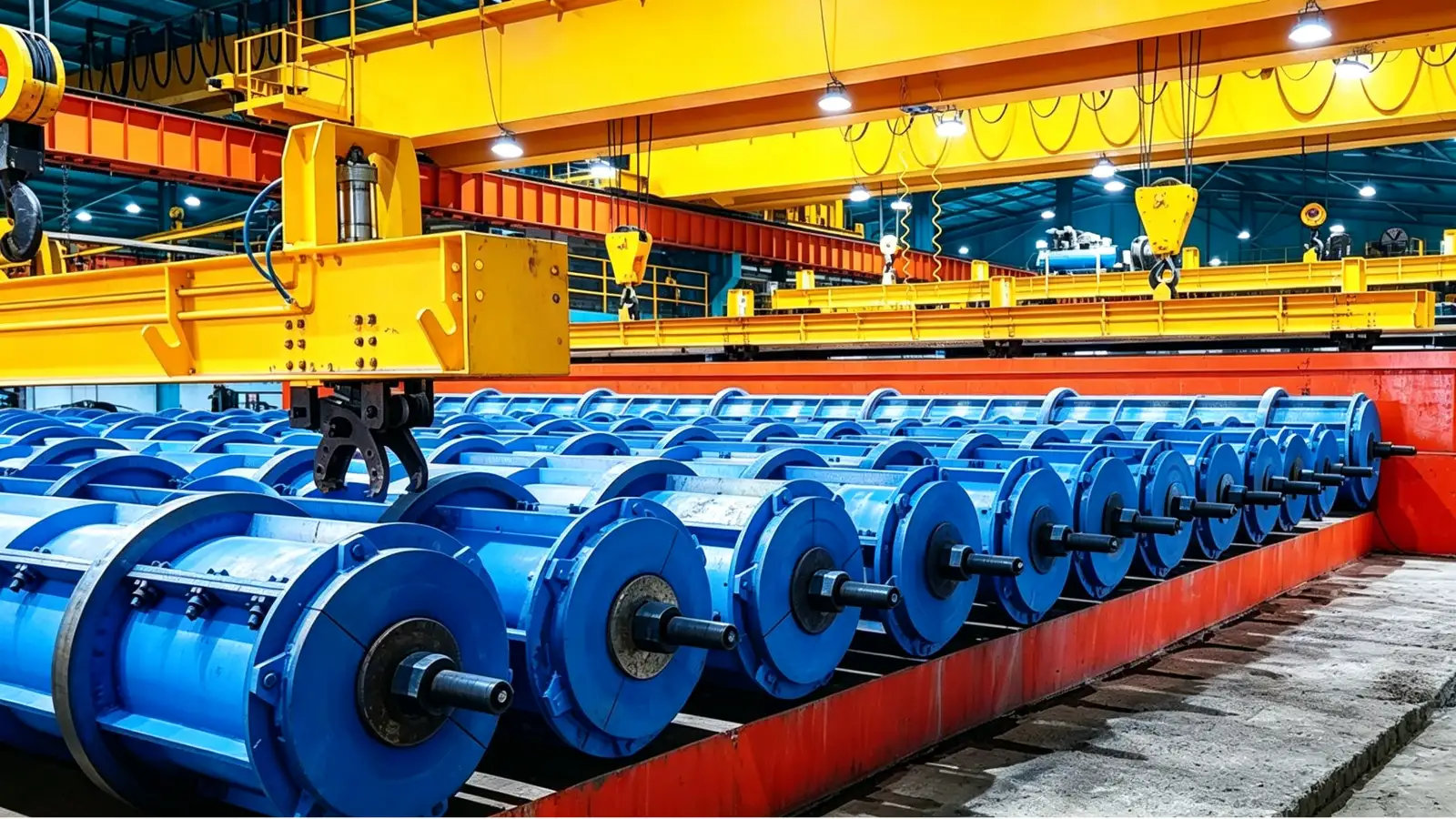
Project background
In 2015, Realjet upgraded an operating production line for prestressed concrete pipe piles and centrifugal hollow square piles. The client is anonymous for commercial confidentiality.
The factory had been in production since 2007. Its 78 m by 44 m workshop contained a two-bay circulating line, a 1.5 m³ twin-shaft batching system, four spinning machines, four double-girder overhead cranes, eight steam-curing pits and the existing reinforcement equipment. The plant could produce standard pile sizes, but its original process had become a constraint as the client moved towards thicker-wall products and a wider product mix.
Before the project, one shift produced no more than 80 to 90 piles. Concrete feeding took almost five minutes per mould and still needed considerable manual shovelling. Underfilling, exposed aggregate and leakage along mould joints were frequent, especially on the thicker-wall products.
Realjet's task was to improve the existing factory rather than replace the full line. The upgrade had to use the available building and retain suitable installed assets while improving output, product consistency, material use and the separation between operators and suspended loads.
| Project item | Before the upgrade | After the upgrade |
|---|---|---|
| Normal single-shift output | 80 to 90 piles | 150 to 160 piles |
| Recorded peak output | Not stated | 167 piles per shift |
| Concrete feeding time | Nearly 5 minutes per pile | About 2 minutes per pile |
| Product range | Circular piles including 400, 500 and 600 mm sizes | Existing range plus 350 and 400 mm centrifugal hollow square piles |
| Construction damage rate | 1 to 2 per thousand | About 0.5 per thousand |
| Reported manufacturing cost reduction | Not applicable | CNY 3 to 4 per metre |
The figures are results from this specific historical project. They are not guaranteed outcomes for another PHC or PC spun pile production line. Existing equipment condition, pile specifications, mould quantity, curing cycle, utilities and workforce all affect the achievable result.
The bottlenecks Realjet found
The original line did not have a single isolated problem. Several stations were restricting one another.
Loose concrete occupied too much volume during feeding, so it was difficult to place the required quantity into thick-wall pile moulds. Material fell outside the mould and operators had to shovel concrete by hand. The remaining concrete near the mould edges then made upper-mould placement and bolt tightening more difficult. Poor closure contributed to leakage and dimensional inconsistency.
The feeding track also remained occupied while workers closed and bolted each mould. This created waiting at a station that already had a long cycle. Operators moved around the mould while overhead cranes carried loads through the same production zone.
Reinforcement cutting, heading and cage welding were located away from the mould-loading area. Completed cages travelled farther than necessary, and raw PC steel bar took up useful workshop space. Crane movements still relied heavily on manual hook attachment around spinning, curing, mould handling and feeding.
Realjet therefore treated feeding, mould movement, reinforcement flow and lifting as one upgrade programme. Increasing the speed of only one machine would not have removed the line-level constraint.
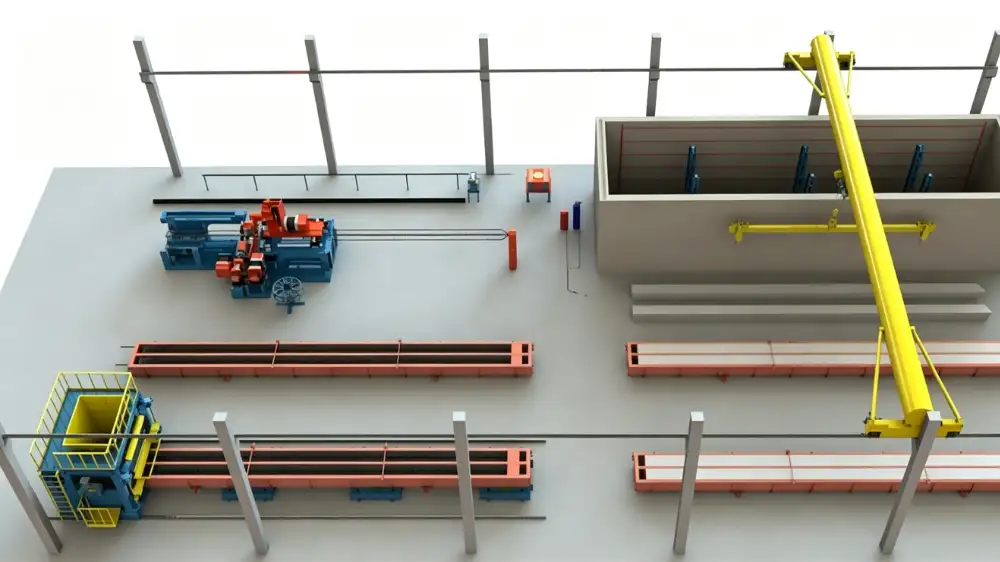
Reference layout used to explain how mould circulation, spinning, curing and crane coverage must be reviewed as one production system.
Concrete feeding and mould-closing upgrade
Realjet removed the existing rotary distributor and feeding cars. The mould-cart rails, previously set 400 mm below floor level, were raised above the finished floor.
A buffer hopper was installed directly below the mixer discharge. It fed a reversible screw conveyor with one outlet at each end. Changing the screw direction sent concrete to either feeding track. Each outlet connected to a chute with a height-adjustable guide. The guide width could be adjusted for different mould sizes.
The conveyor was mounted on a working platform to provide access for cleaning and maintenance. A control station between the two tracks allowed the operator to manage feeding from a protected, fixed position. The tracks were extended by 15 m and covered by a new steel structure. In the revised process, the concrete outlet remained fixed while the mould moved beneath it.
Realjet also added a separate mould-closing track outside the two feeding tracks. Once feeding was complete and the upper mould was placed, the mould moved to this track for bolt tightening. Feeding could continue instead of waiting for the closing operation.
This changed the working method from people walking along a stationary mould to a moving mould passing a largely fixed crew position. The position was located near the centre columns and away from the main path of cranes carrying loads. Variable-frequency drives allowed the track winches to be adjusted to the production condition.
Reinforcement and internal logistics upgrade
The PC steel bar cutting machine, heading machines and cage welders were relocated to the west side of the workshop, closer to mould loading after demoulding. A new 12 m by 18 m steel structure outside the south wall housed the steel-bar pay-off and raw-material storage. A 5 t monorail hoist served this area.
Two heading machines and two cage welders were arranged in process order. The existing pipe-pile cage welder remained in use, while a square-pile cage welder was added to support the expanded product range.
Realjet modified the pipe-pile cage welder for automatic cage discharge and rapid trolley return. This reduced manual work around the machine and shortened the non-welding portion of its cycle. The new arrangement also shortened the route between completed cages and the loading area, while moving raw PC steel bar out of the main production bay.
The change did more than add a machine. It cleared workshop space, reduced unnecessary handling and aligned reinforcement output with the revised mould flow.
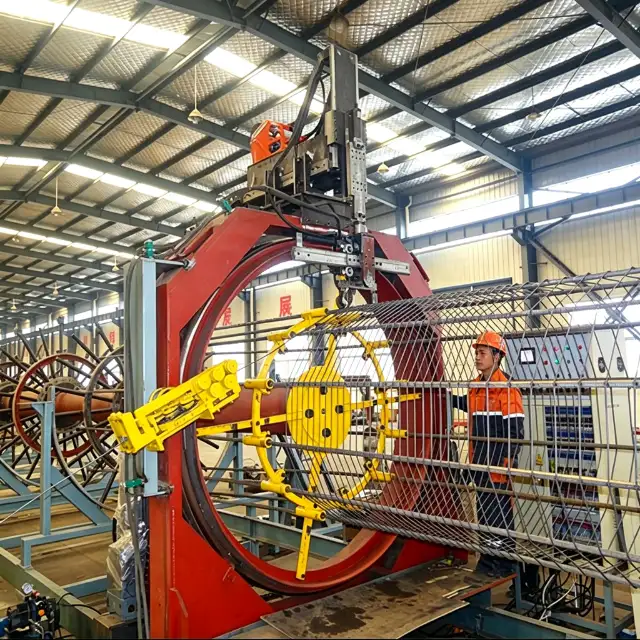
Reference cage-welding equipment. Product range, changeover, discharge and buffer space must be matched to the revised mould cycle.
Crane attachments, curing covers and mould preparation
Three of the four existing overhead cranes received automatic lifting attachments. Two cranes above the spinning and curing area used attachments designed to engage the upper-mould running rings without a conventional large hook. The curing-pit covers were modified to suit this handling method, and missing insulation was added where required.
The crane serving the feeding and closing area received an automatic attachment with a main hook. It handled upper-mould removal, lower-mould lifting and upper-mould placement, replacing several repeated manual hook-on tasks.
Realjet also added an upper-mould cleaning rack near the feeding tracks. After demoulding, the upper mould could be placed directly on the rack instead of being turned on the floor. Operators cleaned the mould and applied release agent from the supported working position before it returned to production.
These measures shortened handling cycles, reduced dependence on manual hooking and improved the organisation of mould cleaning. The final attachment and support designs were matched to the existing moulds, cranes and plant sequence.
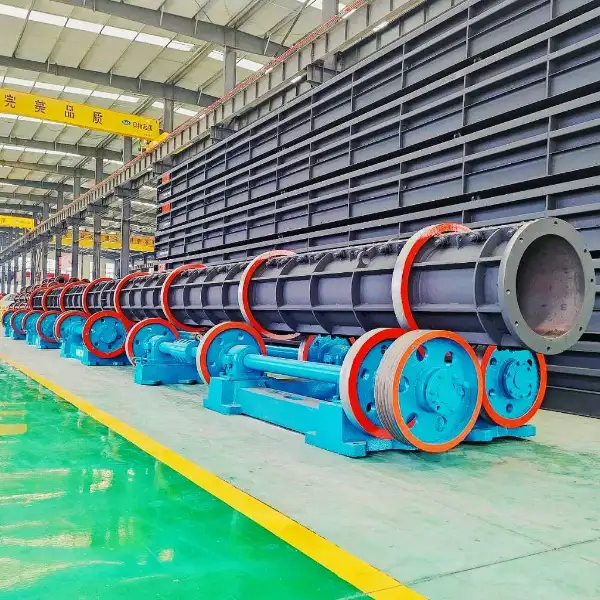
Reference centrifugal spinning stations for prestressed concrete piles. Spinning capacity must be checked against the faster upstream feeding cycle.
Investment, schedule and operating results
The recorded upgrade investment was CNY 480,000 at 2015 project prices. The main items were the feeding equipment, structural and civil work, reinforcement equipment, the steel-bar storage area, curing-cover modifications, automatic lifting attachments and the upper-mould cleaning rack.
The physical upgrade took approximately two months. The line then completed about one month of production ramp-up while operators became familiar with the revised flow.
Normal single-shift output reached 150 to 160 piles, with a recorded peak of 167. This was close to an 80 percent increase from the previous maximum shift output. Feeding time fell to about two minutes per pile. Workers mainly consolidated the concrete at the two ends and cleaned the central area before placing the mould-joint sealing rope.
The revised feeding method allowed the upper and lower mould edges to meet more closely. Leakage along the main joint was largely eliminated, wall thickness became more consistent and the internal surface improved. The recorded construction damage rate fell from 1 to 2 per thousand to about 0.5 per thousand.
Material loss also decreased. Before the project, discarded concrete commonly amounted to one or two loader buckets per shift. After the upgrade, the reported waste was approximately one hand cart. Manufacturing cost fell by CNY 3 to 4 per metre. Using the client's annual single-shift output basis of 600,000 m, the project recorded an estimated annual saving of CNY 1.8 million to CNY 2.0 million.
These cost figures reflect the project's historical prices, operating conditions and accounting basis. They should not be used as a current quotation or payback estimate.
What buyers should provide for a similar line review
This case shows why an existing-line upgrade should begin with measured constraints rather than a generic equipment package. For a comparable review, the buyer should provide:
- pile drawings, applicable standards and the planned product mix;
- current and target output by shift;
- a scaled building and equipment layout;
- the installed equipment list and condition of assets to be retained;
- mould quantities, masses, running rings and lifting points;
- observed cycle times, queues, concrete waste and recurring defects;
- crane coverage, curing capacity and available utilities; and
- the shutdown window and acceptance products for the upgrade.
Realjet can then review concrete feeding, mould circulation, reinforcement preparation, spinning, curing, handling and controls as a connected system. Share the current layout and the production problem through the spun pile production line planning page to define a project-specific upgrade boundary.