
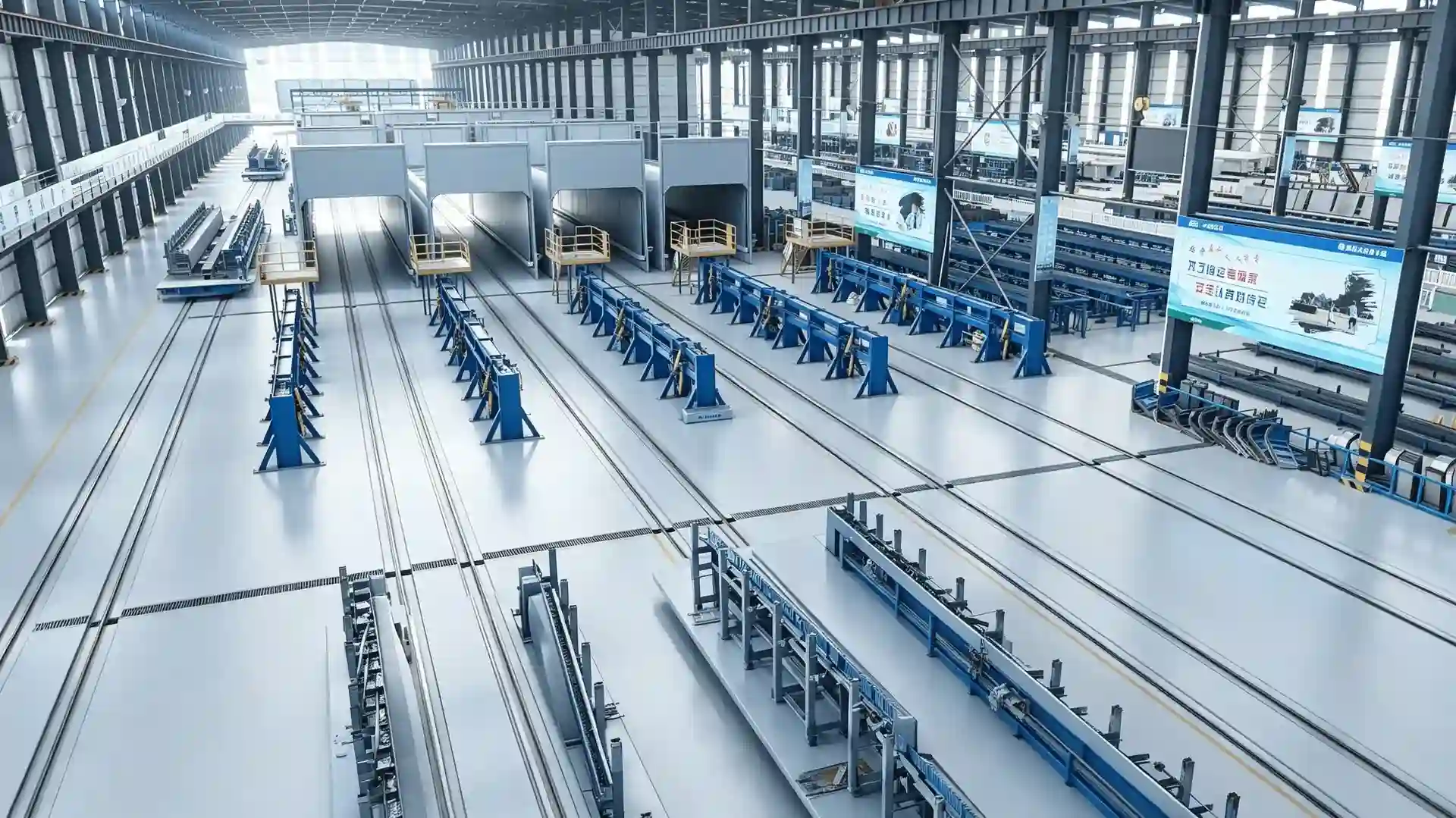
What a rebar cage does in a precast line
A reinforcement cage is the skeleton of longitudinal bars and stirrups or ties that gives a precast beam its structural capacity. In a precast beam production line it is usually built before or alongside casting, then placed into the formwork. The cage must hold its position so the concrete cover stays within the tolerance the structure depends on. Buyers planning a new or expanded line need to decide early whether cage fabrication sits inside the equipment scope or is sourced separately, because that choice drives factory space, power, staffing, and the line takt.
Manual tying, semi automatic, and automatic cage welding
Cages can be made by hand tying, by semi automatic equipment, or by fully automatic cage welding machines. Automatic roller or winding machines feed the longitudinal bars, position the stirrups, and weld them to a set pitch under CNC control. Published supplier specifications describe machines handling longitudinal bars around 12 to 32 mm and stirrups around 4 to 16 mm, producing cage diameters up to about 2.5 m and lengths beyond 20 m, often with one or two operators and pitch accuracy in the low millimetre range. These figures describe equipment on the market, not a Realjet specification. Confirm any capacity with the supplier against your cage dimensions.
Welded reinforcement joints are governed by ISO 17660-1 for load bearing welded joints. Whether your project allows welded cages, and to what standard, is set by your design engineer and the applicable code such as ACI 318 or EN 1992.
How the three methods compare
| Method | Typical operators | Best fit |
|---|---|---|
| Hand tying | Several per cage | Low volume, many one off geometries |
| Semi automatic | Two to four | Mixed short runs with frequent changes |
| Automatic welding | One to two | Repeated cage sizes at line takt |
The right method depends on how many cages per shift the line must produce and how often the cage geometry changes. A line making one beam type in long runs favours automatic welding; a jobbing plant with constant variation may prefer flexible manual or semi automatic setups.
What to specify in the line RFQ
State the cage parameters the equipment must meet:
- Cage diameter and length range, and the number of cages required per shift to match the line output.
- Longitudinal and stirrup bar diameters, and whether pitch must be adjustable for different beam types.
- Welding versus tying, and the acceptance standard for the joints, for example ISO 17660-1 or tying per the project specification.
- Interface with the casting beds or forms, and how cages are transported and placed.
- Utilities the equipment needs: three phase power, any compressed air, and extraction for welding fume.
- Tolerance expectations for cage diameter and stirrup pitch, referenced to the relevant standard.
PCI MNL-116 sets out quality control for structural precast plants and EN 13369 gives common rules for precast concrete products. Use these as references for the quality system your plant or supplier should demonstrate, not as Realjet performance claims.
Where the cage sits in the line takt
Casting a beam and building its cage are two parallel workflows that must stay in step. If cage preparation is slower than the casting cycle, cages become the bottleneck and the casting beds wait empty. If cage making is far faster, the finished cages pile up and occupy floor space. Buyers should size cage capacity to the target beams per day, not to a generic machine rating. Give the supplier your required cages per shift and the casting cycle, and ask how the cage equipment keeps pace without becoming the constraint.
Utilities and floor space to budget
Automatic cage welding machines draw three phase power, often in the range of roughly 18 to 30 kW for machines of this type, and need a straight bay long enough to handle the cage length plus feed and discharge zones. Supplier data for larger machines cites a linear footprint around 30 m for some configurations. Welding also produces fume, so budget extraction at the design stage rather than retrofitting it later. These are market equipment characteristics to help you plan the bay, not Realjet supply specifications, so confirm the exact figures against the model you select.
Supplier scope versus buyer responsibility
Realjet supplies production lines for precast concrete components, including the engineering and equipment needed for the process, where confirmed by the project documents. The reinforcement design, cage geometry, bar sizes, and cover are the buyer's design responsibility, defined by the project's structural drawings and the applicable code. A common boundary question is whether the line package includes rebar processing and cage fabrication or only the casting and curing side. State that explicitly in the RFQ so bids are comparable. Final equipment scope, interfaces, and acceptance remain subject to the approved project documents.
The precast beam factory planning page explains the production line offer and the kind of decisions a buyer faces when scoping a plant. Use it to frame the cage equipment question before requesting a quote.
Next step before you scope the line
Before asking for quotes, fix the cage dimensions and the per shift quantity, decide whether welding is permitted by the design code, and confirm the utilities available in the factory bay. With those inputs, a line supplier can size the cage equipment and show how it fits the casting takt. When your product mix and output target are clear, open a scope review with a supplier who provides production lines for precast concrete components.